Why Accident Victims Need Legal Help After a Car Crash
Accident victim legal help can be the deciding factor between receiving fair compensation and being left with overwhelming medical bills and lost wages. After a car accident, you’re likely facing insurance companies that prioritize profits over your recovery, complex legal deadlines, and mounting financial pressure.
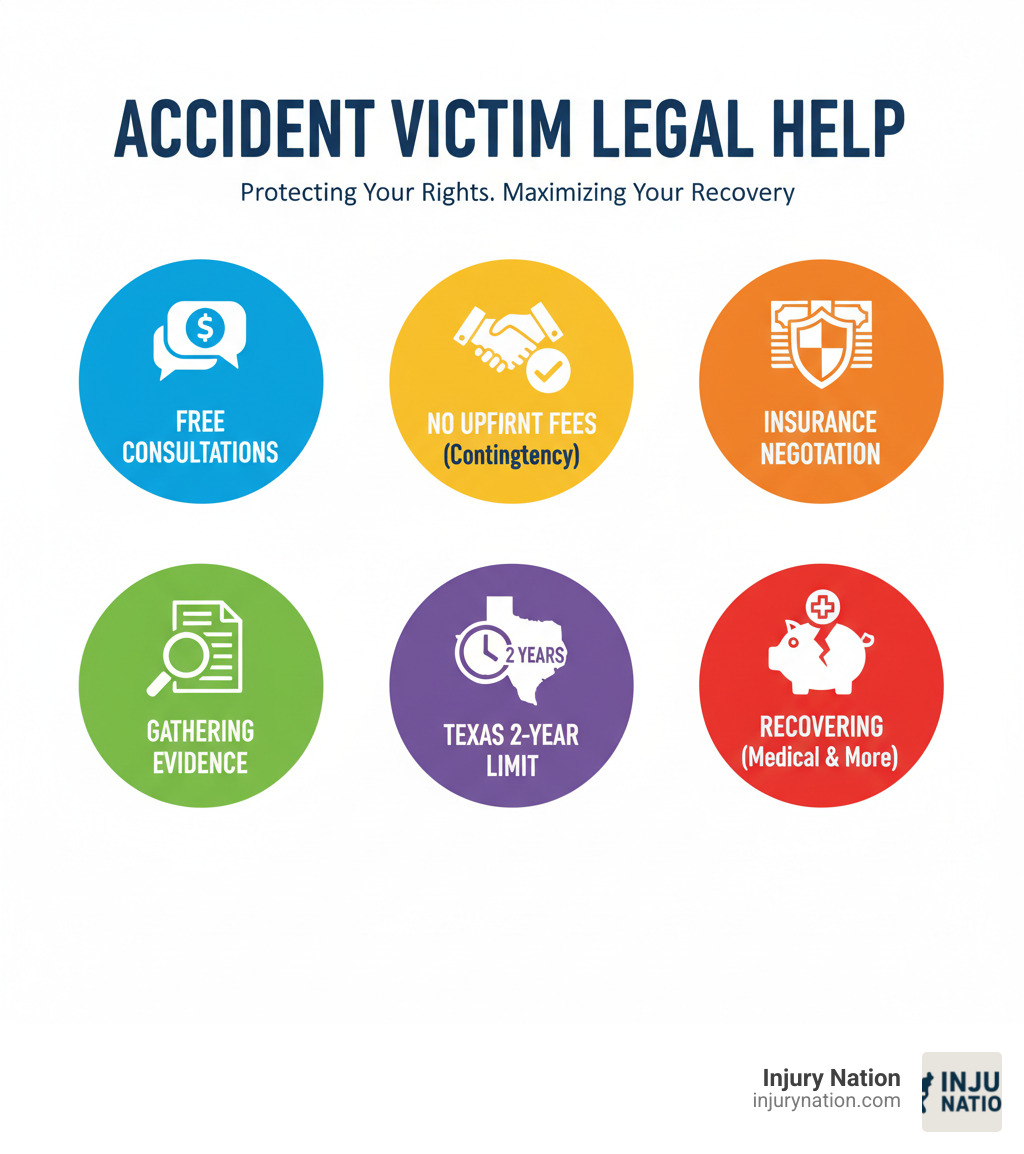
An experienced personal injury lawyer can help you steer this difficult time. Most offer free consultations to evaluate your case and work on a contingency basis, meaning you pay nothing unless you win. Their goal is to secure maximum compensation for your medical bills, lost wages, and pain and suffering by countering lowball settlement offers and proving fault. In states like Nevada, you typically have only two years to file a personal injury claim, making prompt action essential.
Research shows that people who hire attorneys statistically receive more money in their settlements, even after legal fees. An experienced legal advocate is crucial when you’re dealing with injuries, constant calls from adjusters, and piling bills. Whether you’re facing a disputed liability case or simply need someone to handle the paperwork while you heal, understanding your legal options is the first step toward protecting your rights.
For a local overview custom to Southern Nevada, see our car accident injury lawyer las vegas.
What Evidence Should I Gather After a Crash?
The moments after a car accident are chaotic, but your actions can significantly impact your ability to secure fair compensation. First, always stop, check for injuries, and call 911 if needed. Contact the police to file an official report, and never admit responsibility.
As soon as it’s safe, gather this key information:
- Photos and Videos: Document vehicle damage, the accident scene, road conditions, traffic signs, and any visible injuries from multiple angles.
- Witness Information: Collect names and phone numbers of anyone who saw the accident.
- Police Report Number: Get the report number and the officer’s contact information.
- Driver and Insurance Details: Exchange names, contact info, driver’s license numbers, and insurance policy details with all other drivers.
- Medical Records: Keep detailed records of all medical treatments, diagnoses, and appointments related to your injuries.
- Expense Receipts: Document all financial losses, including medical bills, repair estimates, and other out-of-pocket expenses.
Organizing this information provides your attorney with a strong foundation for your case.
The Critical Role of Medical Records
Seeking immediate medical attention after an accident is vital for your health and your legal case. Medical records are pivotal in any personal injury claim for several reasons.
- Documenting Injuries: They provide an objective, professional account of the nature and extent of your physical harm.
- Linking Injuries to the Accident: Records establish a direct causal link between the crash and your injuries, countering claims that they pre-existed.
- Proving Severity and Justifying Costs: Diagnostic tests and treatment notes offer concrete evidence of your condition’s seriousness and justify your medical expenses.
- Supporting Pain and Suffering Claims: Consistent documentation of your pain and limitations helps substantiate claims for non-economic damages.
- Projecting Future Needs: Medical opinions can help project future medical costs, which your lawyer will include in your compensation demand.
Consistent medical treatment is key. Gaps in care can be used by insurance companies to argue your injuries weren’t severe. For complex injuries like traumatic brain injuries (TBIs), where symptoms can be delayed, early and thorough medical evaluation is even more critical. We can connect you with legal professionals specializing in such injuries. For more information, we have dedicated resources to guide you through brain injury claims.
Understanding Your Legal Options: Why Choose a Personal Injury Lawyer

After a car accident, you might wonder if hiring a lawyer is necessary. While you can handle a claim yourself, accident victim legal help provides an experienced advocate who knows how to steer the complex world of insurance companies, legal deadlines, and personal injury law.
Most people don’t realize that free legal consultations are standard for personal injury cases. This allows you to discuss your situation with an attorney and get professional advice without any upfront cost. During the consultation, the attorney will review your evidence, discuss your injuries, and explain how the law applies to your situation. It’s an opportunity to ask questions and find a lawyer who is the right fit for you.
Choosing the right lawyer is crucial. You want a specialist in personal injury law with a proven track record and clear communication. They should be transparent about their fee structures and the entire legal process.
A personal injury lawyer’s scope of services is broad. They handle everything from gathering evidence and dealing with insurance adjusters to representing you in court. Crucially, they know how to properly value your claim, which can mean the difference between a fair settlement and being shortchanged. The benefits of professional representation are clear, as studies show that clients with lawyers typically receive significantly higher settlements.
How Do Personal Injury Lawyers Work?
One of the biggest myths about hiring a lawyer is that you need money upfront. In personal injury cases, attorneys work on a contingency fee basis, making legal help accessible to everyone.
This “no win, no fee” arrangement means you don’t pay attorney fees unless your lawyer successfully recovers money for you through a settlement or court award. Your lawyer will also typically cover upfront case expenses, such as filing fees, costs for obtaining records, and expert witness fees. These expenses are usually reimbursed from the settlement if your case is successful.
When you win, your lawyer receives a predetermined percentage of the settlement, typically between 25% and 40%. This is agreed upon before any work begins, so there are no surprises. This structure aligns your lawyer’s interests with yours: they are motivated to fight for the maximum compensation you deserve.
It all starts with a free initial consultation where you can learn about your options without financial risk. For more detailed information, check out our Car Accident Lawyers resource.
Key Features of Personal Injury Legal Representation
| Feature | Personal Injury Lawyer |
|---|---|
| Cost | No upfront fee; % of settlement |
| Eligibility | Based on case merit |
| Case Type | Specializes in injury claims |
| Resources | Extensive investigative resources |
| Goal | Maximize client compensation |
Why You Need Accident Victim Legal Help

When you’re hurt after a car accident, fighting with insurance companies is the last thing you need. Without proper accident victim legal help, you’re likely leaving money on the table—money you deserve for your recovery.
Insurance companies are businesses focused on minimizing payouts. Their adjusters and lawyers are trained to pay you as little as possible. Going against them alone puts you at a serious disadvantage. Studies consistently show that people who hire attorneys recover significantly more compensation, even after legal fees. This isn’t a small difference; it’s about maximizing compensation that can prevent financial ruin.
Navigating complex laws requires expertise. The legal system has specific rules about fault, time limits, and insurance that can make or break your case. A missed deadline or misunderstood law could cost you your right to compensation.
When it comes to proving liability, insurance companies will try to shift blame. They’ll look for any reason to claim the accident was your fault or that your injuries aren’t serious. An experienced lawyer knows how to gather evidence, interview witnesses, and work with experts to build a strong case that protects your interests.
How an Experienced Lawyer Maximizes Your Claim
An experienced lawyer acts as your advocate, ensuring you receive every dollar you’re legally entitled to. They understand that your damages go far beyond just medical bills and missed work.
- Calculating All Damages: Your lawyer will factor in future medical expenses, lost earning capacity, and non-economic damages like pain and suffering.
- Negotiating with Adjusters: Lawyers speak the language of insurance adjusters and won’t be fooled by tactics designed to get you to accept less.
- Countering Lowball Offers: The first settlement offer is almost always too low. A skilled attorney knows your case’s true value and will fight for a fair amount.
- Handling All Paperwork: Personal injury claims involve mountains of forms and strict deadlines. Your lawyer manages this so you can focus on healing.
- Representing You in Court: While most cases settle, having a lawyer ready for trial gives you serious negotiating power. Insurance companies are more likely to offer fair settlements to avoid a court battle.
Navigating Complex Fault and Insurance Laws
Understanding your state’s rules is crucial to getting fair compensation. Many states, including Nevada, operate under a modified comparative fault rule. This means you can still get money even if you were partly at fault for the accident.
If you’re found to be 50% or less at fault, you can recover compensation, but it will be reduced by your percentage of fault. For example, if you have $100,000 in damages but are found 30% at fault, you’d receive $70,000. However, if you’re found 51% or more responsible, you are barred from recovering anything.
In an at-fault state, the person who caused the accident is financially responsible. Proving the other driver’s negligence is essential. All drivers are required to carry minimum liability insurance, but these amounts are often insufficient for serious injuries. For example, Nevada’s minimums are $25,000 per person, $50,000 per accident, and $25,000 for property damage, which may not cover all your losses.
What if the At-Fault Driver is Uninsured or Underinsured?
It’s a frustrating but common scenario: the at-fault driver has little or no insurance. This is not the end of the road for your compensation.
Your own Uninsured/Underinsured Motorist (UM/UIM) coverage can be a lifeline, covering your medical bills, lost wages, and other damages up to your policy limits. Personal Injury Protection (PIP), if you have it, can also provide immediate help for medical expenses and lost wages, regardless of fault.
Suing the driver directly is an option, but collecting a judgment can be difficult if they lack assets. An attorney can review your insurance policy and explore every possible source of compensation, which is especially important for vulnerable road users. For more information, you can explore resources about Pedestrian Accident Claims.
Navigating the Car Accident Claim Process

The legal journey after a car accident can feel daunting, but with the right accident victim legal help, you’ll have a clear roadmap. Your attorney acts as your guide through the legal system, managing the process so you can focus on recovery.
After you hire an attorney, they will begin investigating and building your case. This involves analyzing police reports, medical records, and witness statements, and sometimes hiring accident reconstruction experts. Your lawyer will then formally notify all insurance companies of your claim.
Next, your attorney will calculate your total damages, including both economic and non-economic losses. Armed with this valuation, they will enter negotiations with the insurance companies. If a fair settlement cannot be reached, your lawyer will file a lawsuit to protect your rights. This initiates the formal litigation process, which includes findy and potentially mediation.
Most cases settle before trial, but if a trial is necessary, your legal team will be prepared to fight for you in court. This entire process can take months or even years, but your attorney handles the legal heavy lifting throughout.
What Is the Statute of Limitations for a Car Accident?
There is a limited time to file a lawsuit after a car accident. This deadline, known as the statute of limitations, is strict and can permanently bar you from seeking compensation if you miss it.
In many states, including Nevada, you have two years from the date of your accident to file a personal injury lawsuit. While there are some exceptions to this rule, such as for minors or in cases where an injury isn’t immediately findable, they are rare.
It’s also important to know that claims against government entities often have much shorter and stricter deadlines. You might have only a few months to provide formal notice of your claim. This is why it’s crucial to seek legal advice as soon as possible. Evidence disappears and memories fade, but legal deadlines are absolute.
What Compensation Can I Recover After a Car Accident?
While money can’t undo the harm you’ve suffered, it can provide the resources needed to rebuild your life. The law allows accident victims to seek compensation for a wide range of losses.
Economic damages cover your measurable financial losses. This includes all past and future medical bills, lost wages and diminished earning capacity, property damage to your vehicle, and other out-of-pocket expenses like transportation to appointments.
Non-economic damages address the intangible impact on your quality of life. This includes pain and suffering for your physical and emotional distress, loss of enjoyment of life for your inability to participate in hobbies, and compensation for mental anguish like anxiety or PTSD.
In rare cases involving extreme recklessness, such as drunk driving, courts may award punitive damages. These are intended to punish the wrongdoer and deter similar behavior in the future. An attorney’s job is to identify every loss and fight to ensure you are fully compensated.
Will My Case Go to Trial or Settle Out of Court?
Most accident victims are relieved to learn that the vast majority of cases—around 90-95% of personal injury claims—settle out of court.
Typically, your attorney submits a settlement demand to the insurance company, which starts a period of negotiation. If talks stall, mediation is often the next step. A neutral mediator helps both sides find common ground and reach a voluntary agreement.
A case is more likely to go to trial if there is a major dispute over liability or if the injuries are severe and the insurance company’s offer is far too low. Sometimes, an insurer simply refuses to negotiate fairly, and a lawsuit is the only way to achieve justice.
While the goal is often a fair settlement, a good lawyer prepares every case as if it will go to trial. This readiness provides leverage during negotiations and ensures you are prepared for any outcome.
Support Resources for Accident Victims

Dealing with the aftermath of a car accident involves more than just legal and medical challenges. The emotional and financial stress can be overwhelming, but you don’t have to face it alone. Various programs and organizations are available to help accident victims rebuild their lives.
These resources can work alongside your legal representation to provide comprehensive support during your recovery. Whether you need financial assistance for bills or emotional support from people who understand, help is available.
Victim Support and Compensation Programs
Many states offer programs to provide financial assistance to victims of violent crimes, which can include certain types of car accidents like DWI crashes or hit-and-runs. In Nevada, the Victims of Crime Program (VOCP) serves as a crucial safety net.
This program can help cover expenses when other resources are not available. You may qualify if you were injured in a violent crime, including eligible vehicle-related incidents. The program can provide financial assistance for medical and rehabilitation costs, lost wages, counseling services, and funeral expenses.
To qualify, the crime must be reported to law enforcement, and you must cooperate with the investigation. Generally, you must apply within a specific timeframe from the date of the crime. This compensation can provide critical support while your civil claim is pending.
If you believe you may qualify for assistance, it’s important to act quickly. You can learn more and find application information through your state’s official resources, such as the Nevada Victims of Crime Program.
How Community Organizations Provide Support
While state programs offer financial aid, community organizations provide vital emotional and practical support. Mothers Against Drunk Driving (MADD) is a prominent example, offering comprehensive services for victims of impaired driving crashes.
MADD provides a 24/7 helpline at 1-877-MADD-HELP (1-877-623-3435) for immediate support. Trained advocates can guide you through the criminal and civil justice systems, explain your rights as a victim, and help you prepare victim impact statements to share your story in court.
The organization also connects victims through support groups, creating a safe space to share experiences and find strength in community. MADD advocates can help you access a full range of resources, including Crime Victim Compensation, legal aid, and mental health services. For more information on federal programs, you can learn about the Victims of Crimes Act (VOCA) and the Crime Victims Fund.
For families facing the tragedy of losing a loved one, these support systems are even more critical. Our Wrongful Death Claims resources offer compassionate guidance during these difficult times.
Frequently Asked Questions about Accident Victim Legal Help
It’s natural to have questions about the legal process after a car accident. Here are clear, honest answers to some of the most common concerns about accident victim legal help.
How is liability determined in a car accident case?
Determining who is at fault requires concrete evidence. The investigation typically relies on several key elements:
- Police Reports: The officer’s report provides an initial assessment of the scene, witness accounts, and often an opinion on what occurred.
- Witness Statements: Independent witnesses offer unbiased accounts that can clarify conflicting stories.
- Traffic Law Violations: Evidence that a driver ran a red light, was speeding, or was driving distracted creates a strong presumption of fault.
- Accident Reconstruction Experts: In complex cases, specialists analyze physical evidence to scientifically determine factors like speed, impact angles, and driver behavior.
Your legal team uses this evidence to build a strong argument proving the other party’s negligence.
Can I still get compensation if I was partly at fault for the accident?
Yes, in many states, being partially at fault does not automatically prevent you from receiving compensation. States like Nevada use a modified comparative fault rule.
Under this rule, you can still recover damages as long as you are not found to be 51% or more at fault. Your compensation will be reduced by your percentage of fault. For example, if you have $100,000 in damages but are found 20% responsible, you can still recover $80,000.
Because of this rule, it is critical to have an experienced attorney who can effectively argue against unfair allocations of blame and protect your right to compensation.
How much does it cost to hire a car accident lawyer?
Cost should not be a barrier to getting legal help. Most personal injury lawyers work on a contingency fee basis.
This means you pay nothing unless you win. If your lawyer doesn’t secure a settlement or court award for you, you owe no attorney fees. This system removes the financial risk of pursuing a claim.
When your case is won, the attorney’s fee is a predetermined percentage of your recovery, which is agreed upon at the start of your case. The firm also typically advances all case expenses, which are reimbursed from the settlement. This structure ensures your lawyer is motivated to fight for the maximum compensation possible, and studies show that clients with legal representation generally recover more, even after fees.
Conclusion: Find the Right Legal Partner for Your Recovery
Getting hurt in a car accident is overwhelming. You’re suddenly faced with injuries, insurance calls, and mounting bills for an incident that wasn’t your fault. But you don’t have to face this challenge alone.
Having the right accident victim legal help can be the difference between financial struggle and a secure recovery. An experienced attorney understands how insurance companies operate and will fight for your rights.
Time is a critical factor. In states like Nevada, you have only two years to file a personal injury claim. Evidence becomes harder to gather with each passing day, so the sooner you act, the stronger your case will be.
Most personal injury lawyers offer free consultations and work on a no win, no fee basis. You have nothing to lose by making a call, but you could gain the resources you need to get your life back on track.
Let an experienced attorney handle the legal battle while you focus on what matters most—getting better. Don’t give the insurance company an advantage by waiting.
Ready to find someone who will fight for your rights? We’re here to connect you with experienced personal injury lawyers who understand what you’re going through and know how to win cases like yours.