

Understanding Personal Injury Claims: Your Path to Fair Compensation
Claiming personal injury compensation is your legal right when someone else’s negligence causes you harm. Whether you were hurt in a car accident, by medical malpractice, or in a slip and fall, the claims process follows a clear path—though it can feel overwhelming when you’re also dealing with injuries and medical bills.
Here’s what claiming personal injury involves:
- Proving four key elements: Duty of care, breach of that duty, causation, and damages
- Filing within your state’s statute of limitations (typically 2-3 years from the date of injury)
- Gathering evidence: medical records, accident reports, photos, and witness statements
- Negotiating with insurance companies or filing a lawsuit if needed
- Seeking compensation for medical expenses, lost wages, pain and suffering, and other losses
Every personal injury claim begins with harm—whether physical, emotional, or to your reputation. These aren’t just statistics; they represent real people facing real challenges while navigating a complex legal system.
You don’t have to do this alone. Most personal injury cases settle out of court, and experienced attorneys typically work on a contingency basis, meaning you pay nothing unless you win. This guide breaks down the entire claims process into manageable steps, from the critical first 72 hours through settlement or trial.
Understanding your rights and the claims process helps you make informed decisions. It ensures you don’t accept a low settlement offer, miss important deadlines, or accidentally say something that weakens your case.
The Foundation of a Claim: What You Need to Know Before You File
Before claiming personal injury compensation, it’s crucial to understand the fundamental legal concepts that underpin every case. This knowledge will empower you and help you recognize if you have a valid claim.
What Constitutes a Personal Injury Claim?
A personal injury claim is a legal process where an injured person seeks compensation from the party responsible for their harm. This harm isn’t limited to physical injuries; it can also include emotional distress, psychological trauma, and damage to your reputation. Personal injury law, or tort law, aims to make the injured party whole again by awarding monetary compensation for their losses. Every claim hinges on two issues: liability (who is legally responsible) and damages (the extent of the losses).
The Three Legal Grounds for Filing a Claim
When claiming personal injury, your case will typically fall into one of three main legal categories:
- Negligence: This is the most common basis for personal injury claims. It occurs when someone fails to exercise reasonable care, and that failure causes injury. To prove negligence, you must show four elements: a duty of care was owed, that duty was breached, the breach caused the injury, and you suffered actual damages.
- Strict Liability: In some cases, a defendant is liable for injuries regardless of their intent or negligence. This often applies to defective products, abnormally dangerous activities, and, in many states like Nevada, dog bites.
- Intentional Wrongs (Intentional Torts): These claims arise when the defendant intentionally acts in a way that causes harm. Examples include assault and battery, false imprisonment, and defamation. These are civil actions separate from any criminal charges.
Common Causes That Justify Claiming Personal Injury
Personal injury claims can arise from a wide array of incidents. Some of the most common causes include:
- Car Accidents: The most frequent type of personal injury action, often involving negligence like distracted driving or speeding. In 2020, there were 35,766 traffic fatalities in the United States, a 6.8% increase from 2019.
- Medical Malpractice: When healthcare professionals fail to provide the standard of care, leading to patient injury or death.
- Product Defects (Product Liability): Injuries caused by dangerous or faulty products, where the manufacturer, distributor, or retailer can be held liable.
- Workplace Accidents: Injuries sustained on the job due to unsafe conditions or negligence. While workers’ compensation often applies, a separate personal injury claim may be possible if a third party was at fault.
- Slip and Fall Accidents: Injuries on someone else’s property due to hazardous conditions (premises liability).
- Bicycle and Pedestrian Accidents: Often involving motor vehicles, these can lead to severe injuries.
- Dog Bites and Animal Attacks: Injuries caused by dangerous animals, for which the owner is typically responsible.
- Wrongful Death: When an injury results in death, surviving family members can file a claim for their losses.
The Critical Deadline: Understanding the Statute of Limitations
One of the most crucial aspects of claiming personal injury is the statute of limitations—the legal deadline for filing a lawsuit. If you miss this deadline, you lose your right to seek compensation, no matter how strong your case is.
The statute of limitations varies by state and claim type. For instance, in Nevada, the statute of limitations for most personal injury claims is two years from the date of the injury or the date you reasonably should have found the injury. This is a firm deadline.
Rare exceptions can alter this period, such as for minors or claims against government entities, but these are complex. Acting quickly is vital. Delaying not only risks missing the deadline but also makes it harder to gather fresh evidence and locate witnesses. We always advise seeking legal counsel as soon as possible to protect your rights.
Your First 72 Hours: Critical Steps to Protect Your Claim
The actions you take immediately after an injury can significantly impact the success of your claim. These initial steps are vital for your health and for preserving the evidence needed when claiming personal injury compensation.
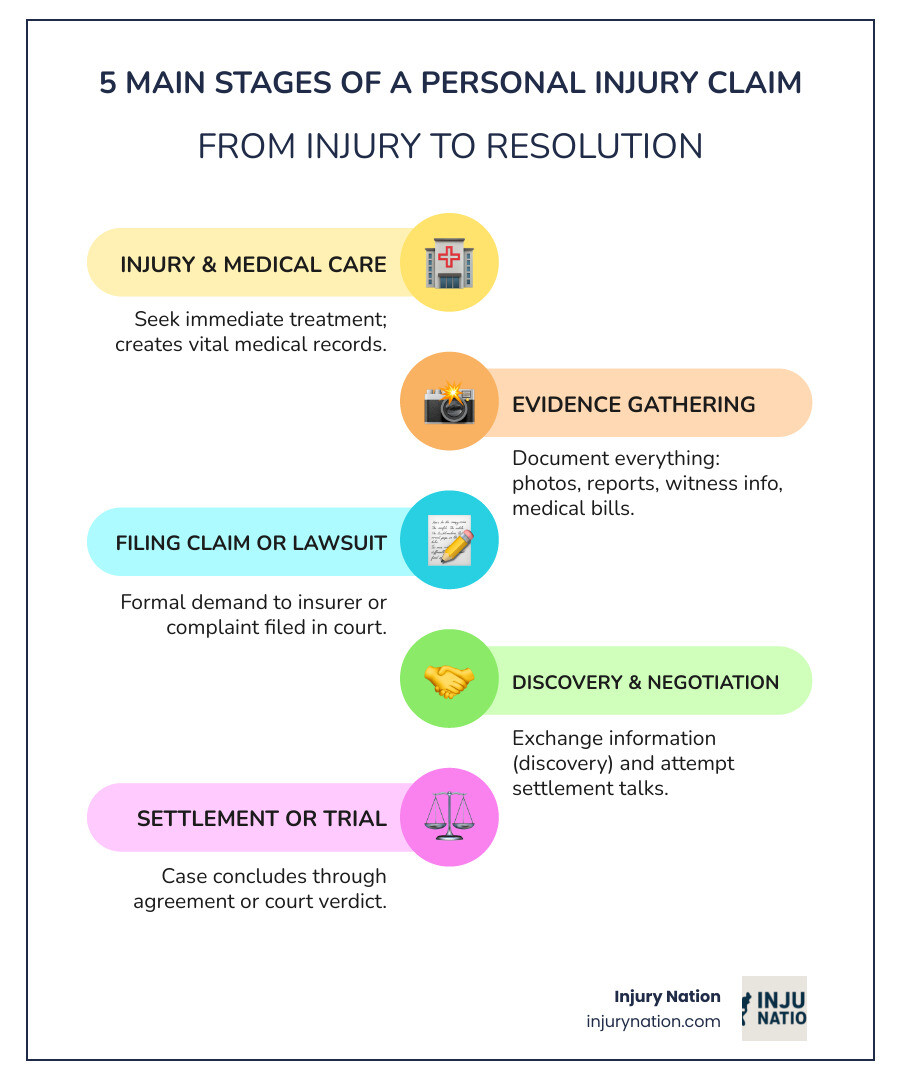
Prioritize Your Health: Seek Immediate Medical Care
Your health is the top priority. Seek immediate medical attention after any accident, even if you feel fine. Here’s why:
- For Your Health: Some serious injuries, like concussions or internal bleeding, have delayed symptoms. An early diagnosis is critical for your recovery.
- Creates Medical Records: Medical records are crucial evidence. They document your injuries, treatment, and the direct link between the incident and your harm. Without immediate medical documentation, an insurer might argue your injuries aren’t related to the accident.
- Proves Injury Link to the Incident: Seeking prompt care establishes a clear timeline connecting your injuries to the accident, which is essential for proving causation.
Always follow all medical advice and attend all follow-up appointments. This demonstrates the severity of your injuries and your commitment to recovery.
Document Everything: The Power of Evidence
Evidence is the backbone of your claim. The more you document, the stronger your case will be.

- Police Reports: For car accidents, a police report provides an official account of the incident.
- Witness Contact Information: If there were witnesses, get their names and contact information. Their statements can be invaluable.
- Photos and Videos: Use your phone to document the accident scene, property damage, your injuries over time, and any hazardous conditions that caused the injury (e.g., a wet floor).
- Medical Bills and Records: Keep a file of all medical expenses, diagnoses, and treatment plans.
- Keep a Journal: Record your daily pain levels, emotional state, missed work, and how the injuries affect your life. This provides a powerful personal account of your suffering.
- Lost Wages Documentation: Collect pay stubs and employer statements to prove lost income.
Be Cautious When Dealing with Insurance Companies
Soon after an injury, you will likely be contacted by insurance companies. Approach these conversations with caution.
- Role of Insurance Adjusters: An adjuster’s job is to protect the insurance company’s bottom line by minimizing payouts. They are not on your side, no matter how friendly they seem.
- Avoid Recorded Statements: Never give a recorded statement to an insurer without first speaking to an attorney. Anything you say can be taken out of context and used against you.
- Do Not Sign Anything Without Legal Review: Do not sign any releases or settlement offers without having a lawyer review them. You could unknowingly sign away your rights to fair compensation.
- What to Say: You must report an accident to your own insurer. When speaking to the at-fault party’s insurer, provide only basic facts: your name, contact information, and the date/location of the accident. Politely decline to discuss details and state that your attorney will be in touch.
The Step-by-Step Process of Claiming Personal Injury
After taking the initial steps, the process of claiming personal injury compensation moves through several distinct phases. Understanding this progression can help you manage expectations.
How is Fault or Liability Determined?
Determining fault is central to any personal injury claim. It involves proving that the at-fault party’s actions directly caused your injuries, usually by establishing the four elements of negligence: Duty, Breach, Causation, and Damages.
- Duty: The other party had a legal obligation to act with a certain level of care.
- Breach: They failed to meet that obligation.
- Causation: Their failure directly caused your injury.
- Damages: You suffered actual losses (medical bills, lost wages, etc.) as a result.
Nevada follows comparative fault rules. This means you can still recover damages even if you were partially at fault, as long as your share of the blame is not 50% or more. Your total compensation will be reduced by your percentage of fault. For example, if you are found 20% at fault, your award is reduced by 20%.
Filing the Lawsuit: From Complaint to Service
Most cases settle out of court. However, if negotiations with the insurance company fail, filing a lawsuit becomes necessary.
- Demand Letter: Before filing suit, your attorney will typically send a demand letter to the insurer. This letter outlines the facts, your injuries, and the damages you are seeking, supported by documentation.
- Filing a Complaint: If the demand is not met, your attorney files a “complaint” with the court. This formal document details the legal and factual basis for your lawsuit.
- The Summons: A “summons” is issued with the complaint, officially notifying the defendant they are being sued and must respond.
- Service of Process: The complaint and summons must be formally delivered to the defendant according to strict legal rules.
- The Defendant’s Answer: The defendant has a limited time (e.g., 30 days in Nevada) to file an “answer,” admitting or denying the allegations in your complaint.
The Findy Phase: Uncovering the Facts
The findy phase is where both sides exchange information and evidence to prepare for trial. This process can last from six months to over a year.
- Interrogatories: Written questions sent to the opposing party, which must be answered under oath.
- Depositions: Oral testimony taken under oath where lawyers question witnesses, the plaintiff, and the defendant.
- Requests for Documents: Formal requests for relevant documents like medical records, police reports, and employment records.
- Expert Witnesses: In complex cases, experts like doctors or accident reconstructionists may be hired to provide specialized opinions to help establish fault or damages.
The Final Stages: Settlement vs. Trial
After findy, the case moves toward a final resolution.
- Settlement Negotiations: Over 95% of personal injury cases are resolved through out-of-court settlements. Negotiations often intensify after findy when both sides have a clearer picture of the case’s strengths and weaknesses.
- Mediation: If negotiations stall, a neutral mediator may be brought in to help the parties find common ground and reach a settlement. Mediation is non-binding but is often successful.
- Going to Trial: While a trial offers the potential for a larger jury award, it is also costly, time-consuming, and unpredictable. There is always a risk of receiving less than a settlement offer, or nothing at all. Because of these risks, both sides often prefer the certainty of a settlement.
Calculating Your Compensation: What Is Your Claim Worth?
One of the most common questions is, “How much is my personal injury claim worth?” The answer is complex and depends on the unique facts of your case. However, understanding the types of damages is key to grasping your potential compensation when claiming personal injury.
Understanding Damages When Claiming Personal Injury
In personal injury law, “damages” refers to the monetary compensation awarded for your losses. They fall into two main categories:
| Type of Damage | Definition -|
| Economic Damages | Also known as special damages, these are tangible, calculable financial losses directly resulting from the injury. This includes all medical bills (past and future), lost wages, lost earning capacity, and property damage. These are proven with receipts, bills, and expert financial projections. -|
| Non-Economic Damages | Also known as general damages, these are intangible losses that don’t have a specific price tag. This category includes pain and suffering, emotional distress, loss of enjoyment of life, and loss of consortium (impact on your relationship with your spouse). These are subjective and harder to quantify. -|
How Are Damages Calculated in a Personal Injury Case?
Calculating damages, especially for non-economic losses, is not an exact science. It often involves a blend of established methods and persuasive arguments.
- Economic Damages: These are calculated by adding up all verifiable financial losses, such as medical bills, lost wage statements, and property repair costs. Future costs may require testimony from medical and financial experts.
- Non-Economic Damages (Pain and Suffering): There is no set formula for these subjective damages. Attorneys and insurers often use methods like the Multiplier Method (multiplying economic damages by a number from 1.5 to 5, based on injury severity) or the Per Diem Method (assigning a daily rate for pain and suffering). The value depends on the jury’s assessment of your testimony and the impact on your life.
Key Factors That Influence Your Claim’s Value
Several factors significantly influence the potential value of your claim:
- Severity of Injury: More severe, permanent injuries (e.g., spinal cord injury) lead to higher compensation.
- Total Medical Costs: The full extent of your past, present, and future medical expenses is a primary driver of value.
- Length of Recovery: A longer recovery or the need for ongoing care increases the claim’s value.
- Impact on Daily Life: How the injuries affect your work, hobbies, and relationships is crucial.
- Clarity of Fault: A clear case of the defendant’s liability strengthens your position. If fault is shared, Nevada’s comparative fault rules will reduce your compensation.
- Defendant’s Insurance Policy Limits: The at-fault party’s insurance coverage can set a practical limit on the amount you can recover.
Do You Need a Lawyer? Navigating the Final Steps
For most significant injury cases, hiring a lawyer is crucial due to the complexity of the law and the tactics of insurance companies.
The Benefits of Hiring a Personal Injury Attorney
While you might handle a minor claim alone, you should consult an attorney if an insurer pushes back or you are considering a lawsuit. Here’s why:
- Leveling the Playing Field: Insurance companies have teams of lawyers dedicated to minimizing payouts. An attorney advocates for your rights and ensures you are treated fairly.
- Legal Expertise and Resources: Personal injury lawyers understand the nuances of tort law and have the resources to investigate your case, gather evidence, and hire necessary experts.
- Accurately Calculating Damages: An experienced attorney can assess both your economic and non-economic damages, including future losses, to ensure you seek the full compensation you deserve.
- Skilled Negotiation: Attorneys are skilled negotiators who often secure larger settlements than individuals can on their own. Studies show that claimants with legal representation generally receive higher awards.
- Contingency Fee Basis: Most personal injury attorneys work on a contingency fee basis. You pay no upfront fees, and the attorney only gets paid if they win your case, typically as a percentage (30-40%) of the settlement or verdict.
How Long Does the Personal Injury Lawsuit Process Take?
The duration of a personal injury claim varies greatly based on its complexity, injury severity, and court schedules.
- Varies Greatly: Simple cases might settle in a few months, while complex cases can take several years.
- Settlement Timeline: If a case settles without a lawsuit, it can take a few months to a year or more.
- Trial Timeline: If a lawsuit goes to trial, the process can easily last one to two years or longer. This includes:
- Factors Affecting Duration: Key factors include court backlogs, the amount of evidence, the number of witnesses, and the insurer’s negotiating tactics.
What Happens After Winning a Personal Injury Lawsuit?
After winning your case or securing a settlement, the process isn’t over. Here’s what happens next:
- Receiving the Award: The insurance company issues a check to your attorney, who then disburses the funds. You may receive a single lump sum or a structured settlement (periodic payments over time), which is common for large awards.
- Paying Medical Liens: Your attorney will negotiate and pay any outstanding medical liens from your settlement. This includes money owed to health insurance companies, Medicare, or Medicaid.
- Attorney Fees and Costs: Your attorney’s contingency fee and any case expenses they advanced (e.g., filing fees, expert witness fees) are deducted from the gross award.
- The Possibility of Appeals: If you won at trial, the losing party might appeal the verdict. An appeal can significantly delay the final payment as a higher court reviews the case for legal errors.
Conclusion: Take the Next Step Towards Justice
Claiming personal injury compensation is a challenging process, especially while recovering from an injury. However, it is a path designed to provide justice and the resources you need to move forward.
We’ve covered what a personal injury claim is, the legal grounds for filing, the importance of the statute of limitations in Nevada, and the steps involved from the moment of injury to final resolution. The key takeaway is that while the process is complex, it is manageable with professional guidance.
An experienced personal injury attorney acts as your advocate, handling the legal complexities, protecting your rights, and fighting for the maximum compensation you deserve. They understand Nevada law, know how to counter the tactics of insurance companies, and will guide you through every step.
Don’t let the fear of a complex legal system prevent you from seeking the justice you are entitled to. Taking the first step by scheduling a free consultation can make all the difference in your recovery.