When Hospital Care Turns Harmful
Hospital negligence cases occur when hospitals or their staff fail to provide the standard of care patients deserve, resulting in preventable harm or death. These cases can involve surgical errors, misdiagnoses, medication mistakes, infections, or administrative failures like understaffing and inadequate training.
Quick Facts About Hospital Negligence:
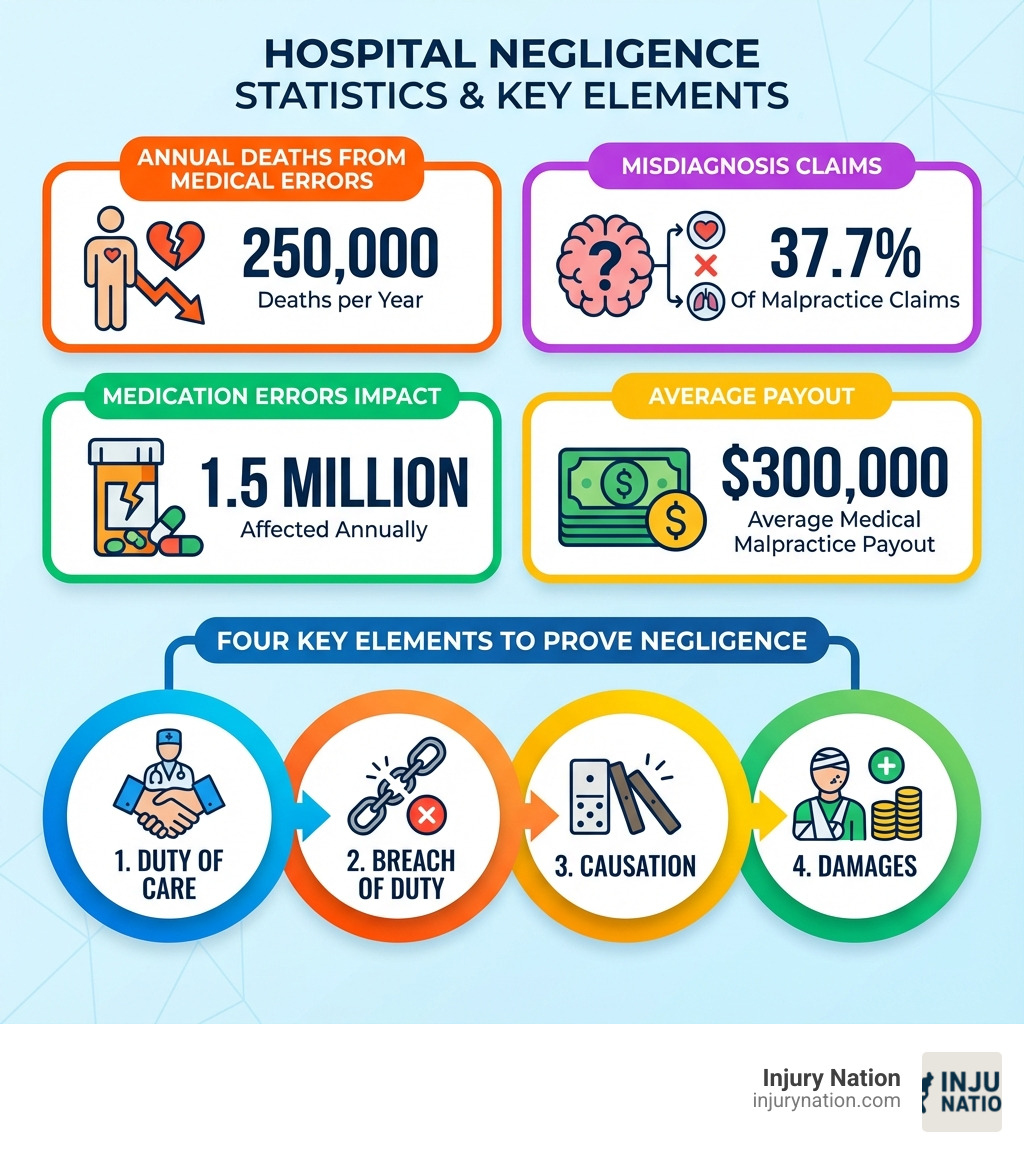
- Medical errors are the third leading cause of death in the United States, behind only heart disease and cancer
- An estimated 250,000 deaths per year are due to medical errors
- Misdiagnosis accounts for 37.7% of all malpractice claims
- Medication errors affect 1.5 million people annually in the U.S.
- The average medical malpractice payout in 2021 was $300,000
Stories like Cynthia Adae’s, whose delayed diagnosis led to permanent disability after a $2.3 million settlement, aren’t rare exceptions. They represent a systemic problem affecting hundreds of thousands of patients every year.
If you or someone you love has been harmed by hospital care, you’re not alone. You’re also not powerless. Understanding what constitutes negligence, who can be held accountable, and what evidence you need is the first step toward justice and compensation.
This guide breaks down everything you need to know about hospital negligence cases—from identifying when negligence has occurred to understanding your legal rights and the path forward.
Important Hospital negligence cases terms:
What is Hospital Negligence?

Imagine you’re seeking care, trusting medical professionals with your health and well-being. When that trust is broken due to preventable mistakes, and you suffer harm as a result, you might be looking at a case of hospital negligence. Essentially, hospital negligence occurs when a hospital, or any of its employees, fails to uphold the accepted standard of care, causing injury or worsening a patient’s condition.
While the exact legal definitions can vary by state, the core concept remains: hospitals have a fundamental responsibility to ensure patient safety. This duty of care means they must act reasonably and prudently to prevent foreseeable harm. When they don’t, and that failure causes injury, it constitutes negligence. For example, some jurisdictions define hospital negligence as when hospitals fail to provide competent care to patients, and this failure results in injuries and damages.
If you suspect you’ve been a victim of such circumstances, understanding your rights and options is crucial. We at Injury Nation can help you connect with a medical error attorney who understands these complex cases.
Administrative vs. Provider Negligence
When we talk about hospital negligence cases, it’s important to understand that negligence isn’t always about a single doctor’s mistake. It can stem from two main areas:
-
Administrative Negligence: This involves systemic failures within the hospital’s operations or management. Think of it as the “behind-the-scenes” issues that create an environment where errors are more likely to happen. Examples include:
- Understaffing: When there aren’t enough qualified nurses, doctors, or support staff to adequately care for patients, leading to delays in treatment or monitoring.
- Lack of Training: If staff aren’t properly trained on new equipment, procedures, or safety protocols, they’re more prone to making mistakes.
- Improper Protocols: The hospital’s own rules and procedures might be flawed, or they might fail to enforce existing safety guidelines.
- Failure to Maintain Equipment: Neglecting to inspect and repair medical equipment can lead to malfunctions that directly harm patients.
-
Provider Negligence: This refers to errors made by individual healthcare professionals employed by the hospital, such as nurses, technicians, or staff doctors. While individual doctors can be liable for medical malpractice, the hospital can also be held responsible for the negligence of its employees. Common examples include:
- Nurse Errors: Mistakes in medication administration, failing to monitor a patient’s vital signs, or neglecting wound care.
- Technician Negligence: Errors in operating lab equipment, mishandling samples, or incorrect imaging procedures.
- Staff Doctor Mistakes: Misdiagnosis, surgical errors, or prescribing incorrect treatments by physicians who are directly employed by the hospital.
Common Examples of Hospital Negligence Cases
Hospital negligence cases can manifest in countless ways, often with devastating consequences. Here are some of the most common scenarios:
- Surgical Errors: These can range from operating on the wrong body part, leaving surgical instruments inside a patient, or causing damage to surrounding organs during a procedure.
- Misdiagnosis or Delayed Diagnosis: When a hospital or its providers fail to correctly identify a condition or significantly delay doing so, it can lead to a worsening of the patient’s health or missed opportunities for effective treatment.
- Medication Errors: Administering the wrong medication, an incorrect dosage, or failing to check for dangerous drug interactions can have severe side effects.
- Birth Injuries: Negligence during labor and delivery, such as failing to monitor fetal distress or improper use of delivery tools, can lead to lifelong injuries for the baby or mother.
- Hospital-Acquired Infections (HAIs): Patients can contract serious infections like MRSA or C. diff due to unsanitary conditions, improper sterilization of equipment, or inadequate hygiene practices by staff.
- Anesthesia Mistakes: Errors by anesthesiologists or nurse anesthetists, such as administering too much or too little anesthesia, or failing to properly monitor a patient during surgery, can lead to brain damage or death.
- Failure to Monitor: Patients, especially those in critical condition, require constant observation. A failure to adequately monitor vital signs, changes in condition, or potential complications can lead to rapid deterioration and severe harm.
- Premature Discharge: Releasing a patient too soon, or without proper instructions for follow-up care, can result in complications or a relapse that requires re-hospitalization.
Case Study: Cynthia Adae’s Delayed Diagnosis
A poignant example of the impact of delayed diagnosis is the case of Cynthia Adae. She sought care for shoulder pain, cough, and fever. Despite blood tests indicating a serious infection, she was discharged without being informed of the results or receiving follow-up. This led to an undiagnosed epidural abscess that progressed to permanent paraplegia, slurred speech, and acute renal failure. Six years and one day after filing her initial claim, Cynthia Adae settled her medical negligence case with the University of Cincinnati for $2.3 million. This case underscores the critical importance of timely communication of diagnostic test results and thorough patient investigation before discharge.
Proving Hospital Negligence Cases: The Four Key Elements

Proving hospital negligence cases isn’t as simple as just showing that something went wrong. The legal system requires a clear demonstration of specific elements, often referred to as the “four D’s” of negligence. Without establishing each of these, your claim for compensation may not succeed. Our legal team understands that pursuing compensation requires proving a direct chain of causation between the hospital’s duty of care and the damages you have sustained.
1. Duty of Care
The first step in any negligence claim is proving that the hospital or its staff owed you a “duty of care.” This is usually straightforward: when you become a patient at a hospital, a patient-provider relationship is established. This relationship inherently creates a legal obligation for the hospital and its employees to provide medical care that meets accepted standards. They have a responsibility to act competently and safely, just as any other reasonable and prudent medical professional would under similar circumstances.
2. Breach of Duty
Next, we must demonstrate that the hospital or its employees “breached” that duty of care. This means proving that they failed to meet the accepted medical standard of care. The standard of care isn’t about perfect care, but rather the level of skill and diligence that a reasonably competent hospital or healthcare provider would have exercised in the same or similar situation. For instance, if a nurse fails to administer medication as prescribed, or a hospital’s policy leads to a critical delay in treatment, that could be a breach.
3. Causation
This is often the trickiest part of hospital negligence cases. We must prove a direct link, or “causation,” between the hospital’s breach of duty and your injury. It’s not enough to show that negligence occurred and that you were injured; we must show that the negligence directly caused or significantly contributed to your harm. If your injury would have occurred regardless of the hospital’s actions, then causation may not be established. This involves demonstrating that the harm you suffered was a foreseeable consequence of the negligent actions.
4. Damages
Finally, we must show that you suffered actual “damages” as a result of the negligence. Damages represent the quantifiable harm you experienced due to the injury. This isn’t just about physical pain; it includes both economic and non-economic losses. We’ll dig into the types of damages you can recover shortly, but generally, this element establishes the tangible and intangible costs of the hospital’s negligence.
Hospital vs. Individual Doctor: Understanding Liability
When medical errors occur, it’s natural to wonder who is responsible. Is it the doctor? The nurse? Or the hospital itself? The answer can be complex, as liability in hospital negligence cases often involves distinguishing between the actions of individual medical professionals and the broader responsibilities of the institution.
| Category | Hospital Corporate Negligence | Individual Physician Malpractice |
|---|---|---|
| Focus | Systemic failures, policies, procedures, and oversight within the hospital. | Actions, decisions, and omissions of a specific doctor. |
| Basis of Claim | Negligent hiring/credentialing, inadequate staffing, faulty equipment, failure to create/enforce proper safety protocols, corporate negligence. | Breach of the medical standard of care by the physician in diagnosis, treatment, surgery, etc. |
| Liability Theory | Direct liability (hospital’s own negligence) or vicarious liability (for employees). | Direct liability for the physician’s own negligent acts. |
| Proof Required | Hospital had a duty to patient, hospital breached that duty (e.g., poor management, unsafe environment), breach caused injury, patient suffered damages. | Doctor had a duty to patient, doctor breached standard of care, breach caused injury, patient suffered damages. |
| Examples | Infection due to unsanitary conditions, injury from broken bed rail, harm from understaffing, negligent hiring of an unqualified doctor, failure to follow up on critical test results (if due to systemic failure). | Misdiagnosis by a doctor, surgical error by a surgeon, medication error by a prescribing physician, failure to obtain informed consent for a procedure. |
| Key Distinction | The hospital’s responsibility for the overall environment and the conduct of its employees. | The individual physician’s direct professional responsibility. |
| Independent Doctors | Generally not liable for independent contractor doctors, but doctrines like “apparent agency” can create liability if patient reasonably believed the doctor was a hospital employee. | Directly liable for their own negligence, regardless of employment status. |
A key factor is whether the negligent party was an employee of the hospital or an independent contractor. Many doctors, even those who practice exclusively at a particular hospital, are independent contractors with admitting privileges, not direct employees. This distinction is crucial because while hospitals are typically liable for the negligence of their employees (under a legal principle called “vicarious liability” or “Respondeat Superior,” meaning “let the master answer”), they are generally not automatically liable for the malpractice of independent contractor physicians.
Corporate and Administrative Negligence
However, even if a doctor is an independent contractor, hospitals can still be held directly liable for their own “corporate negligence.” This refers to the hospital’s independent duty to patients, separate from the duties of individual providers.
Examples of corporate and administrative negligence include:
- Negligent Hiring or Credentialing: If a hospital grants privileges to a doctor it knows or should have known was incompetent or had a history of malpractice, the hospital can be liable for that doctor’s subsequent negligence.
- Inadequate Staffing Policies: As mentioned earlier, chronic understaffing can be a systemic failure for which the hospital is directly responsible.
- Failure to Maintain Equipment: A hospital has a duty to ensure its equipment is safe and functional. If a patient is injured by a faulty hospital bed or a malfunctioning MRI machine, the hospital can be held liable.
- Lack of Proper Procedures: Hospitals must implement and enforce policies to ensure patient safety, such as infection control protocols or timely communication of critical test results.
Case Study: Emory’s $38.6M Settlement
A significant case highlighting corporate negligence involved Emory University and its health care system. A jury awarded $38.6 million in a medical malpractice lawsuit over the death of 20-year-old heart transplant patient Tre’von Falson. Attorneys alleged that Emory’s medical team failed to perform a CT scan before his heart transplant surgery. This oversight meant they didn’t realize a mechanical heart pump had moved, leading to it being lacerated during surgery, resulting in massive blood loss and organ failure.
The Doctrine of ‘Apparent Agency’
Even when a doctor is an independent contractor, there’s another way a hospital can be held responsible for their negligence: the doctrine of “apparent agency.” This applies when a patient reasonably believes that a doctor is an employee of the hospital, and the hospital’s actions or inactions contribute to that belief.
For apparent agency to apply, usually three things must be true:
- Representation by the Hospital: The hospital, through its actions, made it seem like the doctor was its employee (e.g., the doctor wore a hospital uniform, worked exclusively at that hospital, or the hospital didn’t clearly inform the patient of the doctor’s independent status).
- Reliance by the Patient: The patient relied on this representation when choosing to receive care at that hospital.
- Change in Position: The patient changed their position by accepting treatment from the doctor based on this reasonable belief.
This doctrine is particularly relevant in emergency room settings, where patients typically don’t choose their doctors and assume anyone providing care is part of the hospital’s team.
Ordinary vs. Professional Negligence
Another important distinction in hospital negligence cases is between ordinary negligence and professional negligence.
- Ordinary Negligence: This refers to a failure to exercise the care that a reasonably prudent person would exercise in a similar situation.
- Professional Negligence (Medical Malpractice): This involves a failure to meet the specific standard of care expected of a qualified medical professional in a particular field.
Why does this matter? Because the statute of limitations (the time limit for filing a lawsuit) can differ for these two types of claims. In some states, professional negligence actions against healthcare providers have a shorter statute of limitations compared to general personal injury actions. Courts have deliberated whether a hospital’s failure to maintain equipment, like a collapsed bed rail, falls under ordinary or professional negligence. While the immediate cause might seem “ordinary,” the underlying duty to ensure patient safety through proper maintenance can be considered a professional obligation within a medical setting.
The Legal Journey: Building and Filing Your Claim
Finding that you or a loved one may have been harmed by hospital negligence can be overwhelming. However, understanding the legal journey ahead is the first step toward seeking justice. The most important thing is to act quickly, as time limits can significantly impact your ability to file a lawsuit.
Gathering Crucial Evidence
In any legal battle, evidence is king. For hospital negligence cases, collecting comprehensive and accurate documentation is paramount. Here’s what is typically needed to build your claim:
- Medical Records: These are the bedrock of your case. They provide a detailed account of your treatment, diagnoses, medications, procedures, and any adverse events. This can include hospital charts, doctors’ notes, lab results, imaging reports, nurses’ notes, and discharge summaries.
- Billing Statements: These show the costs associated with your care, which directly relate to the damages you’ve incurred.
- Witness Testimony: Accounts from family members, friends, or even other healthcare providers who observed your condition or the care you received can be valuable.
- Photos of Injuries: Visual evidence of your injuries, especially as they developed or worsened, can illustrate the impact of the negligence.
- Communication Logs: Any written or recorded communication with the hospital or staff regarding your care, complaints, or concerns should be preserved.
The Role of Expert Witness Testimony
Hospital negligence cases are inherently complex, often involving intricate medical procedures and standards. This is why expert witness testimony is usually required to prove your claim.
An expert witness is a medical professional with experience and knowledge in the relevant field. Their role is to:
- Establish the Standard of Care: They explain to the court what a reasonably prudent and competent healthcare provider would have done in the same situation.
- Explain Complex Medical Issues: They translate intricate medical terminology and procedures into understandable language for judges and juries.
- Prove the Breach of Duty and Causation: They offer an informed opinion on whether the hospital or its staff deviated from the standard of care, and whether that deviation directly caused your injuries.
In many states, an “affidavit of merit” or similar filing from a qualified expert must accompany your initial lawsuit. This affidavit must confirm that the expert believes, based on their review of the records, that negligence occurred and caused your injury.
Navigating the Statute of Limitations in Hospital Negligence Cases
One of the most critical aspects of filing a hospital negligence case is understanding the “statute of limitations.” This is a strict legal deadline for filing a lawsuit. If you miss this deadline, you will likely lose your right to seek compensation, regardless of how strong your case might be.
In Nevada, the general statute of limitations for medical malpractice claims is typically:
- Three years after the date the malpractice occurred, OR
- Two years after the date the injury was finded or should have reasonably been finded, whichever comes first.
For wrongful death lawsuits stemming from medical malpractice, the statute of limitations is generally two years after the victim’s date of death.
This “findy rule” is important: if an injury isn’t immediately apparent, the clock might start ticking when you first become aware of it. However, there are often nuances and exceptions, and determining the exact deadline can be tricky. This is why seeking timely legal advice from an experienced Las Vegas medical malpractice attorney is crucial. They can assess your specific situation, determine the applicable deadlines, and ensure your claim is filed correctly and on time.
Consequences and Compensation
When a hospital is found liable in hospital negligence cases, the consequences can be significant, extending beyond just financial payouts.
For the hospital, legal consequences can include:
- Financial Penalties: This is often the most direct impact, involving large settlements or jury awards paid to the injured patient. These payouts can be substantial, as seen in the Emory case’s $38.6 million jury verdict or the $2.3 million settlement for Cynthia Adae.
- Reputational Damage: Lawsuits, especially high-profile ones, can severely damage a hospital’s public image and erode patient trust.
- Corrective Action Plans: Regulatory bodies or internal reviews often mandate changes in hospital policies, procedures, or staff training to prevent similar incidents in the future.
What Damages Can Be Recovered?
One of the primary goals of pursuing a hospital negligence claim is to recover damages that compensate you for the harm you’ve suffered. These damages typically fall into two categories:
-
Economic Damages: These are quantifiable financial losses directly resulting from the negligence. They are designed to put you back in the financial position you would have been in had the negligence not occurred. Examples include:
- Medical Expenses: Past and future costs of medical treatment, rehabilitation, therapy, and prescription medications.
- Lost Income: Wages you’ve lost due to being unable to work, as well as future earning capacity if your injury prevents you from returning to your previous profession or working at all.
- Future Care Costs: Expenses for long-term care, assistive devices, home modifications, or ongoing support services.
-
Non-Economic Damages: These are more subjective losses that don’t have a direct dollar value but significantly impact your quality of life. In Nevada, it’s important to note that non-economic damages in medical malpractice cases are subject to caps. These can include:
- Pain and Suffering: Compensation for physical discomfort, emotional distress, and mental anguish.
- Emotional Distress: Trauma, anxiety, depression, or PTSD resulting from the negligent act and its consequences.
- Loss of Consortium: Compensation for the negative impact on your relationships with family members, such as a spouse’s loss of companionship or a parent’s loss of guidance.
In rare instances, if the hospital’s conduct was particularly egregious or malicious, punitive damages might be awarded. These are intended to punish the wrongdoer and deter similar conduct in the future. However, punitive damages are also subject to caps in Nevada and are only awarded in cases where the conduct was truly outrageous.
Conclusion: Taking the Next Step After Hospital Negligence
Navigating the complexities of hospital negligence cases can feel like an uphill battle, especially when you’re already dealing with the physical and emotional toll of an injury. However, understanding what constitutes negligence, the different forms it can take, and the legal elements required to prove a claim empowers you as a patient.
At Injury Nation, we believe in the power of patient advocacy. When hospitals or their staff fail to uphold their duty of care, causing preventable harm, it’s not just a medical mistake—it’s a breach of trust that demands accountability.
If you suspect you’ve been a victim of hospital negligence in Las Vegas, Nevada, don’t face the legal system alone. The path to justice involves meticulous evidence gathering, expert testimony, and a deep understanding of state-specific laws, including critical statutes of limitations and damage caps.
Our mission is to help you protect your legal rights and pursue the compensation you deserve. We can connect you with a qualified attorney who can review your case, explain your options, and fight on your behalf. Taking that first step can make all the difference in securing your future and holding negligent parties responsible. Find a qualified attorney to review your case today.