When Medical Care Goes Wrong: Your Path to Justice
How to file malpractice requires careful attention to legal procedures and strict deadlines, but understanding the basic steps can help you protect your rights after experiencing medical negligence.
Quick Answer: The Essential Steps
- Consult a medical malpractice attorney as soon as possible to evaluate your case
- Gather all medical records and documentation related to your treatment
- Obtain an expert medical opinion (affidavit of merit) confirming the standard of care was breached
- File your claim within the statute of limitations (typically 2-3 years, depending on your state)
- Serve the healthcare provider with formal legal notice
- Comply with pre-suit requirements specific to your state (screening panels, certificates of merit)
- File the formal complaint in civil court with all required documentation
When you trust a healthcare provider with your life or the life of a loved one, you expect competent care. But doctors, nurses, and hospitals are human—they make mistakes. Some of those mistakes are simple bad outcomes that no one could have prevented. Others represent genuine negligence that causes serious, preventable harm.
The difference matters. Not every bad medical result is malpractice, but when a healthcare provider fails to meet the expected standard of care and causes you injury, you have legal rights.
Filing a medical malpractice claim is significantly more complex than other personal injury cases. You’ll face unique procedural requirements, tight deadlines, and well-funded defense teams from powerful insurance companies.
But don’t let that intimidate you. Thousands of patients successfully pursue malpractice claims each year and receive compensation for their injuries. This guide will walk you through every step of the process, from recognizing malpractice to filing your claim and navigating the legal system.
Whether you’re dealing with a misdiagnosis, surgical error, medication mistake, or birth injury, understanding how the legal process works is your first step toward justice.
Understanding What Constitutes Medical Malpractice
When we talk about medical malpractice, we’re referring to a specific type of professional negligence. In Nevada, the legal term often used is “professional negligence,” but it fully encompasses what most people understand as medical malpractice. This means that a healthcare provider’s act or omission during treatment goes against the expected standard of care, causing a patient to suffer an injury.
Not every negative outcome or complication from medical treatment constitutes malpractice. Doctors are not expected to be perfect. If they make a mistake that a reasonable practitioner in similar circumstances might have made, they may not be liable. The key is whether the care provided fell below the “standard of care.”
The “standard of care” is a legal benchmark. It’s defined by what a reasonably competent and similarly trained healthcare provider would have done under the same or similar circumstances. This standard isn’t about perfection; it’s about competence and adherence to accepted medical practices.
So, who can be held liable in a medical malpractice case? The liability can extend to various healthcare providers, including:
- Doctors: Physicians, surgeons, specialists.
- Nurses: Registered nurses, licensed practical nurses, nurse practitioners.
- Hospitals: For the negligence of their staff, or systemic failures. It’s worth noting that hospitals are generally responsible for their own employees but may not be responsible for outside physicians who only have hospital privileges.
- Other Healthcare Professionals: This can include dentists, chiropractors, optometrists, and more, depending on the specific circumstances and their role in your care.
As the National Institutes of Health defines it, “Medical malpractice is a broad term but is generally defined as an act or omission of information from a physician or healthcare provider during treatment that goes against the standard for patient care. As a result, this act or omission of information causes a patient to suffer an injury.”
Common Examples of Medical Malpractice
Medical negligence can manifest in countless ways, but some types of errors are more common than others. These are situations where a healthcare provider’s actions (or inactions) typically fall below the accepted standard of care, leading to patient harm:
- Misdiagnosis or Delayed Diagnosis: Failing to correctly identify a condition or delaying diagnosis, leading to the progression of an illness, such as a missed stroke or cancer.
- Surgical Errors: Mistakes made during a surgical procedure, such as operating on the wrong body part, leaving surgical instruments inside a patient, or damaging nerves or organs.
- Anesthesia Errors: Mistakes by an anesthesiologist that can lead to brain damage, coma, or even death, such as administering too much or too little anesthesia.
- Medication Errors: Prescribing the wrong medication, incorrect dosage, or failing to check for harmful drug interactions.
- Birth Injuries: Errors made during childbirth that cause harm to the mother or the baby, such as cerebral palsy or other neurological damage. Thousands of newborns suffer birth injuries each year.
- Lack of Informed Consent: Performing a procedure without adequately informing the patient of the risks, benefits, and alternative treatments.
- Failure to Treat or Provide Timely Treatment: Not providing necessary medical care or delaying critical treatment, leading to a worsened condition.
- Inadequate Post-Operative Care: Failing to properly monitor a patient after surgery, leading to complications like infections or internal bleeding.
- Emergency Room Negligence: Errors made in a emergency room setting, such as misinterpreting test results or failing to stabilize a patient.
The Four Essential Elements Needed to Prove Negligence
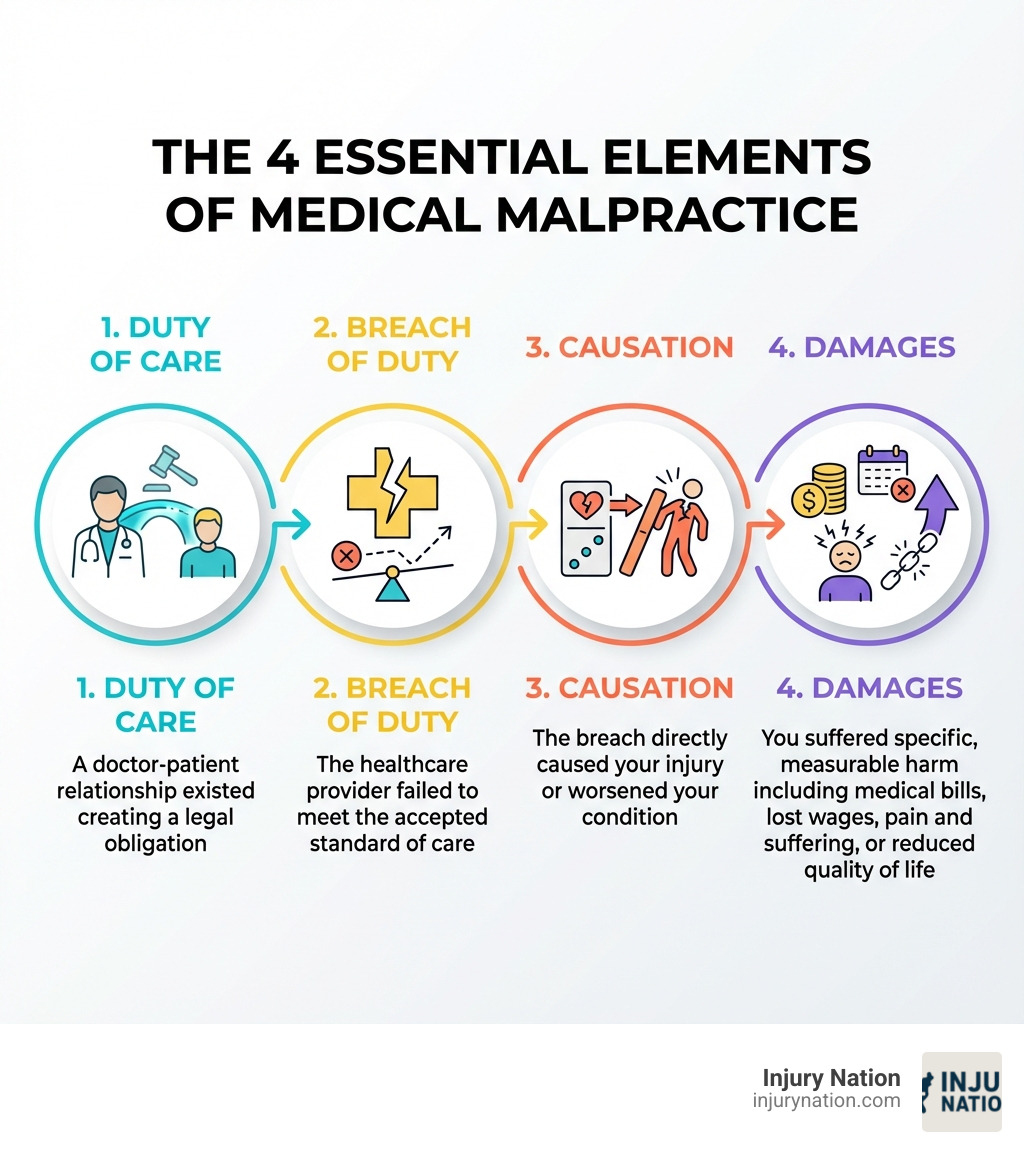
Proving medical malpractice is a complex undertaking. In a civil court, we don’t need to prove guilt “beyond a reasonable doubt” as in criminal cases. Instead, we must prove our case on a “balance of probabilities”—meaning it’s more likely than not that the negligence occurred and caused harm. To do this, we must establish four key elements:

1. A Duty of Care Was Owed
This is the foundational element. It means that a doctor-patient relationship existed, establishing a legal obligation for the healthcare provider to act in your best interest and provide competent care. This relationship usually begins when a healthcare provider agrees to treat you. For instance, if you visit a doctor for a medical issue, that relationship is established. However, a doctor who happens upon a car accident scene and renders first aid as a “Good Samaritan” might not establish a formal doctor-patient relationship for a malpractice claim.
2. The Duty of Care Was Breached
This is where the “negligence” comes in. We must demonstrate that the healthcare provider failed to meet the accepted “standard of care” that a reasonably competent professional would have provided under similar circumstances. This failure could be an action they took or an action they failed to take. For example, if a surgeon operates on the wrong kidney, that’s a clear breach. If a doctor fails to order necessary tests for a patient presenting with classic symptoms of a serious illness, that could also be a breach.
3. The Breach Caused a Direct Injury
It’s not enough that the healthcare provider made a mistake; we must prove that their negligence directly caused your injury or worsened your condition. This is known as causation. There must be a clear link between the breach of duty and the harm you suffered. If a doctor misdiagnoses you, but you already had an incurable condition, proving causation could be difficult. However, if the misdiagnosis led to a delay in treatment that made your condition untreatable, then causation is established. The harm must also be a foreseeable consequence of the negligence.
4. The Injury Resulted in Specific Damages
Finally, we must show that you suffered actual, quantifiable harm as a result of the injury caused by the negligence. This isn’t just a “good scare” from a false cancer diagnosis; it’s real, tangible losses. These “damages” can include:
- Economic Damages: Measurable financial losses such as medical bills (past and future), lost wages (past and future), rehabilitation costs, and other out-of-pocket expenses.
- Non-Economic Damages: Less tangible losses like pain and suffering, emotional distress, loss of enjoyment of life, and loss of consortium.
- Punitive Damages: In rare cases, if the healthcare provider’s conduct was particularly egregious or outrageous (e.g., performing surgery while intoxicated), punitive damages may be awarded to punish the defendant and deter similar behavior.
For a more comprehensive understanding of the types of compensation you might pursue, refer to our Medical Malpractice Damages Complete Guide.
How to File a Malpractice Lawsuit: A Step-by-Step Guide
Starting on a medical malpractice lawsuit can feel daunting, but breaking it down into manageable steps makes the process clearer. Here’s how we approach how to file malpractice claims, ensuring all legal requirements are met.

Step 1: Initial Steps for How to File Malpractice Claims
The very first and most crucial step is to consult with an experienced medical malpractice attorney. As soon as you suspect medical negligence has caused you harm, seek legal advice. An attorney can assess the viability of your case, explain the complex legal landscape, and guide you through the intricate process.
During this initial consultation, we’ll review the details of your experience, discuss potential legal grounds, and determine if you have a strong case. Many personal injury lawyers, including those specializing in medical malpractice, work on a contingency fee basis. This means you don’t pay attorney fees upfront; instead, the lawyer’s payment is a percentage of the final settlement or award. This arrangement makes legal representation accessible to everyone, regardless of their financial situation.
Simultaneously, we’ll begin the critical process of gathering evidence. This includes:
- Medical Records: These are usually the best evidence. We’ll obtain copies of all your relevant medical records, including doctor’s notes, test results, imaging scans (X-rays, MRIs), hospital charts, and prescriptions.
- Bills and Receipts: Documentation of all medical expenses incurred due to the alleged malpractice.
- Photos and Videos: Any visual evidence of your injuries or their impact on your life.
- Personal Notes: Your detailed account of events, symptoms, and conversations with healthcare providers.
Step 2: Complying with Pre-Suit Requirements
Medical malpractice lawsuits often come with specific procedural “hoops” that are unique to these types of claims. These pre-suit requirements vary by state, and in Nevada, there’s a critical one: the Affidavit of Merit.
Nevada law requires an affidavit of merit to be filed with your initial lawsuit complaint in professional negligence cases. This isn’t just a formality; it’s a sworn statement from a qualified medical expert. This expert must:
- Be in a similar medical field to the healthcare provider you are suing.
- Agree with the assertions against the defendant.
- Identify the healthcare provider(s) accused of negligence.
- Clearly describe the negligent acts or omissions.
Failing to submit an adequate affidavit of merit can lead to your case being dismissed. This requirement ensures that claims have a factual basis in medical expertise before proceeding to full litigation, aiming to filter out frivolous lawsuits.
Step 3: The Formal Process of How to File Malpractice Paperwork
Once we’ve gathered sufficient evidence and complied with pre-suit requirements, the formal legal process begins.
- Filing the Complaint: We will draft and file the formal complaint with the appropriate civil court in Nevada. This document outlines the facts of your case, the legal grounds for your claim, and the damages you are seeking. It’s crucial that this paperwork is meticulous and adheres to all court rules.
- Paying Filing Fees: There are applicable court filing fees that must be paid when the complaint is submitted.
- Serving the Defendant: After filing, the defendant (the healthcare provider or institution you are suing) must be officially notified of the legal action. This is called “serving” them with a legal summons and a copy of the complaint. This step ensures due process, informing them they are being sued and providing them an opportunity to respond.
Step 4: Lawsuit vs. Administrative Complaint
There are two distinct paths you can take when you believe you’ve been harmed by a medical professional:
- Filing a Civil Lawsuit for Compensation: This is the process we’ve been describing, where we seek monetary compensation for your injuries and losses in civil court. The goal is to recover damages (economic, non-economic, and sometimes punitive) to help you rebuild your life.
- Filing an Administrative Complaint: This involves reporting the healthcare provider to their professional licensing board or regulatory body. In Nevada, this would typically be the Nevada State Board of Medical Examiners for doctors, or other relevant boards for nurses or other professionals. The purpose of an administrative complaint is to trigger an investigation into the provider’s conduct, which could lead to disciplinary actions such as reprimands, fines, license suspension, or even license revocation. This process does not result in compensation for you, but it can hold the provider accountable and potentially prevent future harm to other patients.
While these are separate processes, they are not mutually exclusive. You can pursue both an administrative complaint and a civil lawsuit simultaneously. Your attorney can advise you on the best strategy for your specific situation.
Navigating Key Deadlines and Common Challenges
Even with a strong case, medical malpractice lawsuits are notoriously complex and can be lengthy. Understanding the deadlines and common problems is essential for managing expectations and preparing for the journey ahead.
Understanding the Statute of Limitations
One of the most critical aspects of how to file malpractice claims is adhering to the statute of limitations. This is a strict legal deadline for initiating your lawsuit. If you miss this deadline, you generally lose your right to sue, regardless of the merits of your case.
Nevada has specific and recently amended statutes of limitations for medical malpractice:
- For injuries or deaths that occurred before October 1, 2023: You generally have one year from the date you finded (or reasonably should have finded) the injury, or three years from the date the injury occurred, whichever comes first. This is outlined in Nev. Rev. Stat § 41A.097.
- For injuries or deaths that occurred on or after October 1, 2023: The law, amended by Assembly Bill 404 in 2023, now states you have two years from the date you finded (or reasonably should have finded) the injury, or three years from the date the injury occurred, whichever comes first.
There are also circumstances where the statute of limitations can be “tolled” (paused or extended):
- Concealment: If the healthcare provider intentionally concealed their error or the injury, the statute may be tolled until the concealment is finded.
- Minority: For minors, the clock often doesn’t start until they reach the age of majority.
- Incapacity: If a person’s ability to manage their affairs is compromised due to their injuries, the period might be paused until they regain capacity or a legal representative is appointed.
Given these strict and complex rules, consulting an attorney immediately is paramount to ensure your claim is filed on time.
The Crucial Role of Expert Witnesses
Expert witnesses are the backbone of almost every medical malpractice case. They are essential for:
- Establishing the Standard of Care: These medical professionals, often doctors or specialists in the same field as the defendant, testify about what the accepted medical practice would have been in your situation.
- Proving Breach: They then explain how the defendant’s actions (or inactions) fell below that established standard.
- Demonstrating Causation: Experts also connect the dots, explaining how the breach of the standard of care directly caused your specific injuries.
As mentioned earlier, Nevada law specifically requires an Affidavit of Merit from a qualified expert even before the lawsuit officially begins. Finding the right expert is a specialized skill, and their testimony can be very expensive, sometimes costing up to $200,000 in disbursements. However, their expertise is invaluable in clarifying complex medical issues for the court and jury.
Common Defenses and Potential Outcomes
Healthcare providers and their insurance companies will mount a vigorous defense. Common defenses they might use include:
- Contributory/Comparative Negligence: Arguing that your own actions (e.g., not following medical advice, failing to disclose full medical history) contributed to your injury.
- Pre-existing Condition: Claiming your injury was due to a condition you had before the alleged malpractice, not their negligence.
- Foreseeable Risk/Bad Outcome: Asserting that your injury was a known, unavoidable risk of the procedure or a complication that could occur even with competent care, rather than a result of negligence.
- Lack of Causation: Arguing that even if there was a mistake, it wasn’t the direct cause of your specific harm.
Despite these challenges, many medical malpractice claims are resolved through settlement negotiations before ever going to trial. Both sides may prefer to avoid the expense, time, and uncertainty of a jury trial. If a settlement cannot be reached, the case proceeds to trial, which, while typically lasting one to three days, can be an emotionally and financially draining process.
A significant factor in potential outcomes in Nevada is the presence of damage caps. While there is no cap on economic damages (like medical bills and lost wages), Nevada caps non-economic damages (such as pain and suffering). As of January 2024, the cap for non-economic damages in Nevada is $430,000, which is adjusted over time for inflation. This means that even if a jury awards more for pain and suffering, the amount you can receive is limited by this cap. Punitive damages are also capped in Nevada.
Frequently Asked Questions about Filing for Malpractice
We often hear similar questions from individuals considering how to file malpractice claims. Here are some of the most common inquiries and their answers.
How much compensation can I get in a malpractice lawsuit?
The amount of compensation you can receive in a medical malpractice lawsuit varies significantly based on the specifics of your case, the severity of your injuries, and state laws. In Nevada, compensation can cover:
- Economic Damages: These are quantifiable financial losses, including past and future medical expenses, rehabilitation costs, lost wages, loss of earning capacity, and other out-of-pocket expenses. There is no cap on economic damages in Nevada.
- Non-Economic Damages: These cover intangible losses like pain and suffering, emotional distress, disfigurement, loss of enjoyment of life, and loss of consortium. In Nevada, non-economic damages are capped. As of January 2024, this cap is $430,000, subject to inflation adjustments.
- Punitive Damages: Awarded in rare cases where the healthcare provider’s conduct was malicious, oppressive, or fraudulent. These are meant to punish the wrongdoer and deter similar conduct. Punitive damages are also capped in Nevada.
While settlements can range from $100,000 to tens of millions of dollars, it’s important to note that the total amount paid to victims of medical malpractice across the U.S. between 2010 and 2019 was $42 billion. Your attorney will help you understand the potential value of your specific claim based on Nevada law and precedents.
How long does a medical malpractice lawsuit take?
Medical malpractice lawsuits are known for being lengthy and complex. The timeline can vary greatly depending on the complexity of the medical issues, the number of parties involved, the willingness of both sides to negotiate, and court schedules.
Typically, a medical malpractice lawsuit can take anywhere from two to five years to resolve, and sometimes even longer, especially if it goes to trial and includes appeals. The process involves:
- Investigation and Filing: Months to gather evidence, obtain expert opinions (Affidavit of Merit), and draft the complaint.
- Findy Phase: This is a lengthy process where both sides exchange information, conduct depositions (interviews under oath), and gather more evidence. This alone can take a year or more.
- Negotiation and Mediation: Efforts to settle the case out of court. Most cases are resolved during this stage.
- Trial: If a settlement isn’t reached, the case proceeds to trial. While the trial itself might only last a few days to a few weeks, getting a trial date can take a significant amount of time.
Patience is key, as is having an attorney who can efficiently steer these stages.
Can I sue a doctor if I signed a consent form?
Yes, absolutely. Signing a consent form does not waive your right to sue for medical malpractice. A consent form typically acknowledges that you understand the risks, benefits, and alternatives of a proposed treatment or procedure. It grants the healthcare provider permission to proceed.
However, a consent form does not give a healthcare provider permission to be negligent. If the care you received fell below the accepted standard of care, leading to injury, you may still have a valid malpractice claim. For example:
- If the doctor failed to inform you of all significant risks associated with a procedure, your consent might not have been “informed.”
- If the doctor performed the procedure negligently, causing an injury that was not a known, accepted risk you consented to, then their negligence is the issue, not the consent.
Informed consent means agreeing to accepted risks, not to negligent actions.
Conclusion: Taking the Next Step in Your Malpractice Claim
Navigating the aftermath of medical negligence can be one of the most challenging experiences of your life. We understand the physical, emotional, and financial toll it takes. While the process of how to file malpractice claims is intricate, demanding meticulous attention to detail, adherence to strict deadlines, and the expertise of medical professionals and legal counsel, it is a path to justice and compensation.
The legal system is designed to protect patients who have been harmed by substandard care. We’ve outlined the critical steps, from understanding what constitutes malpractice and proving negligence through the four essential elements, to complying with Nevada’s specific pre-suit requirements like the Affidavit of Merit, and navigating the statute of limitations. We’ve also touched on the crucial role of expert witnesses and the potential outcomes, including Nevada’s damage caps.
You don’t have to face this journey alone. The complexities of medical malpractice law make it nearly impossible to succeed without experienced legal representation. An attorney can help you:
- Evaluate your case and determine its legal viability.
- Gather all necessary evidence, including crucial medical records.
- Secure expert medical testimony.
- Ensure all deadlines and procedural requirements are met.
- Negotiate with insurance companies and defense teams.
- Represent your interests vigorously in court if a settlement cannot be reached.
If you believe you or a loved one has been a victim of medical malpractice in Las Vegas or anywhere in Nevada, we urge you to seek legal counsel promptly. The clock on your ability to file a claim starts ticking early, and every moment counts.
Let us help you find the right legal advocate. Find an experienced medical malpractice lawyer in your area to guide you. Your path to justice begins with a single, informed step.