

Why an Injured Worker Attorney is Critical After a Workplace Accident
An injured worker attorney specializes in helping employees get workers’ compensation benefits after a job-related injury or illness. They steer state-specific laws, handle claim denials, and fight to ensure you receive full compensation for medical bills, lost wages, and disability.
Quick Answer: What Does an Injured Worker Attorney Do?
- Files your claim correctly and on time
- Appeals denied claims through hearings and reviews
- Negotiates settlements with insurance companies
- Protects you from employer retaliation
- Handles third-party claims if another party caused your injury
- Works on contingency, so you pay no fees unless you win
If you’ve been hurt at work, you’re not alone. In Nevada, 29,800 non-fatal workplace injuries were reported in 2021, with 43 workers killed on the job. Many injured workers face a confusing system where employers and insurers challenge claims to reduce costs.
Workers’ compensation is a no-fault system, meaning you can get benefits even if you were partially at fault, as long as the injury happened at work. However, “no-fault” doesn’t mean “no hassle.” Insurers often deny, delay, or dispute claims using legal jargon and strict procedures to minimize payouts.
An injured worker attorney is essential in this situation. They understand your state’s workers’ comp system, gather evidence, file paperwork correctly, and fight for your rights, letting you focus on healing. A denied claim can be devastating, but a lawyer ensures your case is handled correctly from day one so you don’t lose the compensation you deserve.
What is a Workers’ Compensation Lawyer and How Do They Differ from Personal Injury Lawyers?
If you’ve been hurt at work, you’re likely dealing with pain, medical bills, and lost income. You may wonder if you need a lawyer and what kind is right for your situation.
A workers’ compensation lawyer is a specialized attorney who focuses exclusively on helping employees injured on the job. They are your advocate in securing the benefits you’re entitled to under your state’s workers’ compensation system. They handle the complex maze of paperwork, deadlines, and legal requirements so you can focus on getting better.
While they both handle injuries, a workers’ comp lawyer is not the same as a personal injury lawyer. They operate in completely different legal arenas.
Here’s how they stack up:
| Feature | Workers’ Compensation Lawyer | Personal Injury Lawyer |
|---|---|---|
| Primary Goal | Secure benefits for work-related injuries/illnesses | Seek compensation for injuries caused by another’s negligence |
| Legal Basis | State workers’ compensation statutes (no-fault system) | Tort law (requires proving fault/negligence) |
| Damages | Medical expenses, lost wages, disability, vocational rehab | Medical expenses, lost wages, pain and suffering, punitive |
| Defendant | Employer’s insurance carrier | At-fault individual or entity |
| Proof Needed | Injury occurred “in the course and scope of employment” | Proof of negligence and causation |
The biggest difference is that workers’ compensation is a no-fault system. You don’t need to prove your employer did anything wrong. If you were hurt while doing your job, you’re generally covered. Personal injury cases require you to prove that someone else’s negligence caused your injury, which is a more complex process.
The Specialized Role of a Workers’ Comp Attorney
An injured worker attorney specializes in administrative law, handling cases before state boards like the Nevada Attorney for Injured Workers, not in traditional courtrooms. They have a specific skill set for this system.
They are experts at navigating the no-fault system and dealing with insurance carriers. Your attorney handles all communication with adjusters, so you don’t accidentally say something that could hurt your claim. They also understand how to interpret complex medical reports to ensure the evidence clearly connects your injury to your work. Finally, they know how to calculate the full value of your benefits, including lost wages and future medical care, and are masters of state-specific procedures and deadlines, which can make or break a case.
When a Personal Injury Claim is Also Possible
While you can’t sue your employer for a work injury, you can sometimes pursue a personal injury claim against a third party. These “third-party claims” can significantly increase your compensation because they allow you to seek damages for pain and suffering, which workers’ comp doesn’t cover.
Examples include:
- A car accident while on the job, where you could sue the at-fault driver. This is where car accident lawyers or truck accident lawyers can help.
- An injury caused by defective equipment, where the manufacturer could be liable.
- Toxic substance exposure due to a supplier’s negligence.
- An injury on a construction site caused by a negligent contractor.
- A slip and fall on someone else’s property. A slip and fall attorney can evaluate these claims.
An experienced injured worker attorney can identify if you have both a workers’ comp and a third-party claim, helping you pursue all available avenues for compensation.
Why You Need an Injured Worker Attorney to Steer Your Claim

The workers’ compensation system is supposed to help, but it’s filled with complex rules, tight deadlines, and insurance companies that aim to pay as little as possible. In Nevada, where 3.5% of workers get injured on the job, thousands face this battle every year.
Insurance companies have lawyers whose job is to protect the company’s bottom line. They might claim your injury isn’t work-related or that you waited too long to report it. An injured worker attorney levels the playing field. We know the deadlines, the forms, and the tactics insurers use. Our job is to protect your rights and get you every dollar you deserve while you focus on recovery.
Key Scenarios That Demand Legal Representation
While you should always consider a consultation, these situations make legal help critical:
- Denied claims: This is the biggest red flag. A lawyer can review the denial, gather new evidence, and file a compelling appeal.
- Delayed payments: If the insurance company is dragging its feet on paying your medical bills or lost wages, an attorney can apply legal pressure.
- Disputes over your disability rating: Insurers often try to downplay your disability to save money. An attorney can use independent medical experts to prove the true extent of your limitations.
- Employer retaliation: If you are fired, demoted, or have your hours cut after filing a claim, a lawyer can protect you and hold your employer accountable.
- Pre-existing condition arguments: Insurers may claim a pre-existing condition is the real cause of your pain. An attorney can show that your work injury aggravated it, which means it’s covered.
- Complex injuries: Cases involving severe trauma like brain or spinal injuries, or serious burns (see our Burn Injury Lawsuit Guide), require an expert to calculate future costs.
- Third-party fault: If someone other than your employer was at fault, you may have a separate personal injury claim for additional damages like pain and suffering.
The Core Benefits of Hiring an Injured Worker Attorney
Hiring an injured worker attorney provides crucial advantages:
- We handle the legal maze of forms, deadlines, and procedures.
- We protect your rights as the only party focused entirely on your needs.
- We negotiate settlements and won’t let insurers lowball you.
- We handle all communication with the insurance company and other parties.
- We represent you in hearings, so you never have to face a judge alone.
- We give you peace of mind to focus on healing.
- We connect you to resources, like the Nevada Attorney for Injured Workers, for state-specific help.
Best of all, most work on contingency, meaning we don’t get paid unless you win. There are no upfront costs.
How a Lawyer Manages the Entire Workers’ Compensation Process

When you’re injured at work, you’re thrown into a confusing system of forms, deadlines, and insurance adjusters. An injured worker attorney manages this entire process for you, from the initial report to the final settlement or appeal.
We handle the heavy lifting—gathering evidence, filing paperwork, and fighting for your benefits—so you can focus on getting better.
From Initial Injury Report to Filing Your Claim
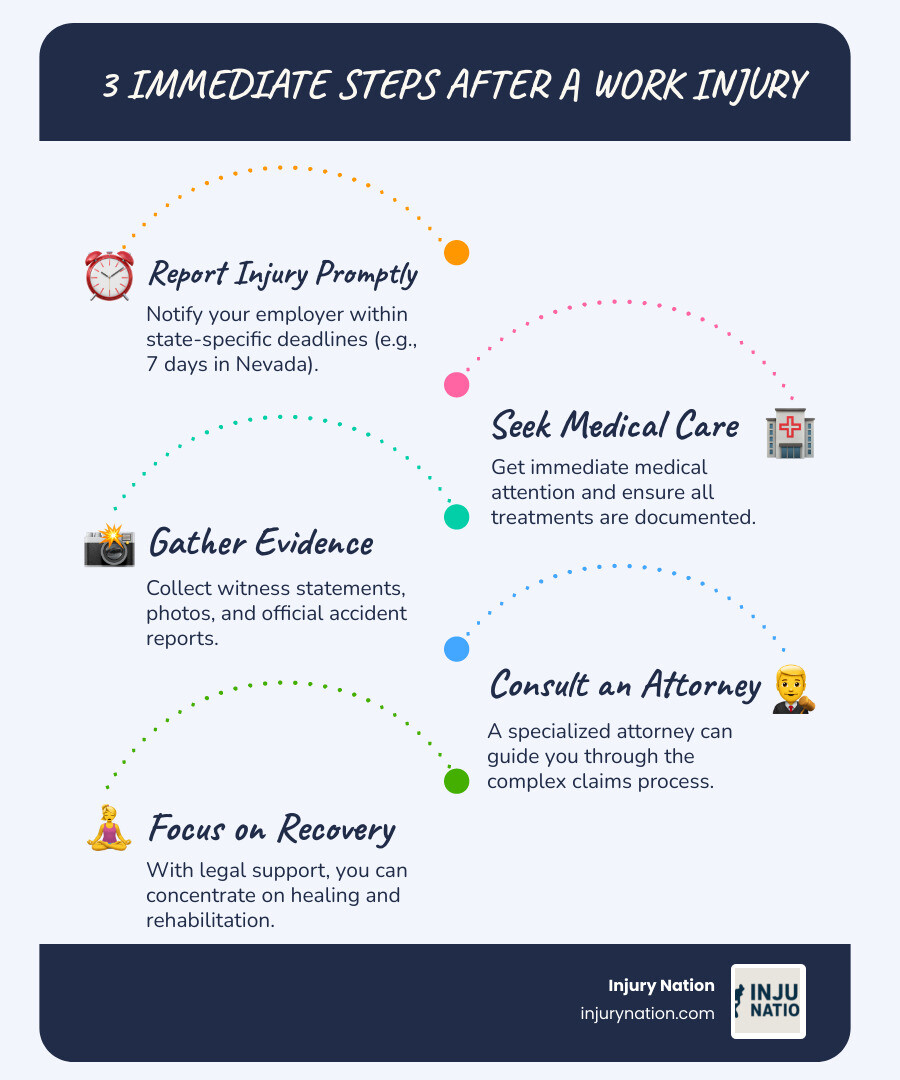
The steps you take immediately after an injury are critical. An attorney ensures you do everything right from the start.
- Report Your Injury: You must report your injury to your employer promptly. In Nevada, the deadline is within 7 days. Delays can jeopardize your claim.
- Get Medical Attention: Seek immediate medical care. This not only helps your health but also creates the necessary documentation for your claim.
- Gather Evidence: We help collect all supporting evidence, including medical records, witness statements, accident reports, and photos of the scene or injury.
- File the Claim: Filing the claim requires precision. In Nevada, you must submit a C-4 Employee’s Claim for Compensation form within 90 days. We handle all state-specific forms and deadlines to prevent costly errors that could lead to a denial.
Handling Denied Claims and the Appeals Process
Many valid claims are initially denied. Insurance companies save money by saying “no” for reasons like insufficient medical evidence or missed deadlines. A denial is not the end; it’s the start of the appeals process, where an injured worker attorney is invaluable.
In Nevada, you have 70 days from receiving a denial to file an appeal with the Hearings Division. We act immediately to build a stronger case.
The appeals process may involve several stages:
- Hearing: We present evidence and witness testimony before a Hearings Officer to challenge the denial.
- Appeal: If the initial hearing is unsuccessful, we can appeal to an Appeals Officer within 30 days.
- Judicial Review: As a final step, we can petition for review in district court.
Throughout this process, we manage all legal arguments and paperwork, gathering independent medical evaluations and other evidence to strengthen your case while you focus on recovery.
Common Injuries and Illnesses Covered

Workers’ compensation covers a wide range of work-related conditions, from sudden accidents to illnesses that develop over time.
- Traumatic Injuries: These are sudden injuries from a specific event, such as falls, equipment accidents, or lifting incidents. They can result in broken bones, concussions, amputations, or severe burn injuries. If a vehicle was involved, a truck accident lawyer or car accident lawyer may also be needed.
- Repetitive Stress Injuries: These develop gradually from repeated motions, like carpal tunnel syndrome from typing or tendonitis from lifting. An attorney can help prove the connection to your job duties.
- Occupational Diseases: These result from long-term exposure to hazards, such as respiratory conditions from dust or fumes, skin diseases, hearing loss from noise, or cancers like mesothelioma from asbestos.
- Psychological Trauma: Conditions like PTSD resulting from a traumatic event at work (e.g., witnessing a fatal accident) may be covered.
- Slip and Fall Injuries: These common accidents can cause serious harm. A slip and fall attorney can help determine if a third party was also at fault.
No matter the injury, if it’s work-related, we can help prove your case.
Understanding Claim Value and Attorney Fees
Between medical bills and lost paychecks, you’re likely worried about money. Let’s clarify what your claim might be worth and how you can afford an injured worker attorney.
How an Injured Worker Attorney Determines Your Claim’s Value
There is no magic formula for a claim’s value; it depends on your unique circumstances. We evaluate the total impact of the injury on your life, both now and in the future.
Key factors include:
- Medical Expenses: This covers all past, present, and future medical care, including doctor visits, surgeries, medication, and physical therapy.
- Temporary Total Disability (TTD): These benefits replace a portion of your lost income while you are unable to work. Typically, this is about two-thirds of your average weekly wage.
- Permanent Partial Disability (PPD): If your injury causes a lasting impairment, these benefits provide compensation based on the severity of the disability.
- Vocational Rehabilitation: If you cannot return to your old job, these benefits can cover retraining or job placement services.
- Lifetime Care Costs: For catastrophic injuries, we calculate the cost of long-term medical support, home modifications, and other necessary lifelong care.
States often cap weekly benefits. For example, in Nevada, the cap for injuries after July 1, 2023, is $1,173.27 per week. An attorney ensures you receive the maximum amount you’re entitled to under these laws.
Typical Fee Structures: The Contingency Fee Agreement
How can you afford a lawyer when you’re not working? The answer is the contingency fee agreement.
This means “no win, no fee.” You pay us nothing unless we successfully recover compensation for you. There are no upfront costs or hourly bills. This gives everyone access to quality legal representation, regardless of their financial situation.
When we win your case, our fee is a pre-agreed percentage of the recovery, which is often regulated by state law to ensure fairness. This system aligns our interests with yours—we are motivated to maximize your compensation because our success depends on your success. If we don’t win, you owe us nothing in attorney fees.
Nearly all workers’ comp attorneys offer a free initial consultation. This is a risk-free opportunity to discuss your case, get an honest assessment, and understand your options without any obligation.
Frequently Asked Questions about Workers’ Compensation Claims
Facing a workplace injury brings many questions. Here are answers to some of the most common concerns we hear from injured workers.
Can my employer fire me for filing a workers’ compensation claim?
No. It is illegal for your employer to fire, demote, or otherwise retaliate against you for filing a workers’ compensation claim. This action is considered wrongful termination.
If you believe you’re facing retaliation, an injured worker attorney can take immediate legal action to protect your job and potentially secure additional damages for your employer’s illegal conduct. Seeking the benefits you are owed is your protected right.
How long do I have to report my injury and file a claim?
Deadlines are strict and vary by state, which is why acting quickly is crucial. In Nevada, for example, you must:
- Report the injury to your employer within 7 days.
- File your formal claim (e.g., the C-4 form) and seek initial medical treatment within 90 days of the injury.
Missing these deadlines can result in a complete loss of your right to benefits. An attorney ensures all paperwork is filed correctly and on time, protecting your claim from procedural denials.
What if my injury was partially my fault?
This is where the “no-fault” nature of workers’ compensation is a major benefit. You are generally entitled to benefits regardless of who caused the accident, even if you were partially responsible.
The key requirement is that the injury occurred in the course and scope of your employment. As long as you were doing your job when you got hurt, you are typically covered.
Exceptions exist, such as for intentional self-injury or intoxication, but for most accidents, your own actions won’t bar you from receiving benefits. An injured worker attorney can protect you if an insurer tries to use your actions to unfairly deny your claim.
Find the Right Legal Partner for Your Workplace Injury
A workplace injury can be overwhelming. You’re facing medical bills, lost income, and a complex legal system that often seems stacked against you. Insurance companies have lawyers fighting to minimize your claim, but you don’t have to face them alone.
An injured worker attorney is your essential advocate. They handle the paperwork, negotiate with insurers, and fight for the compensation you deserve, giving you the peace of mind to focus on your recovery.
Your injury shouldn’t derail your future. With the right legal partner, you can secure the medical care and financial support needed to move forward. At Injury Nation, we connect injured workers with qualified, vetted attorneys who have a proven track record of protecting workers’ rights.
Don’t wait and wonder if you’re making the right choices. Take control of your situation today.