

Why You Need Expert Legal Help After a Rear-End Collision
A rear end accident attorney can be the difference between fair compensation and being shortchanged by insurance companies. After a collision, you’re likely overwhelmed by injuries, car repairs, and mounting medical bills.
Here’s what you need to know about hiring a rear-end accident attorney:
- When to hire: If you have injuries, disputed fault, or insurance delays
- What they do: Investigate your crash, calculate damages, and negotiate with insurers
- Cost: Most work on contingency – no fee unless you win
- Timeline: You typically have 2 years to file a claim (varies by state)
- Compensation: Medical bills, lost wages, pain and suffering, and future care costs
Rear-end collisions are alarmingly common, accounting for 29% of all crashes with severe injuries or fatalities. These aren’t just “fender benders”; they cause injuries to 500,000 people and over 1,700 deaths annually.
The rear driver is usually presumed to be at fault, but this isn’t always the case. Factors like brake-checking, faulty brake lights, or sudden lane changes can shift liability. Insurance companies know this and use these complexities to minimize your payout.
An experienced attorney can help you understand your legal rights and fight for the compensation you deserve for medical bills, lost wages, and pain and suffering.
Understanding Fault and Liability in Rear-End Collisions
In a rear-end collision, the rear driver is generally presumed to be at fault. This is because every driver has a duty to maintain a safe following distance and be able to stop safely if the car ahead brakes suddenly. This is often called the “assured clear distance ahead” rule.
However, this presumption isn’t absolute. Liability can shift if the lead driver contributed to the crash, which is why a skilled rear end accident attorney is essential for investigating the details and protecting your interests.
Your ability to recover damages is also affected by whether you live in a fault or no-fault state.
| Feature | Fault State (e.g., Nevada) | No-Fault State (e.g., Florida, Michigan) |
|---|---|---|
| Recovery | You seek compensation from the at-fault driver’s insurer. | You seek compensation from your own insurer, regardless of fault. |
| Lawsuits | You can sue the at-fault driver for all damages. | You can only sue for “severe” injuries (meeting a specific threshold). |
| PIP Coverage | Not typically mandatory, but can be added. | Mandatory Personal Injury Protection (PIP) covers medical bills/lost wages. |
| Pain & Suffering | Recoverable directly from the at-fault driver’s insurer. | Only recoverable if injuries meet the “severe” threshold for a lawsuit. |
In fault states, victims can typically recover all damages, including pain and suffering, from the at-fault driver’s insurer. In no-fault states, you first file with your own insurer and can only sue the other driver if your injuries meet a “severe” threshold, which can limit recovery.
Common Causes of Rear-End Accidents
Most rear-end collisions are preventable and happen due to negligence.
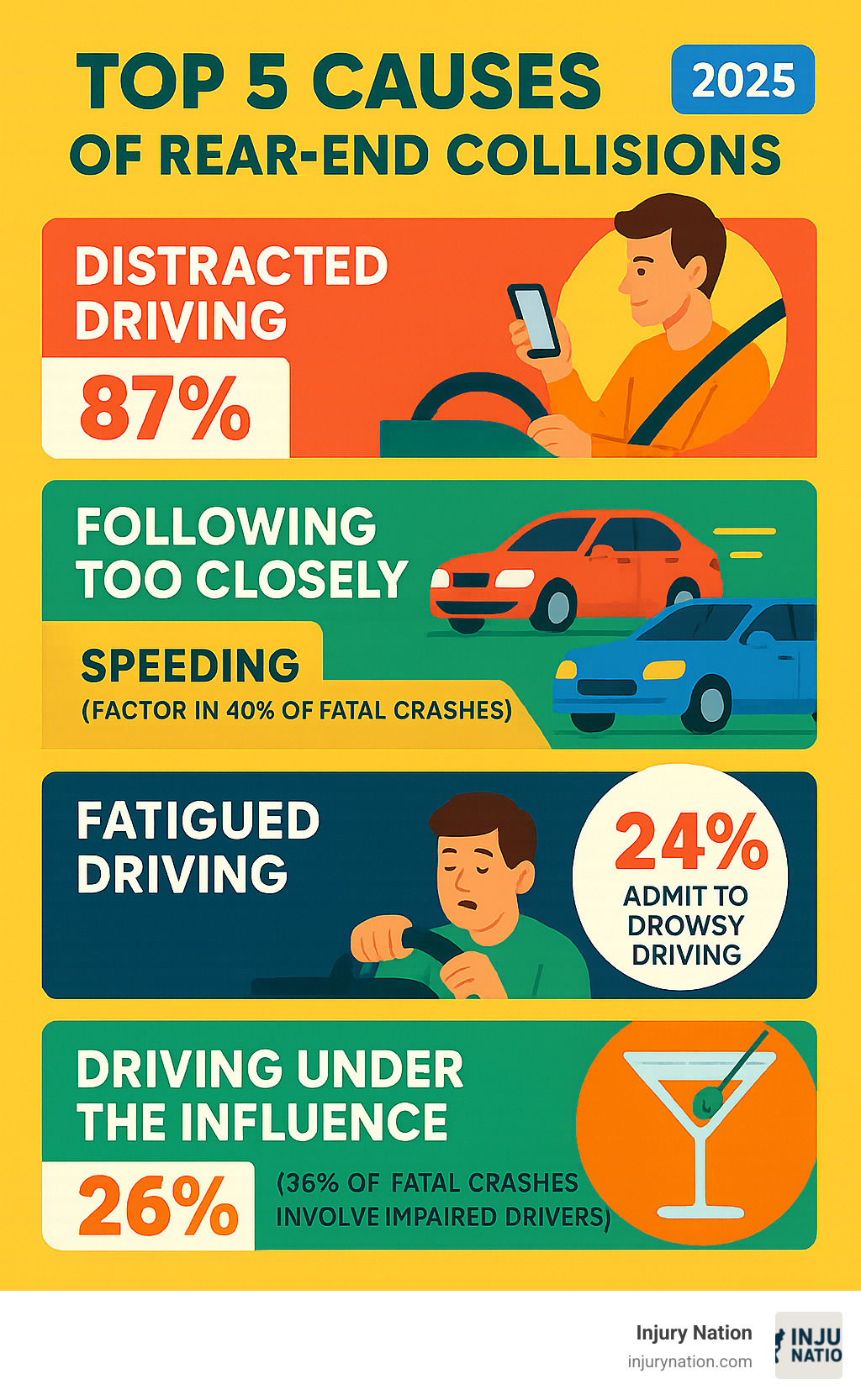
- Distracted driving is the leading cause, involved in approximately 87% of rear-end crashes. This includes texting, adjusting the radio, or any other activity that takes attention off the road.
- Following too closely (tailgating) leaves insufficient time to react to sudden stops. The three-second rule is a good guideline for maintaining a safe distance.
- Speeding reduces reaction time and increases stopping distance. It was a factor in over 40% of fatal rear-end collisions from 2015-2019.
- Fatigued driving impairs judgment and slows reaction time, similar to driving under the influence. About 24% of drivers admit to driving while drowsy.
- Impaired driving from alcohol or drugs severely delays reaction time. Over 26% of fatal rear-end crashes in 2019 involved an intoxicated driver. For more information, see these resources on impaired driving.
- Adverse weather conditions like rain, snow, or fog reduce visibility and traction, requiring drivers to slow down and increase following distance.
When the Lead Driver Can Be At Fault
While unusual, the lead driver can be partially or fully responsible in certain situations.
- Sudden reversing: If the lead car unexpectedly reverses into the car behind it.
- Brake checking: The lead driver intentionally slams on their brakes to intimidate a tailgater, a dangerous form of road rage.
- Faulty brake lights: If the lead car’s brake lights are not working, the trailing driver may not have adequate warning of a stop.
- Unsafe lane changes: A driver cuts into a lane without enough space, forcing others to brake suddenly.
- Pulling into traffic without enough space: A driver merges or pulls out unsafely, causing a collision.
In these cases, comparative negligence may apply, meaning fault can be shared. An attorney will investigate these factors to ensure liability is assigned correctly.
Common Injuries and Potential Compensation
Even a low-speed rear-end collision can cause significant injuries. The violent forces involved can cause harm even if you feel fine at the scene. Adrenaline can mask symptoms that appear hours or days later.
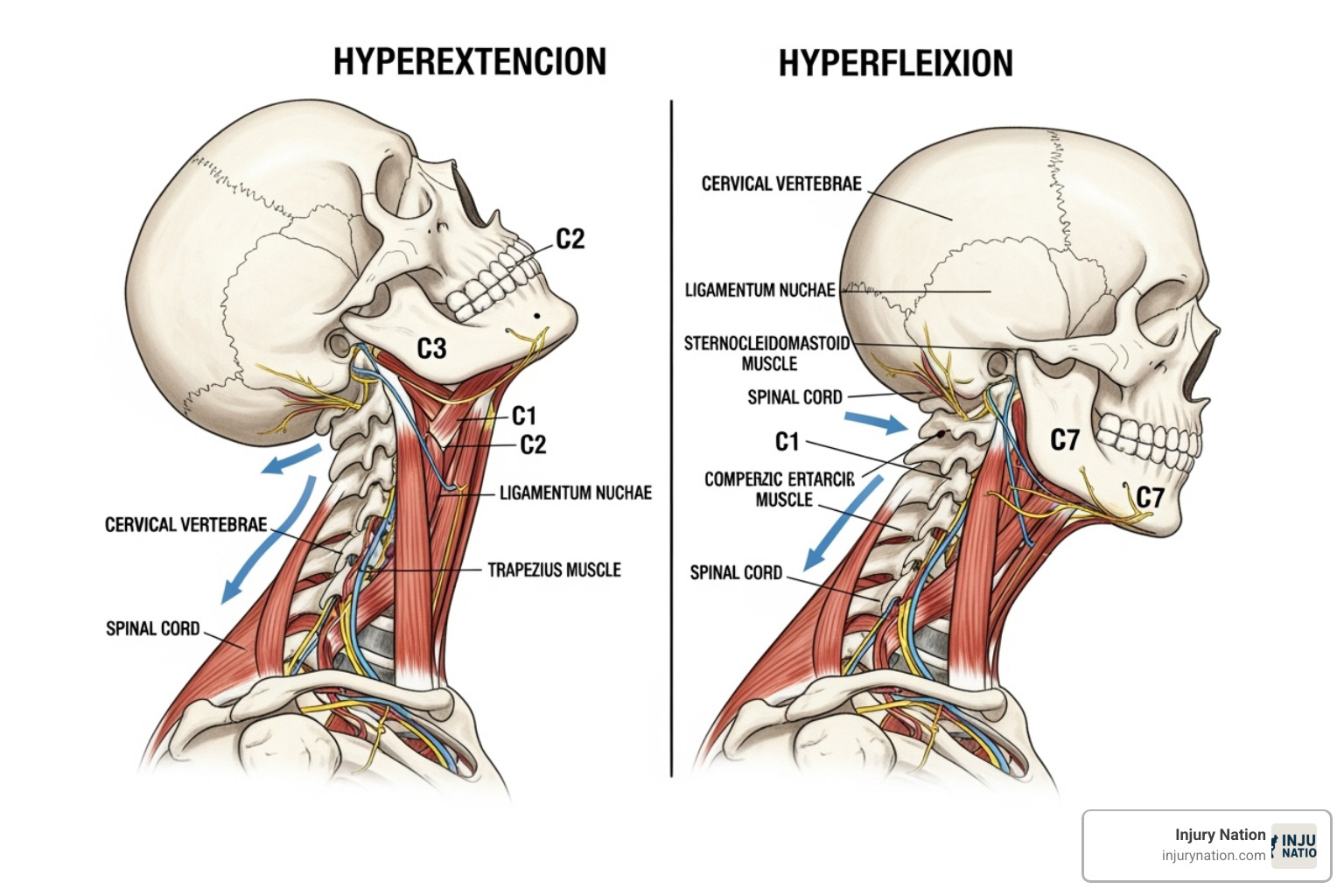
The severity of injuries depends on factors like vehicle speed, car sizes, and your position in the vehicle. A rear end accident attorney ensures all injuries are documented and linked to the crash, countering insurance company tactics that blame pre-existing conditions.
Compensation falls into two main categories: Economic damages (quantifiable losses like medical bills and lost wages) and non-economic damages (intangible losses like pain, suffering, and emotional distress). In cases of extreme negligence, such as drunk driving, a court may also award punitive damages to punish the wrongdoer.
Types of Injuries Sustained
- Whiplash: The most common injury, caused by the rapid back-and-forth movement of the head and neck. Symptoms include neck pain, stiffness, headaches, and dizziness, which may be delayed.
- Back and spinal cord injuries: The same forces can cause herniated discs or, in severe cases, damage to the spinal cord, potentially leading to paralysis.
- Traumatic brain injuries (TBIs): The brain can be injured from striking the inside of the skull during the impact, even without a direct head blow. These injuries can affect memory, concentration, and personality.
- Soft tissue injuries: These include bruises, cuts, and muscle strains throughout the body. Airbags, while lifesaving, can cause burns and bruising to the face and chest.
- Psychological impact: Many victims develop anxiety, panic attacks, or depression related to the trauma of the crash and chronic pain.
What Compensation Can You Recover?
An attorney will fight to recover all damages you are entitled to.
- Medical bills: This includes emergency room visits, ambulance rides, diagnostic tests (X-rays, MRIs), specialist appointments, physical therapy, and any future medical care.
- Lost wages: Compensation for time missed from work and for any reduction in your future earning capacity if your injuries prevent you from performing your job as you did before.
- Property damage: The cost to repair or replace your vehicle and any personal items damaged in the crash, such as laptops or glasses.
- Pain and suffering: Compensation for the physical pain, emotional distress, and mental anguish you have endured.
- Loss of enjoyment of life: Acknowledges the loss of ability to participate in hobbies and activities you previously enjoyed.
The value of your case is unique. An experienced rear end accident attorney can accurately calculate your total damages and fight for a fair settlement. Search for attorneys in your area to explore your options.
Why You Need a Rear End Accident Attorney
While fault in a rear-end collision may seem obvious, the aftermath is rarely straightforward. This is why a skilled rear end accident attorney is crucial.
Insurance companies are businesses focused on protecting their profits, not maximizing your settlement. They often use tactics like offering a quick, lowball settlement before the full extent of your injuries is known. They may also request recorded statements to use against you or argue that your injuries are unrelated to the accident.
Proving fault can also become complex. The other driver might claim their brakes failed or that you stopped suddenly for no reason. An experienced attorney knows how to investigate these claims and establish what truly happened.
Studies show that accident victims with legal representation receive significantly higher compensation than those who handle claims alone. An attorney can calculate the full value of your claim, including future medical costs, lost earning potential, and pain and suffering.
Navigating state laws, filing deadlines, and negotiations with trained adjusters is complex, especially while recovering from injuries. An attorney handles the legal work so you can focus on getting better.

What a Rear End Accident Attorney Does for You
A rear end accident attorney acts as your investigator, negotiator, and advocate.
- Investigates the crash: We go beyond the police report, visiting the scene, interviewing witnesses, and analyzing traffic camera footage to determine fault.
- Gathers evidence: We compile all necessary documentation, including police reports, medical records, witness statements, photos, and expert opinions.
- Calculates total damages: We carefully calculate all economic and non-economic losses, including future medical needs and long-term impacts on your life.
- Negotiates with insurers: We handle all communication with insurance adjusters, protecting you from tactics designed to devalue your claim.
- Files a lawsuit if necessary: If a fair settlement cannot be reached, we are prepared to take your case to court to fight for the compensation you deserve.
- Represents you in court: While most cases settle, we provide full representation through every stage of litigation if a trial becomes necessary.
Handling Uninsured or Underinsured Motorist Claims
If you are hit by a driver with little or no insurance, a rear end accident attorney can help you steer your options.
Your own Uninsured Motorist (UM) or Underinsured Motorist (UIM) coverage can cover your damages. However, filing a claim with your own insurer can still be an adversarial process. They may dispute the claim or offer less than you deserve.
We can negotiate with your insurer and pursue arbitration or litigation if they fail to honor the terms of your policy. In some cases, suing the at-fault driver directly may be an option if they have significant assets, though this is often challenging. We explore every avenue to secure the compensation you need.
The Legal Process: Steps to Take After a Collision
After a rear-end collision, knowing what to do next is critical for protecting your rights. The steps you take can significantly impact your ability to recover fair compensation.
Crucially, you have a limited time to file a legal claim due to the statute of limitations, which is typically two years in most states. Missing this deadline means losing your right to compensation. Acting quickly is also essential because evidence disappears over time—witness memories fade and security footage is deleted. The sooner you begin, the stronger your case will be.
The legal process generally involves investigation, evidence gathering, negotiation with insurers, and, if necessary, a lawsuit. Most cases settle before trial, but a strong foundation of evidence is key to a successful outcome.
What to Do Immediately After an Accident
Staying calm and taking these steps can protect your health and your legal rights.
- Check for injuries and call 911: Your first priority is safety. Adrenaline can mask injuries, so seek medical attention even if you feel fine. A 911 call also creates an official police report.
- Move to a safe location: If possible, move your vehicle out of traffic and turn on your hazard lights to prevent further accidents.
- Exchange driver information: Get the other driver’s name, contact information, driver’s license number, and insurance details. Also, note the vehicle’s make, model, and license plate number.
- Document everything with photos: Use your phone to take pictures of vehicle damage, the accident scene, road conditions, traffic signs, and any visible injuries.
- Do not admit fault: Avoid saying “I’m sorry” or making any statements that could be interpreted as an admission of guilt. Stick to the facts when speaking with the other driver and police.
Gathering Crucial Evidence for Your Case
Building a strong case requires comprehensive evidence.
- Police reports: This official document contains the officer’s observations, witness information, and often an initial assessment of fault.
- Photos and videos: Visual evidence from the scene provides undeniable proof of damage, vehicle positions, and conditions.
- Witness statements: Independent witnesses can provide powerful, unbiased testimony about how the accident occurred. Get their contact information.
- Medical records: These records create a direct link between the collision and your injuries, documenting the extent and cost of your treatment.
- Dashcam footage: If you or a nearby vehicle has a dashcam, the footage can offer an objective view of the crash.
- Vehicle damage estimates: Estimates from mechanics help establish the force of the impact and support your property damage claim.
Contacting an attorney quickly allows them to begin preserving this critical evidence. For more guidance, read our Blog for more tips. A skilled rear end accident attorney knows what evidence is needed to build the strongest possible case for your recovery.
Frequently Asked Questions
After a rear-end collision, it’s normal to have questions about the legal process. Here are answers to some of the most common concerns.
How much does a rear-end accident attorney cost?
Most personal injury lawyers, including a rear end accident attorney, work on a contingency fee basis. This means you pay no upfront costs. The attorney’s fee is a percentage of the settlement or award they recover for you. If you don’t win your case, you don’t owe any attorney fees.
We also offer free consultations to discuss your case without any financial risk. This allows you to understand your legal options and decide if our firm is the right fit for you. This system ensures everyone can afford quality legal representation.
How long do I have to file a claim after being rear-ended?
Every state has a deadline called the statute of limitations for filing personal injury claims. This timeframe varies by state but is often two years from the date of the accident (as it is in Nevada, California, and Texas). If you miss this deadline, you lose your right to seek compensation.
It is crucial to act quickly, well before the deadline expires. Waiting can harm your case, as evidence like witness testimony and video footage can be lost over time. Contacting a rear end accident attorney promptly helps preserve crucial evidence and strengthens your claim.
Can I still get compensation if I was partially at fault?
Yes, in most states, you can still recover compensation even if you were partially at fault. Most states, including Nevada, use a modified comparative fault rule. Under this system, you can recover damages as long as you are found to be less than 50% responsible for the crash. Your total compensation will be reduced by your percentage of fault.
For example, if you are awarded $100,000 but found 10% at fault, you would receive $90,000. An insurance company may try to assign you more blame to reduce their payout. An experienced rear end accident attorney will fight to protect you from unfair allocations of fault and maximize your recovery.
Find the Right Legal Representation for Your Case
After a rear-end collision, you don’t have to face the legal and financial challenges alone. Navigating insurance claims while recovering from injuries is overwhelming, but the right legal support can make all the difference.
An experienced rear end accident attorney understands insurance company tactics and knows how to build a strong case on your behalf. They handle the investigation, evidence gathering, and negotiations, allowing you to focus on your recovery. Finding a local lawyer who knows your state’s specific laws, such as Nevada’s modified comparative fault rule, is critical to the success of your claim.
Injury Nation connects accident victims with top-rated attorneys who have a proven track record of securing larger settlements. Our network includes lawyers across the country who specialize in complex car accident cases.
A free case evaluation is a no-risk first step. You can get professional insight into your case, understand your potential compensation, and learn about the legal process with no obligation. Knowing a professional is fighting for your best interests provides invaluable peace of mind.
Don’t let an insurance company dictate your recovery. You deserve fair compensation for your injuries, lost wages, and pain and suffering. The right attorney will fight to ensure you receive it.