Table of Contents
- Finding Personal Injury Attorneys Across California, Nevada, and Arizona
- Verified Practice Areas and Multi-State Licensing
- Knowledge of State-Specific Fault Rules and Filing Deadlines
- Transparent Fees and Free Consultations
- Warning Signs When Evaluating Attorneys
- Questions to Ask During Your Free Consultation
Finding Personal Injury Attorneys Across California, Nevada, and Arizona
Finding personal injury attorneys in California, Nevada, and Arizona starts with recognizing how state negligence rules shape your case, since most jurisdictions use comparative negligence for proportional recovery while only Maryland, Virginia, Alabama, and North Carolina retain the strict contributory negligence doctrine. A personal injury lawyer in Las Vegas can guide you through Nevada’s comparative negligence rules, while a personal injury lawyer in Phoenix can navigate Arizona’s legal nuances. Similarly, a personal injury lawyer in San Diego understands California’s procedural requirements, and a personal injury lawyer in Irvine provides localized counsel for Orange County cases.
We will match you up with a personal injury lawyer nearby in Las Vegas, Phoenix, San Diego, or Irvine using our nationwide directory, which includes firms that offer complimentary consultations and contingent fee agreements as well as information about any ads that have been paid for. No legal advice is given on this site, nor do we promote any lawyers or establish an attorney-client connection simply by browsing this site. If you want to get legal assistance from someone, check their practice areas and make sure they’re licensed to practice law where you live first.
Key Takeaways
- If you’re looking at personal injury attorneys in California, Nevada, and Arizona you need to be certain their practice area focuses on your injuries and they are licensed in the states where your claim arises.
- Most states have different rules when it comes to fault and filing deadlines for personal injuries.
- We help you find a local personal injury attorney for a free consultation so you can vet costs before committing.
- Opaque fee structures are just one red flag.
- You may want to find out what the filing period is that you have for your case from your attorney.
Verified Practice Areas and Multi-State Licensing
If you’re looking at personal injury attorneys in California, Nevada, and Arizona you need to be certain their practice area focuses on your injuries and they are licensed in the states where your claim arises. Before contacting anyone, check the state bar directory to confirm active licensure in the relevant jurisdiction. Check their web site to see if personal injury is what they primarily handle. And when you talk to them inquire about what types of cases they take and whether or not they will handle more than one state at once.
Practice areas can vary widely between law firms, as some may advertise their services nationally across many states while others might focus just on one specific jurisdiction. Neither is better than another; each has its merits depending on where the lawsuit will take place. Take for instance, the concept of contributory negligence, which demonstrates how important knowing your own jurisdiction is. If you live under strict contributory negligence, any party that is just 1% at fault cannot recover anything; this applies only in four states: Maryland, Virginia, Alabama, and North Carolina. In most states (including California, Nevada, and Arizona), there’s a system called comparative negligence in which everyone who was wronged can get what they’re entitled to based on the degree of responsibility.
Please understand that we neither endorse nor recommend any particular legal representative or law office, Attorney Advertising.
Knowledge of State-Specific Fault Rules and Filing Deadlines
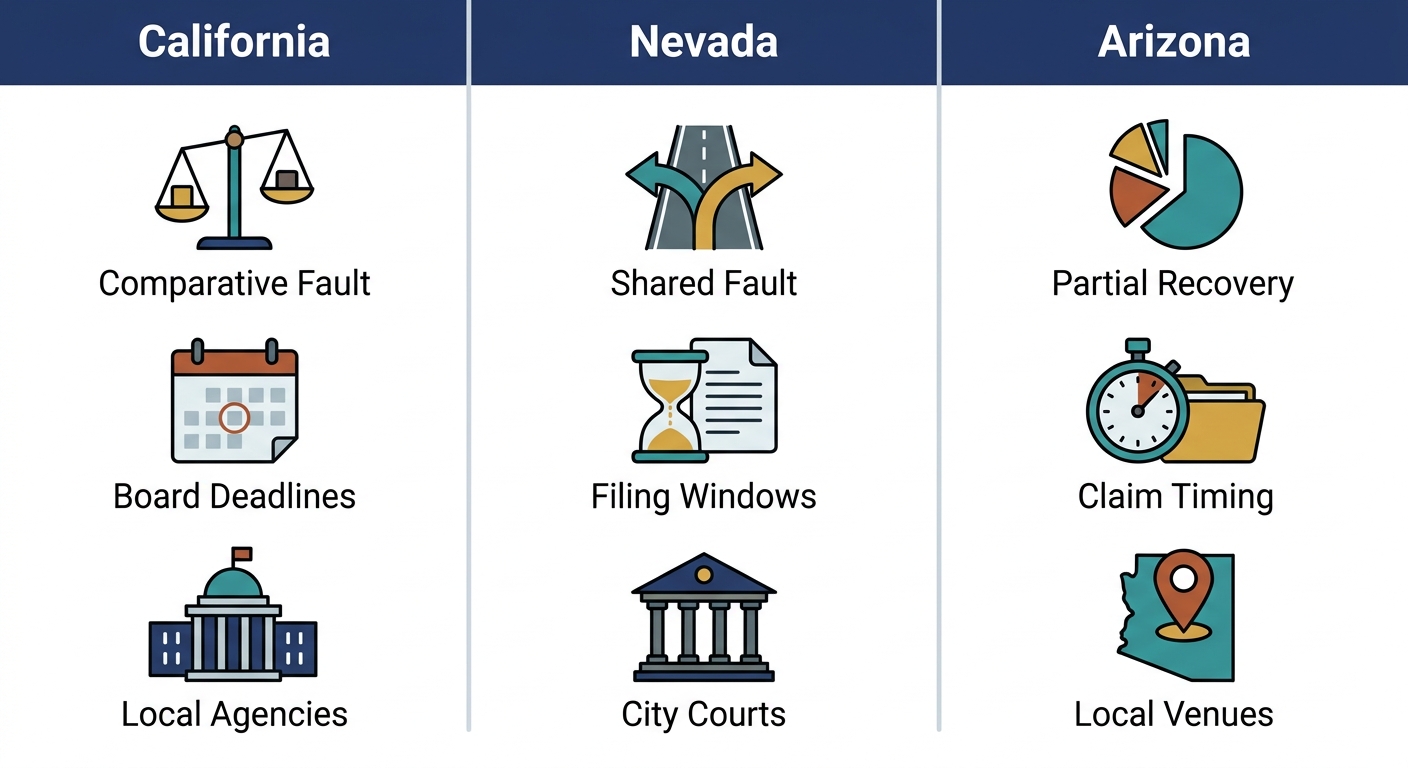
Most states have different rules when it comes to fault and filing deadlines for personal injuries. That said, any personal injury attorney in Nevada or Arizona should make sure they’re up to date on their local laws. The majority of U.S. states practice what’s called “comparative negligence.” Under this legal concept, a plaintiff can be awarded some compensation based upon how much blame goes toward causing his injuries. In other states that don’t follow comparative negligence, if even just 1% of fault rests on the plaintiff, he cannot be awarded anything at all. Maryland, Virginia, Alabama, and North Carolina continue to uphold this archaic standard. But there are occasionally exceptions, such as the “last clear chance” law that allows some compensation.
California’s Victim Compensation Board illustrates how state-specific deadlines work in practice. Under California law (2 CCR § 632.7), victim compensation board claims for death, personal injuries or damage to property must be filed within six months, whereas breach of contract and economic damages claims have only one year to file a claim. Any contract claims that are filed past this limit will not be reviewed by the board.
We do not offer legal advice.
Transparent Fees and Free Consultations
We help you find a local personal injury attorney for a free consultation so you can vet costs before committing. Contingency-fee arrangements mean you typically pay no upfront attorney fee; the lawyer is paid only if you recover compensation, and the exact percentage and terms are set in a written agreement you should review carefully.
Most U.S. jurisdictions use comparative negligence, which allows recovery proportional to fault, making contingency representation more predictable in those states. In contrast, strict-doctrine states like Maryland, Virginia, Alabama, and North Carolina bar recovery if you share any fault, which can influence whether a lawyer will take your case on contingency.
Question how your case would be paid for, filing fees, copying, experts etc., if there was no recovery on your behalf, and make sure they put these provisions in writing. The fact that we can get you in touch with any lawyer doesn’t mean that a lawyer-client relationship has been established. This remains solely within the domain of the lawyer that you actually select and deal with personally.
Warning Signs When Evaluating Attorneys
Opaque fee structures are just one red flag. We encourage readers to also watch for pressure tactics, vague explanations of state fault rules, and poor communication during initial consultations. An attorney’s grasp of your state’s negligence doctrine matters because jurisdictions like California, Nevada, and Arizona apply different rules—some comparative, others strict. Evaluating these factors carefully helps you choose counsel aligned with your needs and local legal landscape.
Evaluating personal injury attorneys in California, Nevada, and Arizona requires careful attention to how they explain fault rules and handle your questions.
Questions to Ask During Your Free Consultation
You may want to find out what the filing period is that you have for your case from your attorney. Under California law, claims regarding personal injuries and property damage must be filed within six months when presented to the board. All other contract and economic-damage claims carry a one-year window.
- Ask how fees and case costs are charged and when they are owed
- Ask who at the firm will handle the case day to day and how you will receive updates
- Ask what the realistic timeline and next steps are after the consultation
- Ask whether the firm has experience with claims subject to strict deadlines like those enforced by the California Victim Compensation Board
Keeping this in mind from the beginning will help you protect your claim and be aware of what’s going to happen next.
What Personal Injury Representation Costs
Most local personal injury lawyers work on a contingency-fee basis for their services. Most customers do not need to make payments towards attorney fees at first. Instead, fees are paid only if money is recovered when your case settles or after a court award. That method lets injured people pursue claims without financial risk. We have an attorney directory that offers totally free preliminary consultations, giving you a chance to discuss your case and fee structure before committing.
Costs for hiring a personal injury lawyer can vary by location and state law, so always confirm fee terms directly with the lawyer you contact. InjuryNation does not offer legal advice and we do not endorse any single legal representative.
Local Considerations: Las Vegas, Phoenix, San Diego, and Irvine
Where you are injured matters because where you injure yourself, in large part, controls the rules governing whether you get any money at all. In Arizona and Nevada, the laws provide for what’s called “comparative negligence.” This means fault can be shared proportionally, so even if you bear some responsibility, you may still recover damages. California also follows the theory of “comparative negligence,” but the problem arises when you’re dealing with claims against state or local government agencies such as the California Victim Compensation Board. If this applies to you, you have six months from the date of injury or loss to file your claim, so check up on the timeline. Those searching for personal injury lawyers in Las Vegas should confirm current timelines with local courts, as state and city rules can shift.
Phoenix matters since each state sets up its own fault system and filing rules. If a crash happens in Phoenix, then that would follow AZ’s comparative rules, but if there was another crash in San Diego or Irvine, that would be decided based upon CA law. You should always call the state or check with a licensed attorney in Phoenix to find out the statute of limitations and required process. You don’t want to rely on some old information that may not work anymore for your case.
Your Attorney Selection Checklist
This list should be used if you’re meeting with attorneys to determine which injury lawyer to keep. Ask if he is licensed in the state where your accident took place and confirm his fee structure at the consultation. Also inquire about his familiarity with local courts.
Use this list together with the Claim Range Estimator in order to provide reasonable expectations for your customer.
Frequently Asked Questions About Multi-State Injury Claims
multi-state injury claims could raise issues since fault laws and filing deadlines vary from state to state. One accident can cause differing results in different states as a result, therefore if you want to make your way toward the court, it’s necessary that you’re acquainted with these differences prior to going through this process.
Could there be variations in state fault laws based on the location where an accident happens as well as if someone claims compensation for more than one state? Do fault rules differ between states, and how does that affect a claim spanning multiple states?
Yes. Most states utilize comparative fault as their rule for awarding compensation that may be apportioned in proportion to each party’s blame. On the other hand, only four states, Maryland, Virginia, Alabama, and North Carolina, adhere strictly to the contributory negligence system, which bars any relief from those parties who suffer some fault at all. Therefore, the same injury can result in compensation under certain circumstances while under others a person will have no recourse to recovery whatsoever.
If you have been injured in more than one state, what kind of deadline for filing my personal injury claim applies. What filing deadlines might apply if my injury claim involves more than one state?
Deadlines vary by state and by claim type. In the case of California, the Victim Compensation Board requires claims involving death or personal injury to be filed within six months. Contract and economic damage claims must be filed within one year. These timelines underscore why consulting a local attorney is critical to avoid missing your window.
Always confirm the rules that apply in your state with a qualified attorney. This is general information, not legal advice, and outcomes depend on the specifics of your situation.
Frequently Asked Questions About Multi-State Injury Claims
Can I hire one personal injury attorney for accidents involving multiple states?
Yes. Injury Nation’s directory includes attorneys licensed in multiple states who can handle claims across jurisdictions. Confirm each attorney’s active licensure in the relevant states before hiring them.
How do different state laws in California, Nevada, and Arizona affect my personal injury claim?
California, Nevada, and Arizona all use comparative negligence, allowing recovery proportional to fault. Only Maryland, Virginia, Alabama, and North Carolina use contributory negligence, which bars recovery if you share any fault.
What should I look for when choosing a personal injury attorney that practices in multiple states?
Verify the attorney is licensed in each state where your claim arises and confirm their experience with that state’s fault rules and filing deadlines. Ask about their fee structure and who will handle your case day to day.
Are there specific statute of limitations differences for personal injury cases in California, Nevada, and Arizona?
California’s Victim Compensation Board requires claims for personal injuries to be filed within six months, while contract and economic damage claims have a one-year deadline. Nevada and Arizona generally impose a two-year statute of limitations for personal injury claims.
How does working with a multi-state law firm impact the settlement process for my injury claim?
A multi-state firm can coordinate filings and deadlines across jurisdictions but does not guarantee faster or larger settlements. Settlement timelines depend on case specifics, evidence, and local court procedures.
Start Your Attorney Search with Injury Nation
Find personal injury attorneys in California, Nevada, and Arizona and explore Local Guides to connect with local counsel. Begin your search today with personal injury attorney free consultation options.
Information on this site is for advertising/informational purposes only and is not legal advice.