Table of Contents
- Find Injury Attorneys in Missouri, Nebraska, and Colorado
- How Much Does It Cost to Hire a Personal Injury Lawyer in St. Louis?
- How Do Contingency Fee Agreements Work for Personal Injury Cases in Omaha, Nebraska?
- What Does a Colorado Springs Personal Injury Lawyer Cost If I Don’t Win My Case?
- What Steps Should I Take Immediately After an Accident in St. Louis to Protect My Legal Rights?
- What Should I Ask During a Free Consultation with a Personal Injury Lawyer in Omaha?
- When Should I Contact a Colorado Springs Personal Injury Lawyer After an Accident?
- What Is the Statute of Limitations for Filing a Personal Injury Claim in St. Louis, Missouri?
- What Is the Deadline for Filing a Lawsuit for a Motor Vehicle Accident in Colorado Springs?
- How Do Filing Deadlines Differ Between Missouri, Nebraska, and Colorado?
- How Long Does It Typically Take to Resolve a Personal Injury Case in Douglas County?
- How Do Comparative Fault Rules in Missouri and Nebraska Affect My Settlement?
- What Should I Look for in an Attorney Profile When Comparing Lawyers Across State Lines?
- Still Have Questions About Finding an Injury Attorney?
Find Injury Attorneys in Missouri, Nebraska, and Colorado
Our nationwide directory will help you find injury attorneys in Missouri, Nebraska, and Colorado, and connect you to local personal injury lawyers working out of cities like St. Louis, Omaha, and Colorado Springs. This site does not provide legal advice or recommendations for any lawyer. Using our site doesn’t create a lawyer-client relationship either. We only list names and information about various attorneys so you may locate qualified counsel located near where you live.
State specific information regarding deadlines tends to get complicated. In Colorado, for instance, general personal injury claims must generally be filed within two years, while motor vehicle accident claims carry a three-year deadline. The other big issue is how much it’s going to cost if you have to hire a personal injury attorney whether you’re hiring a personal injury lawyer in St. Louis, Omaha, or Colorado Springs.
Key Takeaways
- Most injury lawyers working out of St Louis work on a contingency-fee basis, meaning you pay attorney fees only if your case succeeds.
- If you happen to lose the lawsuit under the contingency plan, your personal injury lawyer in Colorado Springs typically won’t charge any attorney fee for their services.
- Get medical treatment immediately, even if it’s just some bumps and bruises.
- A personal injury attorney free consultation is your chance to evaluate whether a lawyer is the right fit for your case.
- It is suggested that you reach out to a personal injury lawyer in Colorado Springs as early as possible after an accident.
How Much Does It Cost to Hire a Personal Injury Lawyer in St. Louis?
Most injury lawyers working out of St Louis work on a contingency-fee basis, meaning you pay attorney fees only if your case succeeds. If your claim wins, they get paid. That structure lets injured people pursue claims without upfront costs.
Before you hire a personal injury lawyer in St. Louis, ask to review the written fee agreement. Find out how the fee percentage is set, whether case expenses — such as filing fees and expert costs — will be deducted, and when payment is due. In Missouri, as in Nebraska, rules require attorney fees to be reasonable and documented in a signed agreement detailing the percentage breakdown and how expenses are handled.
Attorney Advertising
How Do Contingency Fee Agreements Work for Personal Injury Cases in Omaha, Nebraska?
In other words, when you’re dealing with a personal injury lawyer in Omaha, Nebraska on a contingency fee basis, they only get paid if you recover money, taking a set percentage of the settlement or award, and you typically owe nothing upfront. In order for this arrangement to be legal under Rule of Professional Conduct § 3-501.5 of Nebraska law, the contingency agreement must be in writing, signed by you, and clearly state the percentage and how case costs will be handled.
Before hiring a personal injury attorney free consultation, review the agreement to confirm fee terms and cost responsibilities. We do not offer legal advice.
What Does a Colorado Springs Personal Injury Lawyer Cost If I Don’t Win My Case?
If you happen to lose the lawsuit under the contingency plan, your personal injury lawyer in Colorado Springs typically won’t charge any attorney fee for their services. The other expenses such as expert testimony charges or filing costs might apply based upon your fee contract signed during that process. personal injury lawyer in Colorado Springs
In terms of professional conduct, contingency contracts should always be recorded on paper as signed, written agreements that clearly state how costs are handled and the percentage charged if you recover compensation. It’s also important to go over these papers in great detail and request a breakdown of each charge prior to signing it.
Make sure you get all this information from a personal injury attorney free consultation with your lawyer if you’re considering hiring anyone off our site.
What Steps Should I Take Immediately After an Accident in St. Louis to Protect My Legal Rights?
Get medical treatment immediately, even if it’s just some bumps and bruises. Medical records will document what happened during the incident, which means they might come in handy when filing a personal injury claim down the road. Take pictures of the scene, write down names and numbers of witnesses, and take notes about the date and time that the crash occurred. Do not give a recorded statement to anyone at an insurance company until you understand your rights, as these can be used against you later. Under Missouri law, you usually have up to five years from the date of the incident before filing a personal injury case pursuant to Mo. Rev. Stat. § 516.120. To preserve this amount of time, filing a petition and issuing a summons halts the limitations period even if service occurs later in good faith. Acting early is therefore critical.
Now that you’ve taken these steps and understand your deadlines, consider speaking with a personal injury attorney in St. Louis to discuss next steps tailored to your situation. It is important to understand though that any information presented on this website is not intended as legal guidance. Also, using our site doesn’t mean we are now your lawyer.
What Should I Ask During a Free Consultation with a Personal Injury Lawyer in Omaha
A personal injury attorney free consultation is your chance to evaluate whether a lawyer is the right fit for your case. Come prepared with questions about fees and representation.
- Ask how fees are structured and whether the agreement will be put in writing — Nebraska’s professional conduct rules require contingency agreements to be signed by you and include a detailed breakdown of the percentage and expenses.
- Request an itemized accounting of costs and charges; you have the right to receive this at no cost under Nebraska’s rules.
- Inquire about the lawyer’s experience with similar injury claims in Nebraska and who at the firm will handle your case day to day.
- Bring accident reports, medical records, photos, and insurer correspondence to make the most of your time.
Use our directory to find a personal injury lawyer in Omaha, as well as injury attorneys in Missouri, Nebraska, and Colorado who can help move your claim forward.
When Should I Contact a Colorado Springs Personal Injury Lawyer After an Accident?
It is suggested that you reach out to a personal injury lawyer in Colorado Springs as early as possible after an accident. The two-year general statute of limitations on most personal injury claims, plus the three-year period applicable to car accidents means waiting lessens the opportunity to properly research, gather information and make any claims before this timeframe closes. With regard to claims against government entities, written notice is required within 182 days, so contacting a personal injury lawyer in Colorado Springs promptly is essential to protect your rights. Certain exceptions, such as tolling for minors or incapacitated individuals, can alter these timelines, which is why confirming the deadline that applies to your specific case with a personal injury lawyer in Colorado Springs is critical.
What Is the Statute of Limitations for Filing a Personal Injury Claim in St. Louis, Missouri?
Missouri law states that there is a time limit in which someone can file a personal injury claim. The statute of limitations for this state is five years according to Mo.Rev.Stat.§516.120. Any case involving physical harm to oneself or another type of action where a contract does not apply falls within this time frame.
Filing a complaint and issuing a summons tolls the statute of limitations even if service occurs later, provided the attempt to serve was made in good faith. There are many exceptions as well as other deadlines that will apply for the statute of limitations depending on each case. You should consult a personal injury attorney in St. Louis to confirm how long you have left until your deadline expires.
What Is the Deadline for Filing a Lawsuit for a Motor Vehicle Accident in Colorado Springs?
In Colorado, you have up to three years to file suit after a car accident in Colorado Springs if your claim stems from a motor vehicle crash. Three years gives motorists more time to bring claims related to the use of automobiles, whereas most personal injury cases in this state last only two years from the day that the injury occurred.
Should there be any governmental entities implicated in your case, make sure to provide a written statement of the claim within 182 days from when you discovered your injury. Certain exceptions, such as tolling for minors or incapacitated individuals, may pause the filing clock. Make sure you check with a personal injury lawyer in Colorado Springs if you believe any governmental entities might be at fault. Confirm the timeline that applies to your situation with that personal injury lawyer to avoid missing your window for pursuing compensation.
How Do Filing Deadlines Differ Between Missouri, Nebraska, and Colorado?
Missouri gives a person five years to sue for a personal injury per Mo. Rev. Stat. § 516.120. But in Colorado a person’s time limit is usually two years, except when a car accident happens. Then, Colorado will give a person until the third year. That means that if the same type of injury occurs in different states, there could be quite big gaps between being able to start legal action against someone responsible.
Because Nebraska’s rules aren’t covered below you should consult your state’s statute of limitations with an experienced attorney there. We link those that have been hurt with qualified Missouri, Nebraska or Colorado personal injury attorneys who can verify deadlines and protect their rights.
How Long Does It Typically Take to Resolve a Personal Injury Case in Douglas County?
In Douglas County there isn’t much consistency in the amount of time these cases may take when handling these types of cases. Meeting the deadline under Nebraska’s laws does not mean you have resolved any issues with the other party. Some timing factors may include how long treatment for your injuries takes, how quickly the investigation can be completed, and whether the case settles through negotiation or proceeds to litigation. Then a decision must be reached about whether the matter will conclude through negotiation or by a trial before a judge or jury.
We take you step-by-step along the way and will help get you hooked up to an experienced personal injury lawyer in Omaha who can provide a case-specific estimate based on your unique circumstances.
How Do Comparative Fault Rules in Missouri and Nebraska Affect My Settlement?
Nebraska’s modified comparative fault rule under Neb. Rev. Stat. sec. 25-21,185.09 reduces your recovery if you’re found 49 percent or less at fault, but bars it entirely at 50 percent or more. For example, a $180,000 claim drops to $91,800 at 49 percent fault, while 50 percent fault wipes out recovery. Insurance adjusters may assign inflated fault percentages as negotiating tactics, but fault is ultimately decided by a jury—so these positions aren’t final. Because fault rules vary by state, comparing outcomes across Missouri, Nebraska, and Colorado requires confirming how each state’s specific framework applies to your case. Consult a personal injury lawyer in Omaha, a personal injury lawyer in St. Louis, or a personal injury lawyer in Colorado Springs to clarify the local nuances and help protect your recovery.
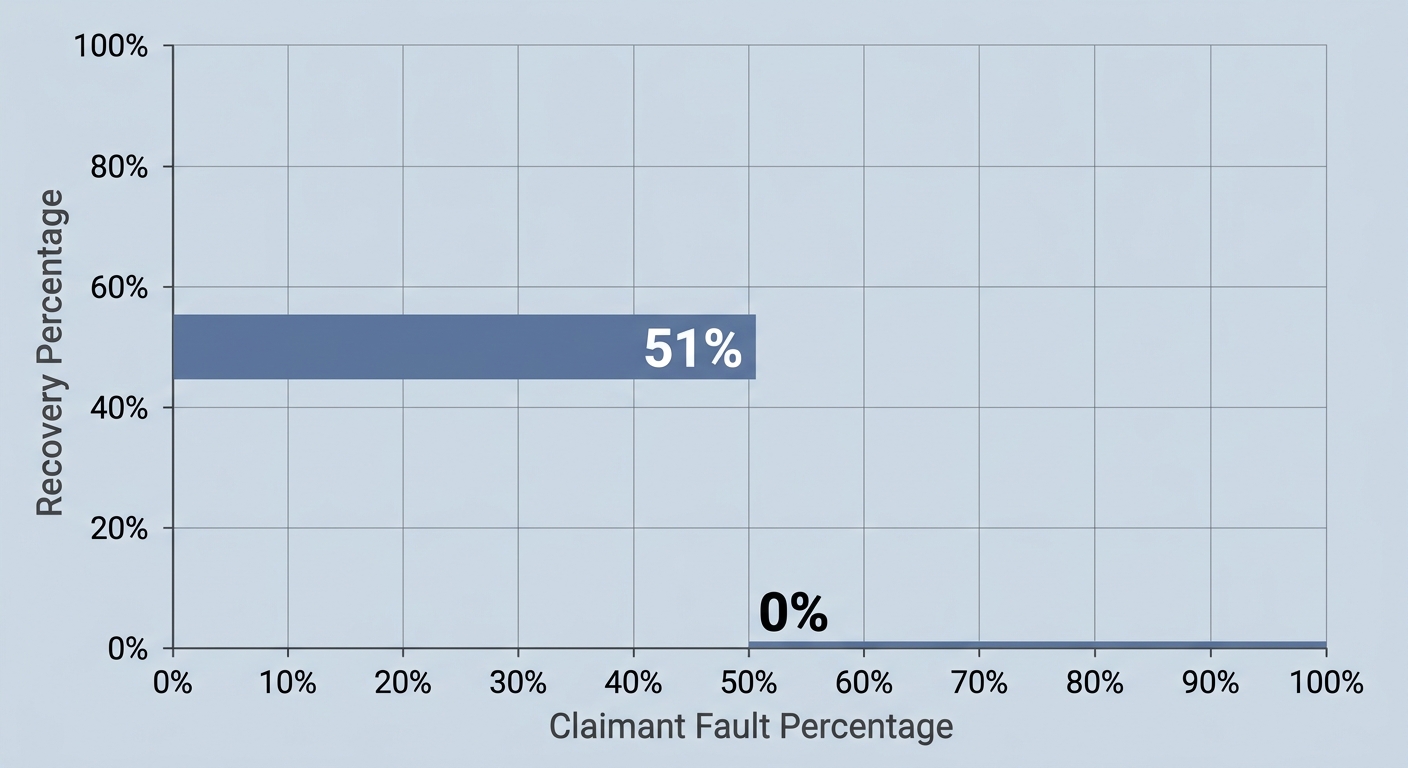
Horizontal bar chart comparing Nebraska modified comparative fault rule: claimant at 49 percent fault recovers 51 percent, at 50 percent fault recovers zero percent
What Should I Look for in an Attorney Profile When Comparing Lawyers Across State Lines?
When you’re looking at the injury attorneys in Missouri, Nebraska, or Colorado, make sure they have a license to practice in all of the places your case needs them to. Be aware if their profile says anything about how they get paid up front, and look for written contingent-fee agreements that detail percentage breakdowns and expenses, per Neb. R. Prof’l Cond. 3-501.5. Also ask for a no-cost itemized accounting of hourly charges, costs, interest, and balances, a right the rule affords clients. Make sure if they are dividing fees up between firms located out-of-state that it shows what portion was earned from their firm vs. Other parties’ firm(s), who were jointly responsible, and whether or not the client gave his/her informed consent for it. Bear in mind these profiles and directories aren’t endorsements for attorneys and don’t establish an attorney-client relationship.
Frequently Asked Questions
How do I find reputable injury attorneys across multiple states like Missouri Nebraska and Colorado?
Injury Nation’s national directory lets you search and compare personal injury attorneys by location and practice area across Missouri, Nebraska, and Colorado. You can filter results by city, claim type, and verified bar licenses to identify qualified counsel.
What are the benefits of using a legal directory to compare injury attorneys in different states?
A legal directory provides side-by-side attorney profiles, verified practice areas, client reviews, and clear fee disclosures. It also shows whether attorneys are licensed and in good standing with state licensing bodies, helping you make an informed choice.
How does the statute of limitations for personal injury claims differ between Missouri Nebraska and Colorado?
Missouri allows five years to file a personal injury claim, while Nebraska generally allows four years. Colorado sets a two-year deadline for most claims and a three-year window for motor vehicle accidents.
Can a national legal directory help me identify attorneys with specific experience in multi-state accident cases?
Yes. Injury Nation’s directory aggregates attorney profiles and practice areas, allowing you to filter for attorneys experienced in multi-state or out-of-state accident cases by reviewing their listed locations and verified credentials.
What should I look for in an attorney’s profile when searching for legal representation in different regions?
Check for active bar licenses in the relevant states, clear fee structures including written contingency agreements, and any disciplinary history. Look for itemized accounting rights and fee division details if multiple firms are involved.
Still Have Questions About Finding an Injury Attorney?
Even after comparing profiles, it’s normal to still have questions. State laws differ—Missouri’s five-year filing deadline contrasts with Nebraska’s 50 percent fault bar, so confirming deadlines and fault rules with a lawyer is key.
Use our nationwide directory and local guides to find personal injury lawyers near you in Missouri, Nebraska, and Colorado.
Information on this site is for advertising/informational purposes only and is not legal advice. No attorney–client relationship is formed by using this site or contacting a listed lawyer via this site. Results are not guaranteed; past outcomes do not predict future results. Some listings are paid advertising or lead-generation placements, and any such payments are advertising fees only. Each lawyer is responsible for the accuracy of their profile and for complying with applicable ethics rules.