Table of Contents
Finding Personal Injury Attorneys in Alabama and Florida
Alabama personal injury lawyers, Florida injury lawyers: It all begins with realizing that different laws govern what happens after you’ve been injured by someone else’s actions. Alabama and Florida approach these issues such as fault and insurance claims differently than other states, so the lawyer you choose can make or break how much you’ll get in compensation for whatever damages were incurred. personal injury attorneys in Alabama and Florida
Alabama’s strict contributory negligence standard bars recovery entirely if you bear any fault, while Florida’s insurance-related requirements can influence eligibility for benefits even for non-residents who keep a vehicle in the state. These differences make local legal knowledge essential when pursuing compensation. A personal injury lawyer in Birmingham or Huntsville can help you navigate Alabama’s strict contributory negligence rules, and a personal injury lawyer in Jacksonville or Tallahassee can assist with Florida’s insurance-related requirements.
Our nationwide directory allows you to find qualified personal injury lawyers in Tallahassee, connecting you with attorneys who understand the nuances of your state’s system and offer free consultations to discuss your case.
Key Takeaways
- If you have a personal injury claim that stretches across multiple states, the location of your lawyer can play a key role in how he handles the case.
- Alabama and Florida have different statutes of limitations that will affect your ability to pursue a personal injury claim.
- Contributory negligence is another “strict” common law principle that operates as a bar on recovery where a plaintiff is found to have even the tiniest fraction of the blame for his injury.
- Although we’re a directory, we don’t endorse any lawyer or recommend them.
- After finding clues that give a warning signal about a lawyer’s tactics, the free consultation becomes your chance to evaluate fit.
Cross-State Representation and Attorney Location
If you have a personal injury claim that stretches across multiple states, the location of your lawyer can play a key role in how he handles the case. Personal injury attorneys in Alabama and Florida often handle claims spanning state borders, but their ability to represent you effectively depends on where they are licensed and where the incident occurred.
FLORIDA’S NON RESIDENT PIP RULES ARE CLEAR ON WHEN OUT OF STATE DRIVERS MUST COMPLY WITH FLORIDA INSURANCE REQUIREMENTS. UNDER FLDHS CODE RULING 69O-176.008, IF A NON-RESIDENT KEEPS A CAR IN THE STATE FOR MORE THAN 90 DAYS WITHIN A 365 DAY PERIOD, IS EMPLOYED IN FLORIDA, OR ENROLLS A CHILD IN PUBLIC SCHOOL THERE, THEY ARE SUBJECT TO FLORIDA’S PIP COVERAGE REQUIREMENTS. WITHOUT COMPLIANT CAR SECURITY, NON RESIDENTS GENERALLY CANNOT RECEIVE FLORIDA PIP BENEFITS OR TORT EXEMPTIONS, THOUGH EXCEPTIONS EXIST IF INJURED IN A COVERED VEHICLE.
Attorney Advertising
You should confirm your circumstances with a licensed local lawyer in a consultation before moving forward to ensure your claim aligns with state-specific rules.
Filing Deadlines in Alabama and Florida
Alabama and Florida have different statutes of limitations that will affect your ability to pursue a personal injury claim. This means the window to file a lawsuit differs depending on where your claim arises. As such, it is imperative to consult an attorney familiar with this law in the area in which your incident occurred.
Failing to file on time can permanently bar your claim, regardless of its merits. Because state laws like these shape every aspect of a case, it’s essential to confirm the exact deadline that applies to your situation. State laws dictate when everything must be done, so make sure what those deadlines mean for your case by checking with the court clerk or hiring a local attorney who is licensed to practice law where your case was filed.
We do not offer legal advice, and using our directory to find a personal injury attorney in Alabama or Florida does not create an attorney–client relationship. These deadline pressures are only one layer of how state law governs claims; the way fault is assigned under doctrines like Alabama’s strict contributory negligence rules also sharply affects recovery potential.
Negligence Rules and How Fault Affects Recovery
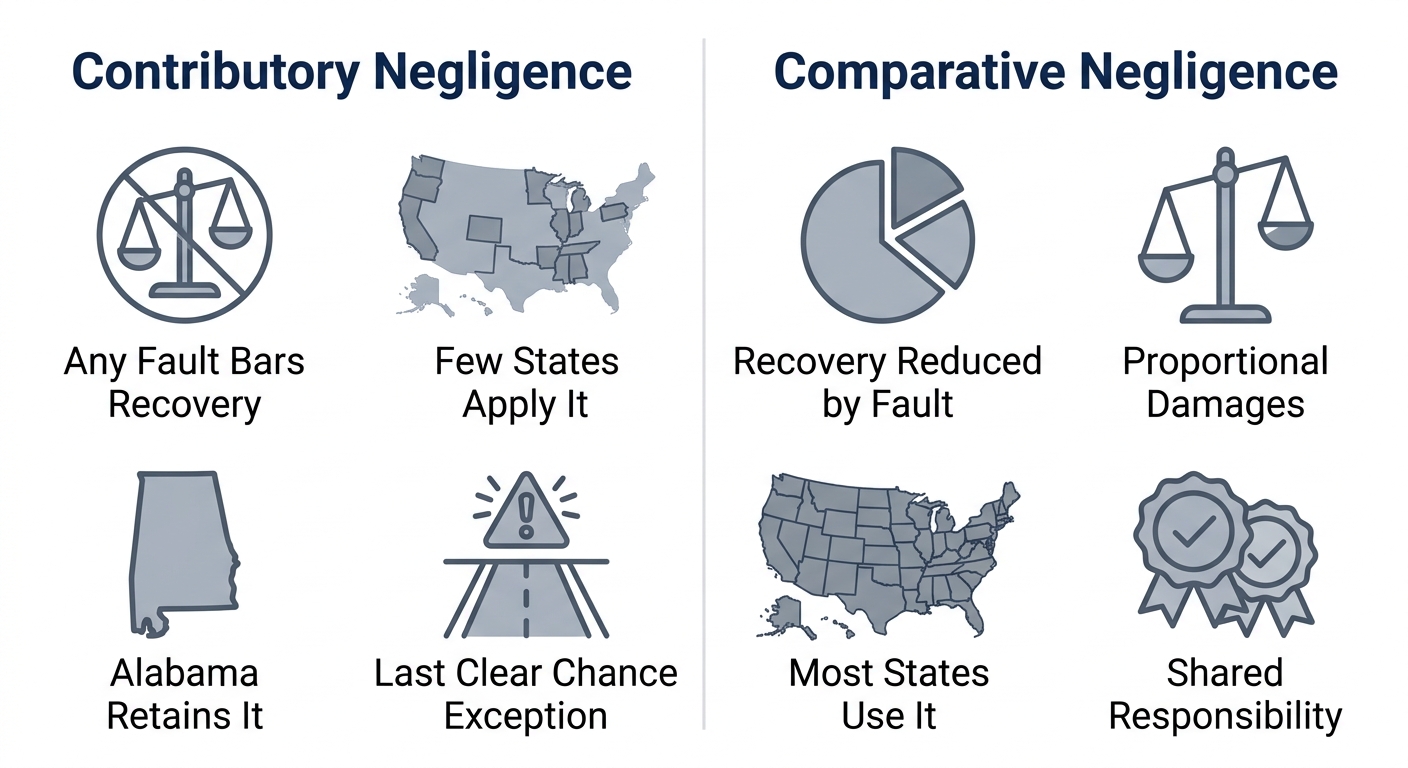
Contributory negligence is another “strict” common law principle that operates as a bar on recovery where a plaintiff is found to have even the tiniest fraction of the blame for his injury. Per Cornell Law School’s Legal Information Institute, this all-or-nothing rule historically prevents courts from apportioning blame and can produce inequitable outcomes.
In most U.S. states, courts have switched to comparative negligence, where a plaintiff’s recovery is reduced by the portion of blame they bear. So if you were 5% at fault, then you’re able to collect back 95% of the damages because the defendant was more responsible for this problem.
There is, however, an exception: the last clear chance doctrine may still allow recovery when the defendant had the final opportunity to prevent the harm despite the plaintiff’s prior negligence.
Because fault rules vary sharply by state, experienced personal injury attorneys in Alabama and Florida understand how these doctrines shape recovery strategies for claimants.
Red Flags When Evaluating Attorneys
Although we’re a directory, we don’t endorse any lawyer or recommend them. It may be worthwhile looking out for vague promises about fees or a lawyer that does not seem willing to explain in detail how state fault rules like Alabama’s strict contributory negligence would impact on a client’s potential recovery. A willingness to clarify these points is more likely indicative that they will act competently on behalf of a client.
To make sure they have a good handle on things, ask some basic questions about your local negligence laws when you’re looking into booking a free consultation.
Questions to Ask During a Free Consultation
After finding clues that give a warning signal about a lawyer’s tactics, the free consultation becomes your chance to evaluate fit. As such, when looking at personal injury attorneys in Alabama and Florida, consultation questions help you clarify how the firm handles out-of-state or non-resident issues after a Florida crash.
- Who will be handling my case day-to-day, and how often will I receive updates?
- What experience does the firm have with accidents like mine and the local courts where my case may be filed?
- How do you communicate with clients, and what response times can I expect?
- What are the next steps if we decide to move forward, and what timeline should I expect?
- How does your fee structure work, and are there any upfront costs I should know about?
It’s also the time for you to ask yourself if this is the lawyer that you want on your side when the time comes. Asking yourself these questions will help you decide, but there should be no pressure.
Contingency Fees and Case Costs
In personal injury cases, lawyers may offer contingency fees which means that their client pays the lawyer only when they win the lawsuit, usually out of a check for money won in court or from settlements instead of upfront bills. Case-related costs, such as court filing fees, or requests made in writing are usually separate expenses from the legal services that would have been paid regardless. What happens with those can vary based on circumstances; talk to your attorney about how you will pay him to cover all possible costs associated with the lawsuit.
Because fee rules and insurance frameworks can differ by state, your free consultation can help you learn what to expect.
Local Considerations Across Birmingham, Huntsville, Jacksonville, and Tallahassee
The city where an injury occurs shapes the legal path forward, which is why choosing local counsel matters. In Birmingham and Huntsville, Alabama applies a strict contributory negligence rule: if a plaintiff is found even 1% at fault, recovery is barred entirely, though the last clear chance exception can still allow recovery when the defendant had the final opportunity to prevent harm. By contrast, Florida’s no-fault system in Jacksonville and Tallahassee requires Personal Injury Protection (PIP) coverage for residents and non-residents who maintain a vehicle in the state for more than 90 days or meet employment or public school enrollment criteria; otherwise, non-residents generally cannot access PIP benefits or tort exemptions. These differences underscore why personal injury attorneys in Alabama and Florida must be deeply familiar with their state’s doctrines to navigate claims effectively.
Your Attorney Comparison Checklist
We suggest checking these key points when comparing personal injury attorneys in Alabama and Florida:
- Experience handling injury claims in your state’s courts
- Clear fee structure and transparency about costs upfront
- Responsiveness and clarity in initial communications
- Familiarity with local judges, court procedures, and opposing counsel
- Client reviews and outcomes for similar cases in your area
Using our directory will assist you in connecting with qualified lawyers. No attorney-client relationship will be created, and this service does not guarantee any specific outcome.
Frequently Asked Questions About Alabama and Florida Injury Claims
A lot of readers who compare injury lawsuits from Alabama and Florida want answers to these basic questions about how rules for each state impact personal injury cases.
Why does being partly at fault matter more in Alabama than in most states?
Alabama has contributory negligence, which is one of the strictest doctrines in the U.S. So if the court determines that you were only 1% negligent, you may recover nothing, even if the other side was 99% at fault. Alabama shares this rule only with Maryland, Virginia, and North Carolina.
Do out-of-state drivers need Florida PIP coverage?
Non-residents must carry Florida PIP if they keep a vehicle in the state for more than 90 days within a 365-day period or if they work or enroll children in public school there.
Can a non-resident injured in Florida collect PIP benefits?
Non-residents usually can’t get PIP benefits from Florida unless that non-resident was in someone else’s car when he got hurt, and that other person had the insurance on his or her car.
If you need help finding local listings, we invite you to browse our directory of personal injury attorneys in Alabama and Florida.
Frequently Asked Questions About Personal Injury Claims in Alabama and Florida
How do personal injury laws differ between Alabama and Florida?
Alabama follows contributory negligence, which bars recovery if you are even 1% at fault. Florida uses comparative negligence, reducing compensation by your share of fault. Alabama also lacks Florida’s no-fault insurance system and PIP coverage requirements.
Can I hire a personal injury attorney to represent me if my accident occurred in a different state?
Yes, personal injury attorneys in Alabama and Florida can handle claims from other states if they are licensed in the state where the claim arises. Their ability depends on where the incident occurred and their own licensing.
What is the statute of limitations for personal injury claims in Alabama versus Florida?
Alabama’s statute of limitations for personal injury claims is two years. Florida also has a two-year deadline for most personal injury claims, though property damage claims have a four-year limit. These deadlines determine when a lawsuit must be filed.
How does comparative negligence affect my compensation in Alabama and Florida?
In Florida, compensation is reduced by your percentage of fault. Alabama’s contributory negligence rule can bar recovery entirely if you are found at fault, even slightly. Florida’s rule allows partial recovery in most cases.
What should I look for when comparing personal injury attorneys across multiple states?
Check their experience with local courts and state laws, fee structures, responsiveness, and client reviews. Confirm they handle cases in the state where your claim arises and understand its specific negligence rules.
Find Personal Injury Lawyers Near You
Browse our nationwide directory to connect with personal injury attorneys in Alabama and Florida serving your city. Listings include paid advertising placements where applicable. Alabama’s strict contributory negligence rule makes choosing a local lawyer especially important, so start your search today.