

Why Understanding Rear-End Collision Claims Matters
A rear end collision lawyer is a personal injury attorney who specializes in helping victims of rear-impact crashes recover compensation. These lawyers understand the challenges of proving fault, dealing with insurance companies, and calculating fair settlements for accidents that are often more serious than they first appear.
Quick answers for rear-end collision victims:
- Who’s usually at fault? The rear driver is presumed at fault, but this can be challenged.
- What can you recover? Medical bills, lost wages, pain and suffering, and property damage.
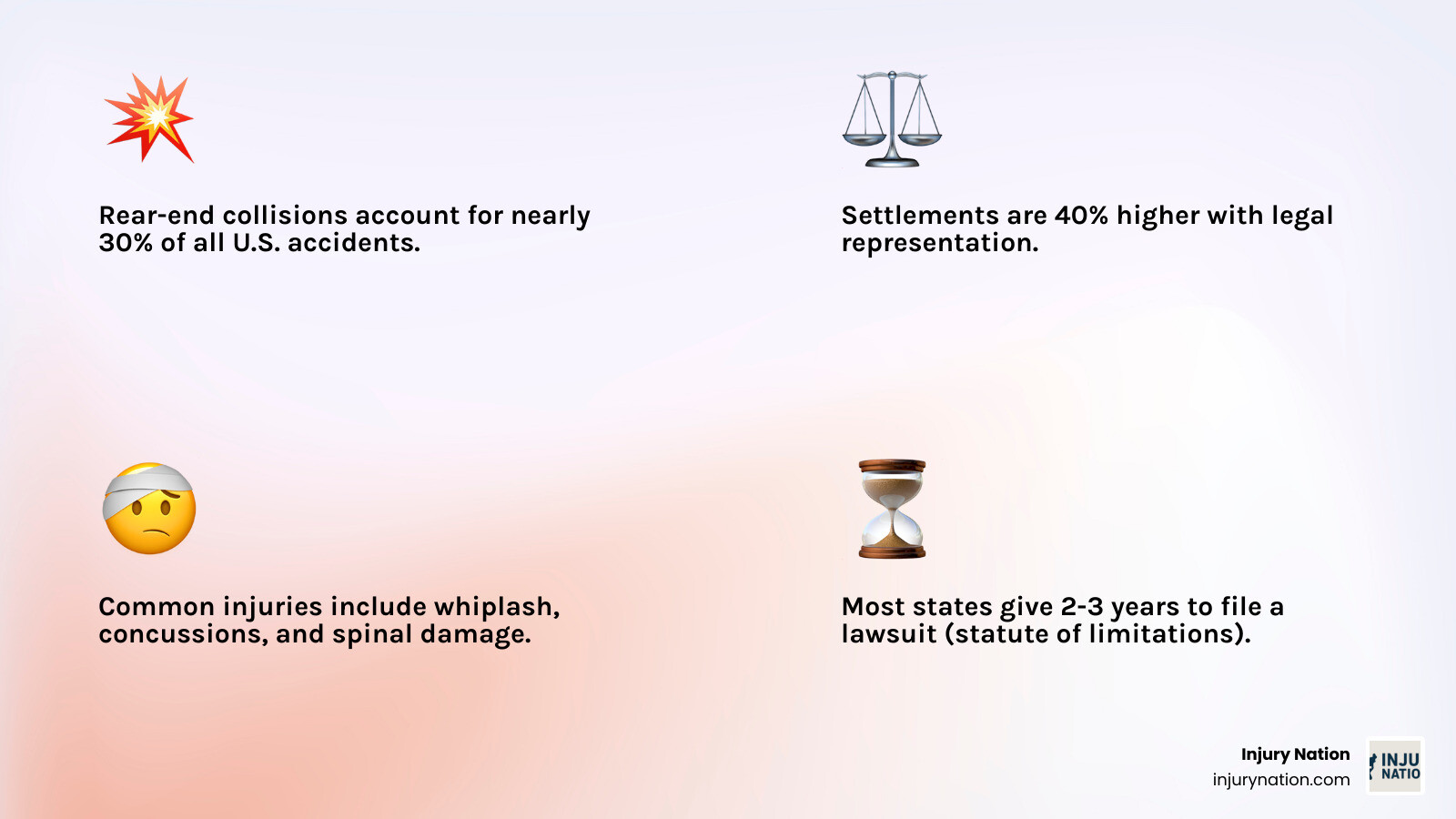
- Do you need a lawyer? Yes – studies show settlements are 40% higher with legal representation.
- How long do you have? Most states give you 2-3 years to file a lawsuit.
- What does it cost? Most rear-end collision lawyers work on contingency (no fees unless you win).
Rear-end collisions are common, accounting for nearly 30% of all accidents in the United States and 21% of all crashes in Canada. While these accidents seem straightforward, determining fault can be complex, especially when dealing with insurance companies focused on minimizing payouts.
Even minor rear-end crashes can cause serious injuries like whiplash or concussions with delayed symptoms. The moments after an accident are overwhelming, with pain, stress, and pressure from insurance adjusters. An experienced rear end collision lawyer levels the playing field and protects your rights.
Rear end collision lawyer further reading:
Understanding Fault in a Rear-End Collision
After being rear-ended, the main question is, “Who’s going to pay for this?” While the answer seems obvious, fault determination is more complex than most people realize.
The rear driver is usually presumed at fault. This is a general rule based on the principle that drivers must maintain a safe following distance and be prepared to stop. In many jurisdictions, this presumption is quite strong.
However, this is a rebuttable presumption, meaning the rear driver can present evidence to prove they were not at fault, or at least not entirely responsible. Every driver has a duty to control their vehicle. Nevada’s law (NRS 484B.127) requires “reasonable and prudent” space between vehicles. Failing this duty is often considered negligence.
Proving negligence means showing the at-fault driver breached their duty of care, directly causing your injuries. A rear end collision lawyer is crucial for building this case.

Common Causes of Rear-End Accidents
Making up nearly 30% of all U.S. accidents, most rear-end crashes are preventable. The primary causes include:
- Distracted driving: Texting, talking on the phone, or any other activity that takes attention off the road is a leading cause. Texting is a “triple threat,” taking your eyes, hands, and mind off driving.
- Tailgating: Following too closely eliminates the reaction time needed to stop safely.
- Speeding: Higher speeds require longer stopping distances and reduce reaction time.
- Impaired driving: Alcohol or drugs severely impact judgment, coordination, and reflexes.
- Driver fatigue: Drowsy driving can be as dangerous as drunk driving.
- Bad weather: Rain, snow, or fog require drivers to adjust their speed and following distance, but not everyone does.
Exceptions: When the Front Driver Can Be At Fault
While the rear driver is usually blamed, there are exceptions where the front driver may be partially or fully at fault:
- Sudden braking without cause: If a driver slams on their brakes for no reason, they may be held responsible.
- Reversing into a car: A driver who backs into the vehicle behind them is typically 100% at fault.
- Broken brake lights: If a trailing driver has no warning that the car ahead is slowing, the front driver may be liable.
- Unsafe lane changes: Cutting into traffic without enough space can make the lane-changing driver responsible.
- Stopping in a travel lane: Stopping in live traffic without hazard lights or an emergency justification creates a hazard.
- Multi-car pile-ups: These are complex, and each impact requires individual investigation to determine fault.
How to Prove You Weren’t At Fault
Overcoming the presumption of fault requires solid evidence. An experienced rear end collision lawyer will systematically gather every piece of relevant information.
Key evidence includes:
- Police reports: These provide official documentation, officer observations, and initial statements.
- Eyewitness statements: Neutral third-party accounts can corroborate your version of events.
- Dashcam footage: Video can definitively show what happened, such as sudden braking or malfunctioning lights.
- Accident scene photos: Document all vehicle damage, license plates, the wider scene, road conditions, and traffic signals.
It’s also vital to collect contact information for all parties and witnesses, the police report number, and photos of any visible injuries. Your lawyer will use this evidence to challenge the insurance company’s fault determination rules and protect your interests.
Common Injuries and Potential Compensation
Even a “minor” rear-end collision at just 15 mph can cause serious injuries. The human body isn’t built to handle the sudden forces of a crash, and your car’s minimal damage doesn’t reflect the harm your body may have absorbed.
Delayed injury symptoms are very common. Adrenaline after a crash can mask pain, which may only surface hours or days later. This is why seeking medical attention immediately after any collision is crucial, even if you feel fine. It protects your health and creates a vital paper trail linking your injuries to the accident, which is essential for your claim. Without prompt care, these injuries can lead to chronic pain and long-term health problems.
Types of Injuries from Rear-End Impacts
The jolt of a rear-end crash can cause a range of injuries as your body is thrown forward and back:
- Whiplash: More than just a sore neck, Whiplash Associated Disorders (WAD) can cause pain, headaches, dizziness, and concentration issues.
- Neck and Back Injuries: These can include herniated discs, pinched nerves, and fractures, leading to radiating pain and numbness. For severe cases, a Spinal Cord Injury Lawyer may be needed.
- Soft Tissue Damage: Injuries to muscles, ligaments, and tendons can cause months of pain and stiffness, even if they don’t appear on X-rays.
- Concussions and Traumatic Brain Injuries (TBIs): The violent motion can cause the brain to impact the skull, leading to symptoms like memory problems, headaches, and mood changes. Serious cases require a specialized Brain Injury Lawyer.
- Fractures: Higher-speed collisions can cause broken bones in the face, hands, wrists, and ribs.
- Psychological Trauma: Many victims develop anxiety, PTSD, or depression after a crash. These mental health impacts are real and compensable.
What Compensation Can You Recover?
The law allows you to recover compensation for your financial losses and the non-financial impact on your life.
Economic damages cover your direct financial losses, while non-economic damages compensate for the personal impact.
| Economic Damages | Non-Economic Damages |
|---|---|
| Medical bills (past and future) | Physical pain and suffering |
| Lost income (past and future) | Emotional distress (anxiety, PTSD) |
| Property repair/replacement | Loss of enjoyment of life |
| Rehabilitation and therapy | Disfigurement or scarring |
| Housekeeping/home maintenance costs | Loss of companionship (consortium) |
| Prescription medications | Mental anguish |
A rear end collision lawyer is key to maximizing your compensation. They know how to calculate the true, long-term cost of your injuries, ensuring you don’t accept a quick, lowball offer from the insurance company.
Why You Need a Rear End Collision Lawyer
After a rear-end collision, you face pain, stress, and a legal system that can work against you. Insurance companies are not your friends; their goal is to protect their profits, not to ensure you get fair compensation.
This is why a rear end collision lawyer is essential. They steer complex legal procedures, fault determination rules, and strict statutes of limitations. Studies show that accident victims with legal representation receive settlements that are 40% higher on average than those who handle claims alone.
Most personal injury attorneys work on a contingency fee basis, meaning you pay no legal fees unless they win your case.

Navigating Insurance Company Tactics
Insurance adjusters use trained tactics to minimize payouts. They may request recorded statements to twist your words or make lowball settlement offers before you know the full extent of your injuries. Never give a recorded statement without your lawyer present.
Understanding your state’s negligence laws is also critical. In comparative negligence states like Nevada, your compensation is reduced by your percentage of fault (you can recover as long as you’re less than 50% at fault). In stricter contributory negligence states, being even 1% at fault can bar you from any recovery. A lawyer can use data, like A report from the National Highway Traffic Safety Administration, to fight unfair fault assignments.
How a rear end collision lawyer Builds Your Case
A lawyer acts as your investigator, analyst, and negotiator. They will:
- Investigate the accident: This includes examining police reports, visiting the scene, and finding evidence like traffic camera footage or cell phone records.
- Gather evidence: They collect medical records, wage statements, and repair estimates to document your losses.
- Calculate total damages: They work with medical and financial experts to project future costs and lost earning capacity.
- Negotiate with insurers: Your lawyer handles all communication, countering low offers with compelling evidence and legal arguments.
- File a lawsuit if necessary: Preparing every case for trial sends a strong message to insurers and often motivates them to offer a fair settlement.
While our guide on How to Negotiate a Car Accident Settlement Without a Lawyer explains the challenges, professional representation is almost always the better path.
The Value a rear end collision lawyer Brings to Your Claim
A lawyer provides more than just legal knowledge. They offer:
- Legal Expertise: Deep understanding of traffic laws, injury statutes, and case precedents.
- Higher Settlements: Proven ability to value claims properly and secure more compensation.
- Deadline Management: They ensure all paperwork, including the statute of limitations, is handled correctly.
- Reduced Stress: They take the legal burden off your shoulders so you can focus on recovery.
- Trial Readiness: Their willingness to go to trial gives you leverage in settlement negotiations.
What to Do Immediately After a Rear-End Accident
The moments after a rear-end collision are confusing and stressful. What you do in these first minutes can significantly impact your potential claim. Staying calm and following a clear plan will protect both your health and your legal rights.

Step 1: Ensure Safety and Call 911
Your first priority is safety. Adrenaline can cloud judgment, so follow these steps carefully.
- Check for injuries on yourself, your passengers, and the other driver. If anyone reports pain or dizziness, it’s a red flag.
- Move vehicles out of traffic if it’s safe to do so. If there’s significant damage or potential injury, leave the cars where they are and turn on your hazard lights.
- Call 911, even for minor accidents. A police report is invaluable for your insurance claim. Many states legally require a police report for accidents with injuries or substantial damage.
Step 2: Document Everything
Your smartphone is your most important tool for documentation. Thorough evidence can make or break your claim.
- Take photos and videos of everything: vehicle damage from all angles, the overall scene, skid marks, road conditions, and traffic signs.
- Exchange information with the other driver. Get their name, phone number, insurance company and policy number, driver’s license number, and vehicle details. If they are reluctant, wait for the police.
- Find witnesses. If anyone saw the crash, get their contact information. An unbiased account is powerful evidence.
- Never admit fault. Even a simple apology like “I’m sorry” can be used against you. Stick to the facts and save detailed discussions for your rear end collision lawyer.
Step 3: Seek Medical Attention and Report the Accident
This step is critical. Adrenaline can mask serious injuries like whiplash or concussions that may not show symptoms for hours or days.
- See a doctor as soon as possible, even if you feel fine. This creates a medical record that directly links your injuries to the accident, which is crucial for your claim.
- Report the accident to your insurance company promptly, as required by your policy. Provide the basic facts, but do not give a detailed explanation, accept blame, or agree to a recorded statement without first speaking to a lawyer. Even your own insurer’s goal is to minimize payouts.
Frequently Asked Questions about Rear-End Collision Claims
After a rear-end collision, it’s normal to have questions. We’ve helped thousands of victims, and these are the most common questions we hear.
How much is my rear-end collision case worth?
Every case is unique, but a rear end collision lawyer can evaluate the factors that determine your settlement value. The average compensation for injured car accident victims is around $29,700, but this varies widely.
- Injury severity is the biggest factor. A minor soft tissue injury might settle for $7,500-$15,000, while more serious injuries requiring extensive treatment often exceed $50,000.
- Medical costs, both past and future, are a primary component.
- Lost income includes wages you’ve already missed and any impact on your future earning ability.
- Property damage covers repairs or replacement of your vehicle and personal items.
- Pain and suffering compensates for physical discomfort and emotional distress.
- Fault percentage can reduce your recovery. In a comparative negligence state like Nevada, if you are 20% at fault for $10,000 in damages, you would recover $8,000.
How long do I have to file a lawsuit for a car accident?
Every state has a statute of limitations, which is a legal deadline for filing a lawsuit. This timeframe varies by state—for example, it’s typically two years in Texas and Nevada, and three years in Maryland. Missing this deadline means you lose your right to compensation forever.
Even with a few years, acting quickly is vital. It gives your rear end collision lawyer the best chance to gather fresh evidence and interview witnesses while their memories are clear. Don’t wait to seek legal help.
Is the rear driver always at fault in a multi-car pile-up?
No, the rear driver is not always solely responsible in multi-car pile-ups. These chain reaction accidents require careful investigation.
The key is to determine the first impact. For example, if Car C hits Car B, pushing it into Car A (which was already stopped), the driver of Car C is likely at fault for the entire chain reaction.
However, shared fault is common. Fault determination rules can be complex. If multiple cars are in motion, the middle car might be found partially at fault for hitting the car in front of it. An experienced rear end collision lawyer will reconstruct the accident to correctly assign liability and ensure you aren’t blamed for another driver’s mistake.
Find the Right Legal Help for Your Rear-End Collision Claim
After a rear-end collision, you shouldn’t have to steer the aftermath alone. The legal and insurance systems are complex, and having an expert on your side is critical.
- Fault is not automatic. The rear driver is presumed at fault, but this can be challenged with the right evidence and legal strategy.
- Injuries can be severe and delayed. A seemingly minor crash can lead to chronic pain and significant medical bills. Whiplash and concussions often have symptoms that appear days later.
- Legal counsel is crucial. Studies show that victims with a lawyer receive settlements that are, on average, 40% higher. An attorney protects you from insurance company tactics designed to minimize your claim.

Injury Nation connects you with top-rated personal injury attorneys who specialize in rear-end collision cases. They understand your state’s laws and know how to build a compelling case on your behalf.
These lawyers work on a contingency fee basis, so you pay nothing unless they win. This allows you to focus on your recovery while a professional handles the legal complexities.
Your financial security and well-being are too important to leave to chance. Find a top-rated Personal Injury Lawyer to handle your case through Injury Nation’s directory and take the first step toward the compensation you deserve.