

When a Misstep Becomes a Legal Matter
A trip and fall accident occurs when your foot catches on an object or uneven surface, causing you to stumble and fall forward. These incidents are legally distinct from slip and falls, where you lose traction and fall backward. The distinction matters because it affects how you prove your case and who may be held responsible. Trip and falls typically result from hazards like cracked pavement, cluttered walkways, or damaged stairs.
Key Facts About Trip and Fall Accidents:
- Cause: Foot catches on an obstruction or uneven surface
- Direction of Fall: Forward motion
- Common Injuries: Facial trauma, broken hands/wrists, knee injuries, head trauma (front of head)
- Most Common Locations: Sidewalks, stairs, parking lots, workplaces, stores
- Your Rights: Property owners can be held liable if they failed to maintain safe conditions or warn of hazards
Falls are a serious public health issue. Every year, more than 17,000 people in the US die from fall-related injuries, making falls the third-leading cause of preventable death. Additionally, over 2 million people are treated in emergency rooms annually for slip, trip, and fall accidents.
If you’ve been injured in a trip and fall accident, understanding your rights is the first step toward recovery. Property owners have a legal duty to maintain reasonably safe premises. When they fail to do so, they can be held liable for your injuries.
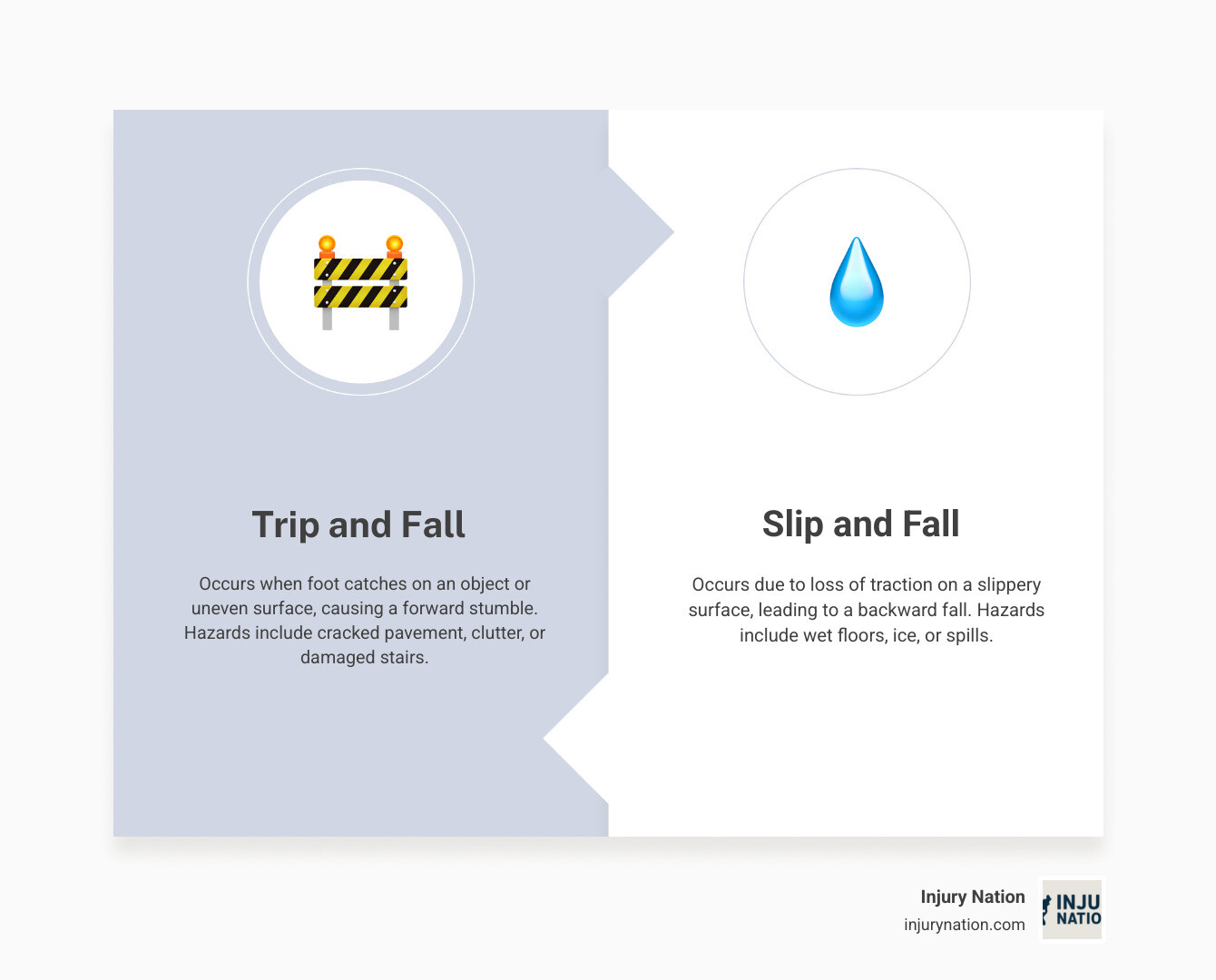
Essential trip and fall accident terms:
Distinguishing Between a Trip and a Slip and Fall
After a fall, it’s crucial to understand how it happened. Whether you tripped forward or slipped backward can affect everything from your injuries to how you prove your legal case. The fundamental difference is the cause of your imbalance.
In a slip and fall accident, your foot loses traction with the ground, causing you to fall backward. In a trip and fall accident, your foot catches on an object, causing you to stumble and fall forward. This distinction is not just a technicality; it often determines which parts of your body take the impact and shapes your entire injury claim.
| Feature | Trip and Fall Accident | Slip and Fall Accident |
|---|---|---|
| Cause | Foot catches on an object or uneven surface | Loss of traction with the walking surface |
| Motion of Fall | Typically forward, stumbling over an obstruction | Typically backward, foot slides out from under |
| Common Injuries | Facial trauma, broken hands/wrists, knee injuries, anterior head trauma | Spinal cord injuries, brain injuries (posterior head), hip fractures, tailbone injuries |
What is a Trip and Fall?
A trip and fall accident occurs when an obstacle interrupts your stride. Research shows that a rise of just 3/8 of an inch in a walkway can be enough to cause a fall. When you trip, you pitch forward, and the natural instinct is to throw your hands out to break the fall. This is why broken wrists, hands, and arms are common.
Common hazards that cause trip and falls include:
- Cracked sidewalks and uneven pavement
- Clutter and obstructions like boxes, power cords, or merchandise in walkways
- Damaged stairs, loose carpeting, or missing handrails
- Torn carpeting or loose floorboards
Because you fall face-first, you are also at risk for facial injuries (broken nose, dental damage), knee injuries (sprains, fractures), and head injuries like a concussion.
What is a Slip and Fall?
A slip and fall happens when you lose traction with the ground, causing your feet to shoot out from under you and sending you falling backward. You often have no time to react or brace for impact.
According to the Health and Safety Authority, common slippery surfaces include:
- Wet or recently waxed floors
- Spills of water, oil, or food
- Ice and snow on untreated walkways
- Loose mats or rugs that slide unexpectedly
Falling backward often leads to severe injuries because you land hard on your back, hips, or the back of your head. Common injuries include spinal cord damage, traumatic brain injuries, and hip fractures, which can be catastrophic, especially for older adults. You might also suffer a fractured tailbone or wrist injuries from trying to break the fall.
Both types of falls can be devastating. Understanding what caused your fall is the first step in holding the responsible party accountable. For more information, see our guide on slip and fall lawsuit cases.
Common Causes and Legal Elements of a Trip and Fall Accident
A trip and fall accident is rarely just bad luck; it’s often the result of a hazard that a property owner should have fixed. These incidents point to a breakdown in property maintenance, which is where premises liability law steps in to protect victims.
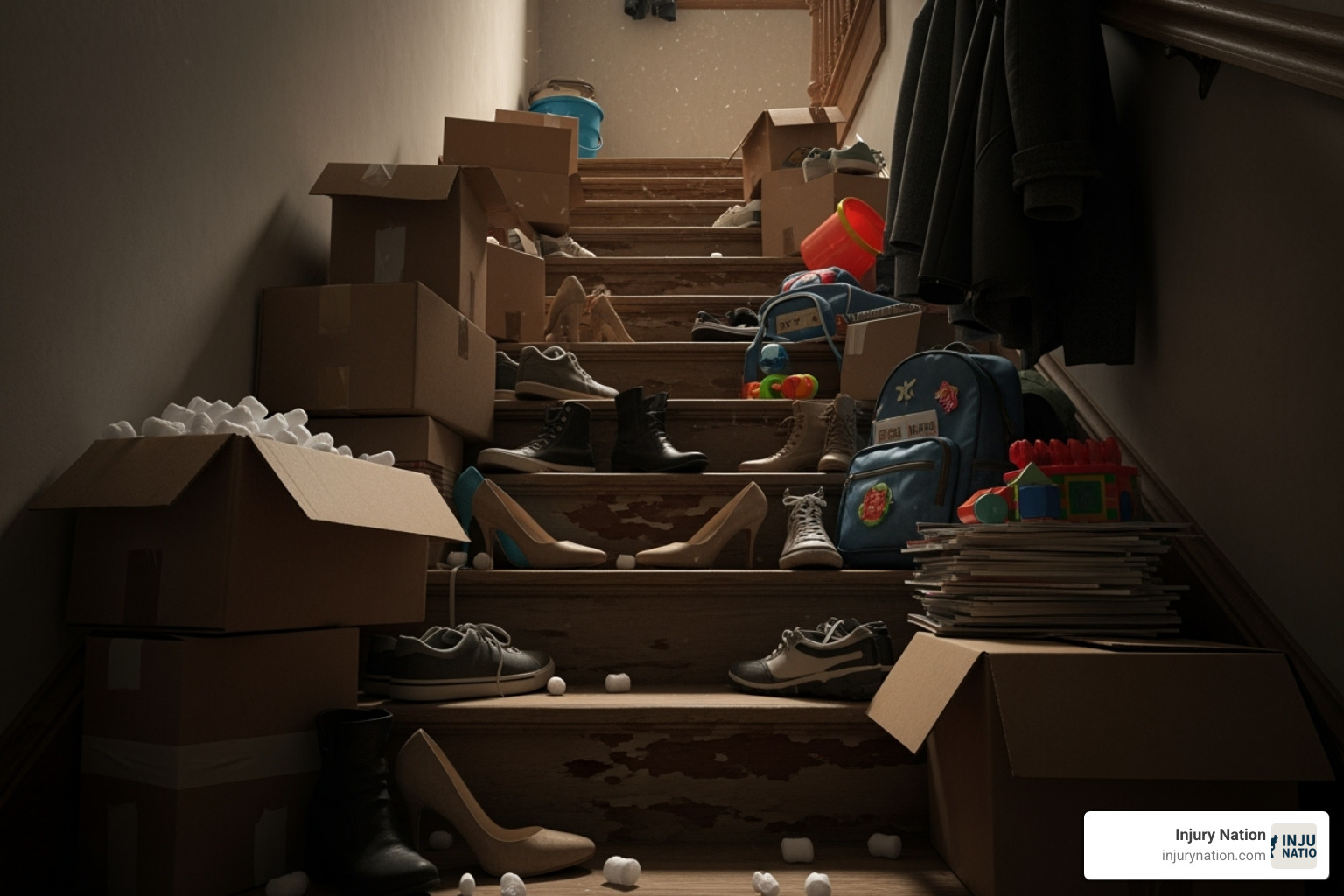
Common Causes of a trip and fall accident
When property owners neglect their duty to maintain safe conditions, ordinary walkways become danger zones. Common hazards include:
- Uneven Surfaces: Cracked sidewalks, potholes, or pavement with a rise of even 3/8 of an inch can catch a foot.
- Poor Lighting: Dimly lit stairwells, hallways, or parking lots can hide dangerous obstacles.
- Clutter and Obstructions: Boxes in aisles, power cords across hallways, or merchandise blocking paths create tripping hazards.
- Damaged Stairs: Broken steps, loose treads, or missing handrails are particularly dangerous.
- Poorly Maintained Flooring: Torn carpeting and loose floorboards can create unexpected snags.
These hazards are prevalent in many environments, from retail stores to workplaces, where falls account for 15 percent of all work-related injuries. They are especially dangerous in nursing homes, where falls are a leading cause of injury and death for residents.
Proving Negligence in a trip and fall accident Case
Pursuing a claim for your trip and fall accident requires proving that the property owner was negligent. This falls under “premises liability” law, which holds owners responsible for maintaining a safe environment. To win your case, you must prove four key elements:
- Duty of Care: The property owner had a legal obligation to keep their premises reasonably safe for visitors like you.
- Breach of Duty: The owner failed in that duty. This can be proven by showing they had actual knowledge (they knew about the hazard and did nothing) or constructive knowledge (they should have known about a hazard that existed for a long time).
- Causation: The owner’s failure directly caused your fall, and the fall directly caused your injuries.
- Damages: You suffered actual harm, such as medical bills, lost wages, and pain and suffering.
Property owners must either repair known hazards or warn visitors about them. When they fail to do either, they can be held liable. Proving this requires careful evidence gathering, a process similar to other personal injury cases like those in our Burn Injury Lawsuit Ultimate Guide.
The Legal Aftermath: Liability and Your Rights in California
After a trip and fall accident, you’re likely facing medical bills and lost wages, wondering who is responsible. In California, the law provides a framework for holding negligent parties accountable, but understand your rights.

Who Can Be Held Liable?
Liability for a trip and fall accident depends on who owned, occupied, or controlled the property. The key question is who had the responsibility to keep the area safe. Potentially liable parties include:
- Property Owners: The owner of a home, business, or land is typically the primary responsible party.
- Business Operators: A tenant, like a retail store or restaurant, is responsible for the safety of its customer areas.
- Management Companies: Companies that manage residential or commercial properties can share liability for maintenance failures.
- Government Entities: Public agencies are responsible for sidewalks, parks, and government buildings, but claims against them have strict rules and short deadlines.
- Landlords and Homeowners: Landlords must maintain common areas, and homeowners can be liable for hazards on their property.
How Comparative Negligence Affects Your Claim
California follows a “pure comparative negligence” rule. This means you can still recover compensation even if you were partially at fault for your trip and fall accident. Your total compensation is simply reduced by your percentage of fault.
For example, if you were found to be 20% at fault for not paying attention, and your total damages were $100,000, you would receive $80,000. Insurance companies will often try to shift as much blame as possible onto you to reduce their payout. An experienced attorney can fight these tactics. If you’re in the Irvine area, our guide on Personal Injury Lawyer Irvine can provide local insights.
Statute of Limitations and Recoverable Damages
The clock starts ticking the moment you fall. In California, you generally have two years from the date of the accident to file a lawsuit. If the fall occurred on government property, this deadline can be as short as six months. Missing this deadline means losing your right to compensation.
You can recover two main types of damages:
- Economic Damages: These are tangible financial losses, including current and future medical bills, lost wages, and loss of earning capacity.
- Non-economic Damages: These compensate for non-financial losses like pain and suffering, emotional distress, and loss of enjoyment of life.
The goal of compensation is to cover every way the trip and fall accident has impacted your life, providing financial relief to help you move forward.
Critical Steps to Take Immediately After a Fall
The moments after a trip and fall accident are chaotic, but the actions you take can significantly impact a future legal claim. Acting quickly to preserve evidence and protect your rights is essential.

Document and Report the Incident
- Seek Immediate Medical Attention: Your health is the priority. Adrenaline can mask serious injuries, and seeing a doctor creates an official medical record linking your injuries to the fall.
- Report the Incident: Inform the property owner, manager, or supervisor. Insist on filing an official incident report and get a copy for your records. If they refuse, document who you spoke to, along with the date and time.
- Photograph Everything: Use your phone to take pictures of what caused your trip and fall accident. Capture the hazard from multiple angles, including wider shots to show the location. Also, photograph your visible injuries immediately and over the following days.
Gather Evidence and Avoid Mistakes
- Get Witness Information: If anyone saw your fall, get their name, phone number, and email address. Independent witnesses can be crucial to your case.
- Preserve Your Clothing: Keep the shoes and clothes you were wearing at the time of the fall. Do not wash them, as they may hold important evidence.
- Do Not Give a Recorded Statement: Insurance adjusters will likely call and ask for a recorded statement. Politely decline until you have spoken with an attorney. Adjusters are trained to ask questions that can weaken your claim.
- Do Not Sign Anything: Never sign documents or accept a settlement offer without legal advice. You could be signing away your right to fair compensation.
- Stay Off Social Media: Avoid posting about your accident, injuries, or activities. Insurance companies monitor social media to find evidence they can use against you, such as a photo that they might argue proves you aren’t seriously injured.
Careful documentation is key, whether you’re dealing with a fall or another incident covered in our bike wreck attorney ultimate guide. Preserving evidence is everything.
Why Hiring a Personal Injury Attorney is Crucial
After a trip and fall accident, trying to handle a legal claim while recovering from injuries is overwhelming. Insurance companies count on your inexperience to settle for less than you deserve. A personal injury attorney levels the playing field and is essential for protecting your rights.
Here’s how an experienced attorney can help:
-
Steer Legal Complexities: Premises liability law involves strict deadlines and procedures. An attorney ensures every requirement is met, preventing your case from being dismissed on a technicality.
-
Investigate the Accident: A legal team will dig deeper than you can alone. They secure surveillance footage, find witnesses, and obtain maintenance records that can prove a pattern of neglect. They can also check for violations of OSHA workplace safety standards if the fall happened at work.
-
Gather and Preserve Evidence: Your attorney knows what evidence is critical and how to obtain it through the legal findy process. They will compile accident reports, medical records, and expert testimony to build a strong case.
-
Calculate Your Total Damages: Your claim is worth more than just your current medical bills. An attorney calculates the full value, including future medical care, lost earning capacity, and non-economic damages like pain and suffering.
-
Negotiate with Insurance Companies: Insurance adjusters are trained to minimize payouts. An attorney handles all communication, counters lowball offers with facts, and negotiates aggressively on your behalf.
-
Represent You in Court: If a fair settlement cannot be reached, your attorney is prepared to take your case to trial and fight for you before a judge and jury.
An attorney’s primary goal is to maximize your settlement so you can cover the life-altering costs of a serious injury. With a legal team managing your case, you can focus on what matters most: your recovery. If you’ve been injured, you deserve expert representation. Find out more in our guide on Lawyers for Slip and Fall Accidents.
Conclusion
A trip and fall accident is a serious event with potentially life-changing consequences, including painful injuries, medical debt, and lost income. As we’ve covered, these falls are often caused by a property owner’s negligence, and you have the right to hold them accountable.
Remember the key takeaways:
- The distinction between a trip and a slip is legally important.
- Property owners have a duty to keep their premises safe from hazards.
- In California, you can recover damages even if you are partially at fault, but the two-year statute of limitations means you must act quickly.
The steps you take immediately after a fall—seeking medical care, documenting the scene, and reporting the incident—are crucial for protecting your rights. However, navigating the legal aftermath alone is a daunting task.
An experienced personal injury attorney can handle the complexities of your case, from investigating the accident to negotiating with insurance companies, allowing you to focus on your recovery. At Injury Nation, we connect victims with the legal advocates who can fight for the justice and compensation they deserve.
If you’ve been injured in a trip and fall accident, don’t wait. The clock is ticking. Find a top-rated personal injury lawyer in your area today to take the first step toward rebuilding your life.