

Understanding Your Rights After Losing a Loved One
Wrongful death compensation is a civil legal remedy that allows surviving family members to recover financial damages when a loved one dies due to another person’s or entity’s negligence, recklessness, or intentional actions. When tragedy strikes and a loved one’s life is wrongly taken, families face not only devastating grief but also unexpected financial hardship.
Quick Answer: What You Can Claim
- Economic Damages: Lost financial support, medical bills, funeral expenses, lost household services
- Non-Economic Damages: Loss of companionship, guidance, care, and emotional support
- Who Can File: Typically spouses, children, parents, and sometimes siblings or other dependents (varies by state)
- Time Limit: Generally 2 years from the date of death to file a claim
- Standard of Proof: Must prove the death resulted from another party’s negligence or wrongful act
The loss of a loved one is always difficult. When that death is caused by someone else’s wrongful actions—whether through a car accident, medical malpractice, defective product, or workplace negligence—surviving family members have legal rights to seek compensation.
This isn’t about putting a price on a human life. No amount of money can replace your loved one or ease the pain of loss. Instead, wrongful death compensation exists to help alleviate the financial burdens that families face after an unexpected death and to hold negligent parties accountable.
Understanding what legally constitutes a wrongful death claim, who can file, what damages you can recover, and how the legal process works can help you steer this difficult time and make informed decisions about pursuing justice for your family.
What Legally Constitutes a Wrongful Death Claim?
A wrongful death claim arises when a person dies due to the “wrongful act, neglect, carelessness, unskillfulness, or default of another.” This isn’t just about intentional harm; it often includes deaths caused by negligence, such as reckless driving, medical malpractice, or defective products. For instance, if a driver runs a red light and causes a fatal collision, that can be grounds for a wrongful death claim. Similarly, a doctor failing to diagnose a life-threatening condition, or an employer neglecting workplace safety, could also lead to a wrongful death.
A wrongful death lawsuit is a civil action, not a criminal case. While a death may result in criminal charges, a wrongful death claim focuses on seeking financial compensation for the survivors, not on punishment for the accused. The standard of proof is also different: in a civil wrongful death case, we only need to prove liability “by a preponderance of the evidence,” meaning it’s more likely than not that the defendant is responsible. This is a lower standard than the “beyond a reasonable doubt” required in criminal cases.
Related to wrongful death claims are “survival actions.” While a wrongful death lawsuit compensates the deceased’s family for their losses, a survival action seeks compensation for the deceased person’s own losses from the moment of injury up until their death, such as medical expenses and pain and suffering. These are distinct statutory claims with different purposes and damage awards.

Who is Eligible to File a Lawsuit?
When a life is tragically cut short, the question of who can seek justice through a wrongful death compensation claim is paramount. Eligibility is determined by state or provincial law.
In many U.S. states, claims may be brought by close family members such as a spouse, children, parents, or other financial dependents, or by the personal representative of the deceased’s estate. Some jurisdictions also allow siblings, grandparents, or other relatives who relied on the deceased for financial support or care to participate in a claim. The specific list of eligible relatives, and how they must file, varies by location.
For example, in Ontario, Canada, the Family Law Act sets out which family members can bring a claim and what types of damages are available to them. This illustrates how each jurisdiction has its own statute governing wrongful death and related claims.
Because these rules are technical and location-specific, it is important to confirm who can file a lawsuit in the place where the death occurred. The goal of these laws is to ensure that those who depended on the deceased, either financially or emotionally, have the opportunity to recover for their losses.
Deciding who should file and how to proceed can be complex, and getting legal guidance is often the first step. You can find more information about finding a lawyer who can help you steer this process on our site: https://injurynation.com/wrongful-death-law-firm/.
Proving Liability: The Four Essential Elements
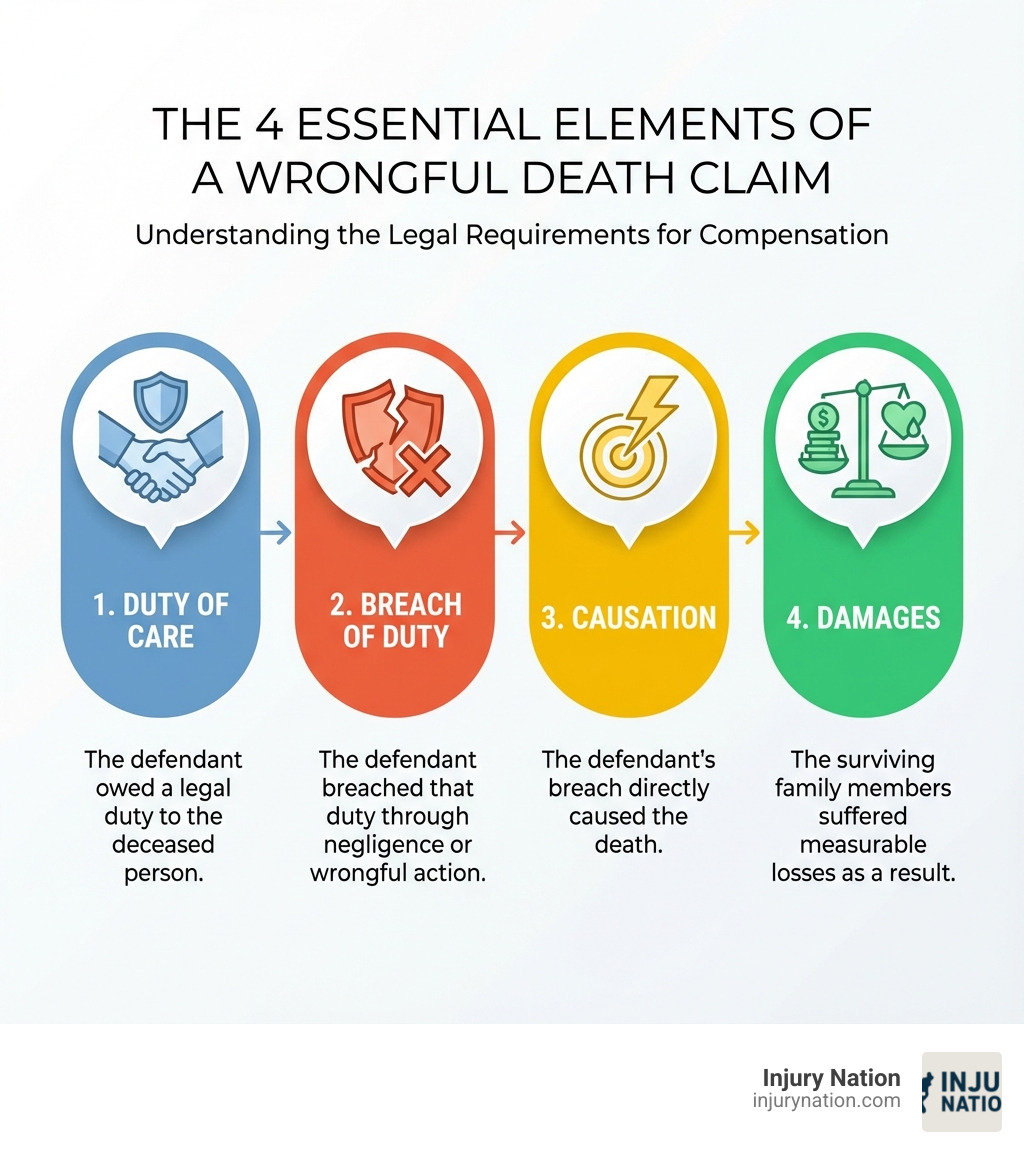
To successfully pursue a wrongful death compensation claim, we must prove four key elements:
- Duty of Care: This means the defendant owed a legal obligation to the deceased person. For example, a driver has a duty to operate their vehicle safely, or a doctor has a duty to provide competent medical care.
- Breach of Duty: This occurs when the defendant fails to uphold that duty of care. A driver speeding or running a red light breaches their duty. A doctor misdiagnosing a condition that a reasonably competent doctor would have identified also breaches their duty.
- Causation: We must show that the defendant’s breach of duty directly caused the death. There must be a clear link between their actions (or inactions) and the fatality. For instance, if a defective product caused a death, expert evidence may be needed to prove the death was caused by the negligent design or manufacture of the product.
- Damages: Finally, we must demonstrate that the surviving family members suffered measurable losses as a direct result of the death. These losses can be economic (like lost income) or non-economic (like loss of companionship).
Proving these elements requires thorough investigation and strong evidence. This can include police reports, medical records, eyewitness testimony, accident reconstruction reports, and expert witnesses (such as medical professionals or economists) who can establish the standard of care, the cause of death, and the extent of the damages. Gathering this evidence and building a compelling case is a critical step in seeking justice for your loved one.
Calculating Wrongful Death Compensation: What Can Be Claimed?
Determining the value of a wrongful death compensation claim is one of the most challenging aspects of these cases. There’s no average value, as it depends on numerous case-specific factors. These include the deceased’s age, income, and life expectancy, as well as the plaintiff’s age and relationship to the deceased. Each jurisdiction has specific laws governing what damages are recoverable, and local statutes where the death occurred will guide the available categories of compensation. Our goal is to assess both the financial and non-financial losses suffered by the family.

Understanding Pecuniary (Economic) Damages
Pecuniary damages, also known as economic damages, are quantifiable financial losses resulting from the wrongful death. These are often easier to calculate because they have a direct monetary value. In a wrongful death claim, these can include:
- Lost Financial Support: This covers the income and financial contributions the deceased would have provided to their family had they lived. This often includes future lost earnings, which can be a significant portion of the compensation. For example, a spouse might typically receive about 60-70% of the deceased’s potential future income stream.
- Loss of Inheritance: If the deceased was on a trajectory to accumulate significant wealth, the loss of that potential inheritance for their heirs can also be claimed.
- Medical Bills: Any medical expenses incurred from the time of the injury until the deceased’s passing.
- Funeral and Burial Expenses: The reasonable costs associated with the funeral, burial, or cremation.
- Loss of Services: This accounts for the value of household services, childcare, or other practical contributions the deceased would have provided to the family. For instance, if the deceased was responsible for home maintenance or childcare, the cost of replacing those services can be claimed.
To properly calculate these damages, especially future losses, we often rely on expert economists and financial analysts. They can provide detailed reports on expected future earnings, the impact of inflation, and the present cash value of these future losses.
Here’s a comparison of Pecuniary and Non-Pecuniary Damages:
| Feature | Pecuniary (Economic) Damages | Non-Pecuniary (Non-Economic) Damages |
|---|---|---|
| Nature | Tangible, quantifiable financial losses | Intangible, subjective losses |
| Examples | Lost wages, medical bills, funeral costs, loss of services | Loss of companionship, emotional distress, pain and suffering |
| Calculation | Often based on invoices, pay stubs, expert financial reports | Based on jury discretion, precedent, severity of loss, individual impact |
| Purpose | Reimburse for direct financial harm | Compensate for emotional, relational, and subjective suffering |
Valuing Non-Pecuniary (Non-Economic) Damages
Non-pecuniary damages are non-economic losses that are much harder to quantify because they don’t have a direct dollar value. These damages aim to compensate for the profound emotional and relational void left by the deceased. Depending on local law, heirs or eligible family members can often bring separate claims to recover for their individual emotional losses. These can include:
- Loss of Companionship: The loss of the love, affection, comfort, and society the deceased provided.
- Loss of Guidance and Care: For children, this could mean the loss of parental guidance, instruction, and nurturing. For a spouse, it could be the loss of care and emotional support.
- Pain and Suffering/Mental Anguish: While the deceased’s pain and suffering before death might be covered under a survival action, the surviving family members’ mental anguish and emotional pain due to the loss can be considered.
- Loss of Consortium: This specifically refers to the loss of the marital relationship, including intimacy, affection, and spousal support.
In many North American jurisdictions, courts have recognized significant awards for non-pecuniary loss where justified by the evidence, and case law shows no cap in some areas. However, other jurisdictions impose statutory caps on certain types of non-economic damages, so the precise rules depend on where the claim is brought.
Non-economic damages are typically assessed in current dollars and are not reduced to present value the same way future economic losses are. These awards are inherently subjective and are usually determined by a jury, judge, or through negotiation, based on the unique circumstances of each case and the impact on each claimant.
Other Potential Benefits and How They Interact
In addition to a wrongful death compensation lawsuit, families may be eligible for other benefits, which can sometimes offset or interact with the lawsuit’s outcome:
- Statutory Accident Benefits or Similar No-Fault Benefits: In some provinces and states, especially in motor vehicle accident cases, there may be no-fault benefits available to help cover medical and rehabilitation costs, income replacement, and funeral expenses, regardless of who was at fault.
- Insurance Policy Payouts: If the deceased had life insurance, those benefits are typically paid directly to the designated beneficiaries and are usually separate from a wrongful death claim. However, if the at-fault party has liability insurance (e.g., auto insurance, homeowner’s insurance), this will be the primary source of funding for any settlement or judgment in a wrongful death lawsuit.
- Workers’ Compensation: If the death occurred on the job, workers’ compensation benefits may be available to the surviving family. These benefits often provide specific payments for funeral expenses and ongoing support for dependents. Depending on local law, receiving workers’ compensation might affect the amount recoverable in a wrongful death lawsuit against a third party (not the employer).
- Social Security Survivor Benefits: In the United States, the Social Security Administration provides benefits to certain family members of a deceased worker, including spouses, children, and dependent parents. These benefits are entirely separate from a wrongful death lawsuit and are based on the deceased’s work record.
It’s important to understand how these different benefits interact. In some cases, certain benefits might be subject to subrogation or offset rules, meaning the party paying them (like a workers’ compensation insurer or an accident benefits provider) might have a right to be reimbursed from any wrongful death settlement. Navigating these complexities requires careful legal guidance to ensure all eligible benefits are claimed and properly coordinated.
The Wrongful Death Lawsuit Process: A Step-by-Step Guide
Pursuing wrongful death compensation is a multi-step process that requires careful attention to detail and a strategic approach. From the initial consultation to potential settlement or trial, each phase is critical.
The Critical First Step: The Statute of Limitations
One of the most crucial aspects of any wrongful death claim is adhering to the statute of limitations. This is a strict deadline by which a lawsuit must be filed. Missing this deadline almost always means forfeiting your right to seek compensation, regardless of the merits of your case.
In many U.S. states, including Nevada, there is generally a two-year deadline to file a wrongful death claim from the date of the deceased person’s death. Other jurisdictions apply their own limitation periods through specific legislation. For example, in Ontario, Canada, the Limitations Act sets out general and specific time limits for bringing civil claims.
These time limits can sometimes be shorter or have exceptions depending on the defendant (for instance, when a government entity is involved) or the circumstances of the case. This is why we always advise families to consult with an attorney as soon as possible after a loss. Even while grieving, it is important to protect your legal rights and ensure proper notices are given of the claim.
Gathering Evidence and Building Your Case
Once we’ve established eligibility and are within the statute of limitations, the next phase involves gathering evidence and building a robust case. This is an extensive investigation process:
- Document Collection: This includes obtaining police reports, medical records (including those leading up to the death), death certificates, autopsy reports, and any financial documentation related to the deceased’s income, expenses, and contributions to the family.
- Eyewitness Testimony: We’ll interview any witnesses to the incident that led to the death, documenting their accounts.
- Expert Consultation: Depending on the nature of the wrongful death, we may consult with various experts. This could include accident reconstructionists, medical specialists, economists to calculate lost financial support, and vocational experts to assess the deceased’s earning capacity.
- Establishing a Clear Timeline: Piecing together all the evidence to create a clear, chronological narrative of how the death occurred and who was at fault is essential for proving negligence and loss.
This meticulous approach helps us establish the duty of care, prove the breach of that duty, demonstrate causation, and quantify the damages suffered by the family.
Navigating Insurance Companies and Settlement Offers
Insurance companies play a significant role in most wrongful death compensation claims. They are typically the primary entities responsible for paying out settlements, up to the policy limits of the at-fault party. However, insurance adjusters work for the insurance company, and their goal is to limit payouts.
Insurance companies often actively investigate claims and may try to resolve them early, sometimes before claimants have even hired a lawyer. They might offer a quick, low settlement hoping to close the case. This is why having legal representation is so critical. We can handle all communications with the insurance company, ensuring your rights are protected and that you don’t inadvertently say or do anything that could jeopardize your claim.
We will engage in settlement negotiations, presenting a well-supported demand for compensation based on the evidence we’ve gathered. Most wrongful death lawsuits settle before going to trial, as settlements can save time, reduce legal costs, and avoid the uncertainty of a jury verdict. However, if a fair settlement cannot be reached, an experienced attorney will be prepared to take the case to trial to fight for the justice your family deserves.
Common Mistakes to Avoid When Pursuing a Claim
When you’re dealing with the profound grief of losing a loved one, it’s easy to make mistakes that could inadvertently harm your wrongful death compensation claim. Being aware of these pitfalls can help protect your family’s rights:
- Speaking to Insurance Adjusters Alone: Insurance adjusters are skilled negotiators whose priority is to minimize the payout from their company. Any statement you make, even seemingly innocuous ones, could be used against your claim. It’s best to let your lawyer handle all communications with insurance companies.
- Posting on Social Media: Anything you post online can become evidence. Discussions about the case, expressions of grief that could be misinterpreted, or even photos of activities could be used by the defense to undermine your claim for damages. We advise clients to refrain from posting anything related to the incident or their emotional state on social media.
- Accepting the First Offer: Insurance companies often make low initial settlement offers, especially if you don’t have legal representation. These offers rarely reflect the true value of your claim, which includes both immediate and future financial and emotional losses.
- Missing Filing Deadlines: As discussed, the statute of limitations is a strict deadline. Failing to file your lawsuit within the two-year window in Nevada can permanently bar you from seeking compensation.
- Failing to Document Expenses: Keep meticulous records of all medical bills, funeral expenses, and any other financial losses you incur due to the death. This documentation is crucial for proving your economic damages.
- Not Hiring an Experienced Lawyer: Wrongful death claims are complex, both legally and emotionally. An experienced wrongful death lawyer understands the nuances of state laws, knows how to gather evidence, negotiate with insurance companies, and represent your interests in court. Failing to consult a lawyer soon after a fatality is a common pitfall that can jeopardize a claim.
Avoiding these common mistakes can significantly strengthen your case and increase the likelihood of securing the full and fair wrongful death compensation your family deserves.
Frequently Asked Questions about Wrongful Death Compensation
How is a wrongful death lawsuit different from a criminal case?
This is a common and important distinction. A wrongful death lawsuit is a civil legal action, meaning its purpose is to seek financial compensation for the surviving family members. It is brought by the deceased’s family or estate against the party whose wrongful conduct caused the death. The standard of proof is “by a preponderance of the evidence,” meaning we must show it’s more likely than not that the defendant is responsible.
In contrast, a criminal case is brought by the state (the government) against an individual to punish them for breaking the law. The outcome can be jail time, fines, or other penalties. The standard of proof is much higher: “beyond a reasonable doubt.” Even if a criminal case results in an acquittal, a civil wrongful death lawsuit can still proceed and potentially succeed, as the burden of proof is lower. A well-known example is the O.J. Simpson litigation: Simpson was acquitted of murder in criminal court but later found liable for wrongful death in a civil lawsuit brought by the victims’ families.
How long does a wrongful death lawsuit typically take?
There’s no single answer to how long a wrongful death lawsuit will take, as every case is unique. However, we can provide a general timeline:
- Investigation Phase (1-6 months): This involves gathering all necessary documents, interviewing witnesses, and consulting with experts.
- Filing the Lawsuit (1-2 months after investigation): Once enough evidence is compiled, the formal lawsuit is filed.
- Findy Phase (6-18 months): Both sides exchange information, conduct depositions, and gather further evidence.
- Settlement Negotiations (Throughout the process): Offers can be made at any point, and many cases settle during findy or mediation.
- Trial (If no settlement, 1-3 weeks or more): If a settlement isn’t reached, the case proceeds to trial.
- Appeals (If applicable, 6-24 months): If either party disagrees with the verdict, they may file an appeal.
Overall, a wrongful death lawsuit can take anywhere from several months to several years, depending on its complexity, the willingness of parties to settle, and court schedules. Most cases do settle before trial, which can significantly shorten the overall timeline.
Can I still file a claim if the deceased was partially at fault?
Yes, in many places you can still file a wrongful death compensation claim even if the deceased was partially at fault, but the rules differ by jurisdiction.
In states that follow a legal principle called “modified comparative negligence” (such as Nevada), if the deceased person was found to be partially responsible for their own death, the total amount of compensation awarded will be reduced by their percentage of fault. For example, if damages are assessed at $1,000,000, but the deceased was found to be 20% at fault, the family would receive $800,000. However, there is typically a limit: if the deceased is found to be 51% or more at fault, the family is usually barred from recovering any damages.
Other jurisdictions apply different systems, such as “pure comparative negligence” (where recovery is allowed even if the deceased was mostly at fault, but reduced by their percentage of responsibility) or, more rarely, “contributory negligence” (where any fault at all could bar recovery).
This system of allocating responsibility ensures that while fault is considered, a family is not necessarily completely denied compensation if another party’s negligence was a significant cause of the death. It is a complex area of law, and determining percentages of fault often requires a thorough investigation and strong legal arguments.
Conclusion: Finding a Path Forward
The journey through a wrongful death claim is undoubtedly one of the most challenging experiences a family can face. We understand that no amount of wrongful death compensation can ever truly replace the void left by a loved one. However, pursuing a claim is about more than just money; it’s about seeking justice, holding negligent parties accountable, and alleviating the immense financial burdens that often accompany such a tragic loss.
By understanding your legal rights, knowing who is eligible to file a claim, recognizing the types of damages you can recover, and being aware of the critical steps and potential pitfalls in the process, you can make informed decisions during this incredibly difficult time. Our goal at Injury Nation is to help you steer this path forward, providing you with the information and support you need.
If you have lost a loved one due to someone else’s wrongful actions, we encourage you to seek legal guidance. A compassionate and experienced personal injury attorney can assess your unique situation, explain your options, and fight tirelessly on your behalf, allowing you to focus on healing. Find a personal injury attorney to guide you through the process and help you honor your loved one’s memory by seeking the justice and compensation your family deserves. You can start your search here: https://injurynation.com/personal-injury-attorney-guide-2025/.