

Why an Accident Lawyer for Slip and Fall Cases Is Essential to Your Recovery
If you need an accident lawyer slip and fall representation, they can be vital to your recovery. An expert lawyer will:
- Investigate your case to gather crucial evidence like security footage and maintenance records.
- Prove negligence by establishing the property owner knew or should have known about the hazard.
- Handle insurance companies that try to minimize payouts or deny claims.
- Calculate fair compensation for medical bills, lost wages, pain and suffering, and future costs.
- Work on contingency, meaning you pay nothing unless they win your case.
- Steer strict deadlines, as some claims require notice within just 10-60 days.
Slip and fall accidents are the most common type of premises liability claim, leading to over 1 million emergency room visits annually. These incidents can cause life-changing injuries, including traumatic brain injuries, spinal cord damage, and hip fractures, with devastating financial consequences.
However, proving a property owner was negligent is challenging. You must show they knew about a dangerous condition, failed to fix it or warn visitors, and that this failure caused your injuries. Insurance companies employ lawyers to fight your claim.
This is where an experienced slip and fall lawyer is crucial. They understand premises liability law, know how to preserve evidence, and can negotiate effectively with insurance adjusters to protect your rights.
Explore more about accident lawyer slip and fall:
Understanding the Legal Foundation of Your Slip and Fall Case
When a slip and fall accident turns your world upside down, understanding the legal basics is crucial. Your case falls under premises liability law, which holds property occupants to a legal duty of care. This means they must keep their space reasonably safe for visitors.

When they fail in this duty and someone gets hurt, it’s called negligence. The key question is whether the property owner should have foreseen the accident. If a reasonable person would have identified and addressed the danger, you likely have a case.
More info about Slip and Fall Lawsuit Cases
What Constitutes a Slip and Fall Accident?
A slip and fall is a serious incident caused by dangerous property conditions. Common culprits include:
- Wet or slippery floors from spills or mopping without warning signs.
- Uneven surfaces like cracked sidewalks, broken tiles, or torn carpeting.
- Poor lighting in stairwells, parking lots, or hallways that hides dangers.
- Weather-related hazards such as uncleared ice or snow on walkways.
- Cluttered walkways with boxes, cords, or other tripping hazards.
- Defective stairs with broken handrails, uneven steps, or worn treads.
If an unreasonable risk on a property caused your injury, an accident lawyer slip and fall specialist can help determine if you have a valid claim.
Who is Legally Responsible for Your Injuries?
Identifying the responsible party is key to getting the compensation you deserve. The “occupier” of the property is typically liable, which can include several parties:
- Property owners are usually the primary responsible party for maintaining safe premises.
- Business tenants may be liable for hazards created within their rented space, like a store or restaurant.
- Management companies that handle daily operations and maintenance can be held responsible.
- Maintenance contractors may share blame if their shoddy work, like poor mopping or repairs, caused the fall.
- Municipalities can be liable for accidents on public property like sidewalks or parks, but these claims have very short notice periods, sometimes just 10 days.
- Homeowners also have a duty to keep their property safe for guests.
The key is proving the responsible party knew (or should have known) about the dangerous condition but failed to fix it or provide a warning. This concept is known as foreseeability. Your lawyer will investigate all potentially liable parties to ensure you seek full compensation.
Critical Steps to Take Immediately After a Slip and Fall
The moments after a slip and fall are chaotic, but what you do next can make or break your claim. Evidence like security footage, witness accounts, and the hazardous condition itself can disappear quickly. Acting fast is essential to protect your rights.

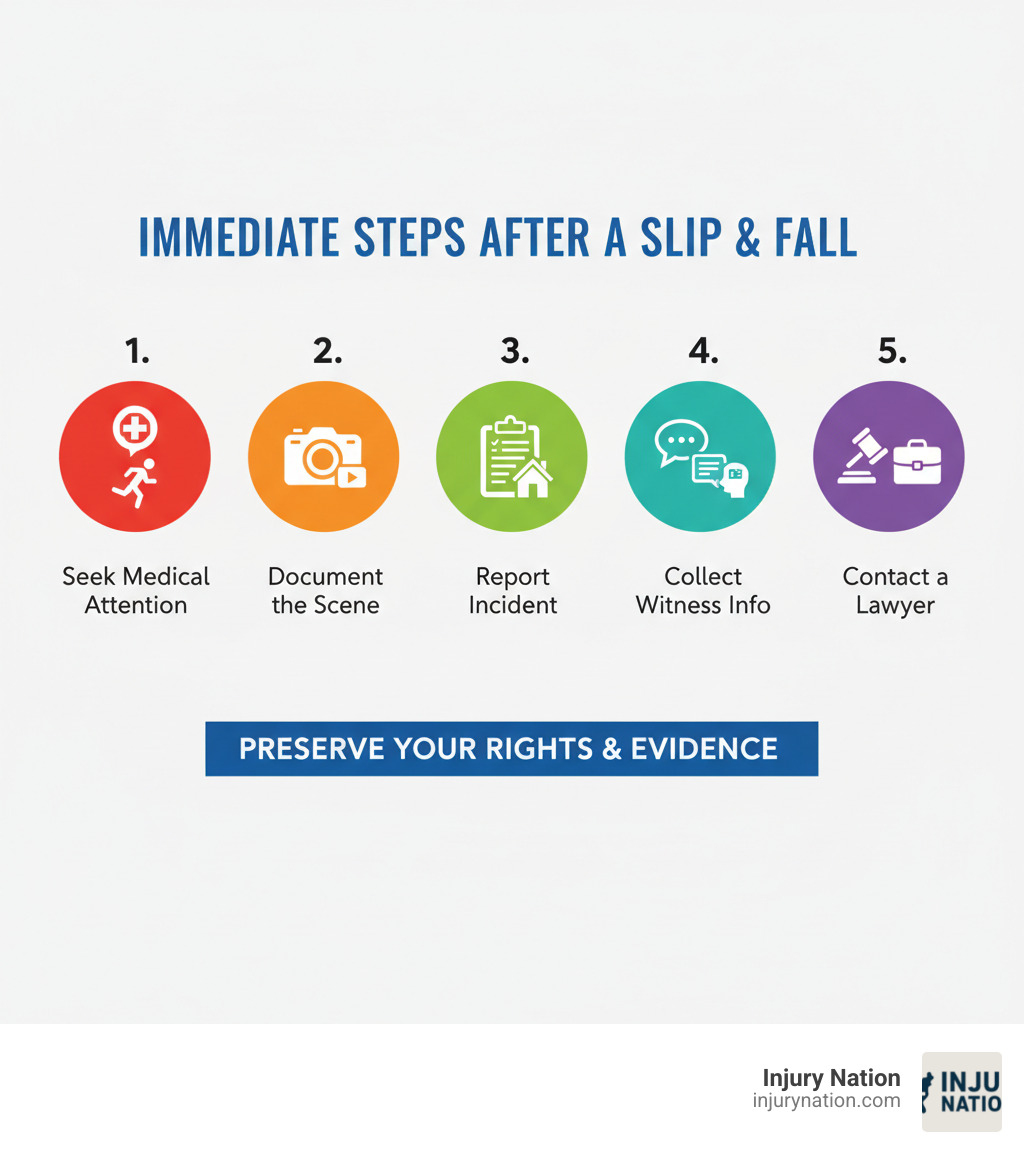
Document Everything at the Scene
Though it may feel awkward, documenting the scene is critical. Conditions change fast, so proving the cause of your fall later can be difficult. Use your smartphone to:
- Take photos and videos of the exact spot where you fell. Get close-ups of the hazard (e.g., wet floor, cracked tile) and wider shots of the surrounding area.
- Photograph your injuries, even if they seem minor. Bruises and swelling can worsen over time.
- Get witness information. Ask anyone who saw the fall or the hazard for their name and contact details. Your accident lawyer slip and fall specialist can contact them for a formal statement later.
- Write down what happened while it’s fresh in your mind. Note the date, time, location, what you were doing, and how you fell.
- Preserve your clothing and shoes. Do not wash or discard them, as they may be important evidence.
Official Reporting and Medical Treatment
Official documentation is just as important as your personal notes. If you fell on a commercial property, report the incident immediately to a manager and insist they file an incident report. Ask for a copy before you leave.
Seek medical attention right away, even if you feel fine. Some serious injuries, like concussions or internal damage, have delayed symptoms. A medical visit creates an official record linking your injuries to the fall, which is vital for your claim. Insurance companies will use any delay in treatment against you.
Follow your doctor’s treatment plan precisely. Keep all medical bills, receipts, and records. Gaps in treatment can be used by insurers to argue your injuries weren’t serious.
Be Aware of Strict Deadlines (Statute of Limitations)
Missing a legal deadline can destroy your case, no matter how strong it is. While the general rule is two years from the accident date to file a lawsuit, some cases have much shorter deadlines.
For example, if you fell on government property (like a city sidewalk), you might have as little as 10 days to provide official notice. Claims involving snow or ice may require notice within 60 days. These short deadlines exist because evidence disappears quickly.
Don’t wait. Contact an accident lawyer slip and fall specialist for a free consultation to ensure you don’t miss a critical deadline.
More info about Personal Injury Lawyer Pittsburgh
How an Accident Lawyer for a Slip and Fall Builds Your Case
After the initial shock, you may wonder what’s next. This is where an experienced accident lawyer slip and fall becomes your advocate, building your case and fighting insurance companies on your behalf.

More info about Attorney for Slip and Fall Cases
Why You Need an Accident Lawyer for a Slip and Fall Claim
While not legally required, facing an insurance company alone is a losing battle. Their goal is to pay as little as possible. A lawyer helps by:
- Navigating complexity: Slip and fall cases involve intricate premises liability laws. Your lawyer knows how to apply them to your situation.
- Leveling the playing field: Insurers have legal teams dedicated to defeating claims. An attorney ensures you are equally represented.
- Maximizing compensation: A lawyer calculates the true value of your claim, including future costs and non-economic damages you might overlook.
- Avoiding costly mistakes: An attorney helps you avoid saying or doing something that could damage your case or miss a critical deadline.
- Providing peace of mind: You can focus on healing while your lawyer handles the legal battles.
The Investigation and Proving Negligence
A successful case hinges on proving the property owner’s negligence caused your injury. Your lawyer will conduct a thorough investigation by:
- Gathering maintenance logs to find patterns of neglect.
- Obtaining security footage that shows the accident and the pre-existing hazard.
- Establishing property owner knowledge, proving they knew or should have known about the danger through reasonable inspection.
- Demonstrating a breach of duty by showing the owner failed to fix the hazard or warn visitors.
- Hiring expert witnesses, like safety consultants, to strengthen your case.
Dealing with Insurance Companies and Understanding Contingency Fees
Insurance adjusters are trained to minimize your claim. Your lawyer acts as a shield, handling all communication to protect you from their tactics. They are skilled at negotiating settlements and will fight the inevitable lowball offers from insurers.
Best of all, personal injury lawyers work on a contingency fee agreement. This means you pay no upfront fees, and the lawyer only gets paid if they win your case. Their fee is a percentage of your settlement or award. This system gives everyone access to quality legal help and motivates your lawyer to secure the best possible outcome for you.
Information on fair legal fees
Determining the Value of Your Claim and the Compensation You Deserve
“How much is my slip and fall case worth?” is a common and understandable question. The answer depends on many factors that your accident lawyer slip and fall will carefully evaluate. The value extends far beyond your initial emergency room bill to include ongoing care, lost income, and permanent life changes.
| Type of Damages | Description | Examples |
|---|---|---|
| Economic Damages | Quantifiable financial losses directly resulting from the accident. | Medical bills (past & future), lost wages (past & future), rehabilitation costs, property damage, household modifications, travel for medical care. |
| Non-Economic Damages | Subjective, non-monetary losses that impact your quality of life. | Pain and suffering, emotional distress, mental anguish, loss of enjoyment of life, loss of companionship, disfigurement, physical impairment or disability. |
Types of Compensation Available for Your Injuries
Compensation covers two main categories: economic and non-economic damages.
Economic damages are tangible losses with clear documentation. This includes all medical expenses (past and future), from ambulance rides to surgery and physical therapy. Lost income is also a major component, covering not just missed paychecks but also reduced earning capacity if your injuries prevent you from returning to your previous job.
Non-economic damages compensate for intangible losses that significantly affect your life. Pain and suffering covers the physical and emotional distress you’ve endured. Loss of enjoyment of life addresses how your injuries have limited your ability to participate in activities you once loved. The psychological impact, such as anxiety or depression, is also compensable as mental anguish.
These accidents can be severe. The Bureau of Labor Statistics reports numerous workplace fatalities from falls annually. In Pennsylvania, for example, 28 workers died from slips, trips, and falls in 2020, showing how serious these incidents can be.
Statistics on fall-related injuries
Factors That Determine Your Claim’s Worth
Your case’s value is based on specific, documented factors:
- Severity of your injuries: This is the most significant factor. A traumatic brain injury will result in a much higher settlement than a minor bruise. For example, a woman who suffered a skull fracture at a Lowe’s received a $13 million settlement.
- Total medical costs: The full extent of your past and future medical expenses heavily influences the claim’s value.
- Impact on your ability to work: If your injuries affect your career long-term, compensation will be higher.
- Long-term consequences: Permanent disability, chronic pain, or significant scarring will dramatically increase a claim’s worth.
- Degree of the property owner’s negligence: Clear-cut negligence often leads to higher settlements.
- Comparative negligence: If you are found partially at fault (e.g., you were texting while walking), your compensation may be reduced. An accident lawyer slip and fall can help assess this objectively.
Frequently Asked Questions about Slip and Fall Claims
When you’re injured in a slip and fall, you’ll have many questions. Here are answers to some of the most common concerns.
Can I still make a claim if I was partially at fault for my accident?
Yes, in most cases. The legal principle of comparative negligence allows you to recover damages even if you share some responsibility. For example, if you were found 20% at fault for an accident with $100,000 in damages, your compensation would be reduced to $80,000.
In many states, like Nevada, you can recover damages as long as your share of fault is not 51% or more (Nevada Revised Statutes 41.141). An experienced accident lawyer slip and fall specialist will work to minimize any fault attributed to you and build a strong case against the property owner.
How long does it take to settle a slip and fall lawsuit?
The timeline varies, ranging from a few months to several years. Factors influencing the duration include:
- Case complexity: Simple cases with clear liability resolve faster.
- Severity of injuries: It’s often best to wait until you reach “maximum medical improvement” to know the full extent of your damages, which can lengthen the process.
- Insurance company cooperation: Some insurers negotiate fairly, while others drag out the process, hoping you’ll accept a low offer.
Most cases settle out of court. However, if the insurer is unreasonable, filing a lawsuit may be necessary, which can add a year or more to the timeline but often results in a fairer outcome.
What are the most common injuries from a slip and fall?
Slip and fall accidents can cause a wide range of serious injuries, including:
- Fractures: Broken bones in the wrists, ankles, and hips are common. Hip fractures are especially dangerous for older adults, with about 95% resulting from falls.
- Traumatic Brain Injuries (TBI): Even a seemingly minor head bump can cause a concussion with lasting symptoms like headaches, dizziness, and memory issues.
- Spinal Cord Injuries: These can range from herniated discs to severe damage causing chronic pain, numbness, or even paralysis.
- Soft Tissue Injuries: Sprains, strains, and tears to muscles and ligaments in the knees, shoulders, and back can lead to chronic pain and limited mobility.
- Neck and Shoulder Injuries: Whiplash and rotator cuff tears are common as people try to brace themselves during a fall.
Seeking immediate medical attention is crucial for both your health and documenting your injuries for a potential legal claim.
Data on hip fractures from falls
Find the Right Legal Partner to Win Your Case
Dealing with a slip and fall injury is overwhelming. You’re in pain, medical bills are piling up, and the future is uncertain. This is when the right legal partner can make all the difference. You need an accident lawyer slip and fall specialist who understands your situation and has the experience to fight for you.
At Injury Nation, we connect victims with top-rated attorneys who can transform their circumstances. These advocates stand up to powerful insurance companies and work tirelessly to secure the compensation needed to rebuild your life.
An experienced lawyer is invaluable. They steer complex premises liability laws, counter insurance company tactics, and build a compelling case on your behalf. They work on a contingency fee basis, so you pay nothing unless they win.
Your lawyer will protect your rights, handle all legal complexities, and fight for full compensation for your medical needs, lost wages, and pain and suffering. This allows you to focus on what matters most: your recovery.
Don’t face this challenge alone. The right legal partner can turn a devastating accident into an opportunity for justice. Every day you wait gives the insurance company an advantage.