

Why a Brain Injury Compensation Lawyer is Essential to Your Recovery
A brain injury compensation lawyer helps victims of traumatic brain injuries (TBIs) secure financial awards for medical bills, lost income, rehabilitation, and pain and suffering. They manage the complex legal process, allowing you to focus on healing while they handle the fight for your settlement.
Key responsibilities of a brain injury lawyer include:
- Investigating the accident and gathering evidence
- Calculating all current and future damages
- Negotiating with insurance companies to prevent lowball offers
- Hiring medical experts to validate your claim
- Representing you in court if a fair settlement isn’t reached
Each year, approximately 1.5 million people in the United States sustain a TBI, facing consequences like memory loss, chronic headaches, and permanent disability. The financial burden can be overwhelming as medical bills mount and income is lost.
If someone else’s negligence caused your injury through a car accident, slip and fall, or other incident, you have the right to seek compensation. However, insurance companies often try to deny or undervalue these complex claims. This guide explains the compensation process and shows how a specialized lawyer can help you achieve financial security and justice.
Understanding the Nature and Impact of Brain Injuries

A traumatic brain injury (TBI) occurs when an external force, like a blow to the head or violent jolt, damages the brain. These injuries range from “mild” concussions to severe, life-altering trauma. A broader term, Acquired Brain Injury (ABI), includes any brain damage after birth, such as from strokes or infections.
TBIs can affect every aspect of your life—how you move, think, feel, and interact with others. The consequences are often long-lasting and profound.
Traumatic Brain Injury (TBI) vs. Concussion
A concussion is a type of TBI, often called a mild TBI (mTBI). However, the term “mild” refers to the initial injury, not its potential long-term impact. A concussion disrupts brain function and can occur without a direct hit to the head; a whiplash-type motion is enough to cause damage. Symptoms include confusion, memory loss, and disorientation.
Moderate to severe TBIs present more alarming symptoms, such as prolonged loss of consciousness, seizures, slurred speech, and extreme agitation. While some symptoms appear immediately, others can emerge hours or days later, making prompt medical evaluation essential after any head injury.
The table below compares concussions to more severe brain injuries:
| Feature | Concussion (mTBI) | Moderate-to-Severe TBI |
|---|---|---|
| Definition | Traumatically-induced disruption of brain function | Significant damage to brain tissue from external trauma |
| Loss of Consciousness | May or may not occur; brief if present | Often present, can be prolonged or lead to coma |
| Memory Loss | May experience some amnesia (before/after injury) | More pronounced and persistent memory deficits |
| Initial Symptoms | Headaches, dizziness, nausea, fatigue, sensitivity to light/noise, confusion, trouble concentrating | Severe headaches, persistent vomiting, slurred speech, extreme drowsiness, seizures, dilated pupils, loss of coordination, agitation, coma |
| Potential Long-Term Effects | Post-concussion syndrome (persistent headaches, dizziness, mood changes), cognitive difficulties, increased risk of future concussions | Permanent physical disabilities, severe cognitive impairment, personality changes, communication problems, epilepsy, increased risk of neurodegenerative diseases |
| Recovery | Often resolves within weeks to months, but up to 15% may have persistent issues | Can be protracted, often requiring extensive, lifelong rehabilitation and care |
Even a seemingly minor head injury can lead to persistent problems. A brain injury compensation lawyer understands these nuances, which is critical for building a strong case.
Common Causes of Traumatic Brain Injuries
Many brain injuries are caused by another’s negligence. Understanding the cause can help determine if you have a legal claim.
- Motor vehicle accidents: Collisions are a leading cause of TBIs. Our Car Accident Lawyer resources offer more information.
- Slip and falls: These are especially common among children and older adults, often due to unsafe property conditions. See our Slip and Fall Lawyer guide for details.
- Workplace accidents: Hazardous environments like construction sites pose significant risks. A Workers Compensation Lawyer can explain your rights if you were hurt on the job.
- Medical malpractice: Surgical errors, birth injuries, or misdiagnoses can cause devastating brain damage. A Medical Malpractice Lawyer can help hold negligent professionals accountable.
Other causes include physical assaults, sports injuries, and explosions. If negligence was a factor, you should explore your legal options.
The Far-Reaching Consequences of a TBI
A brain injury’s impact extends far beyond the initial trauma, affecting physical health, cognitive abilities, emotional well-being, and financial stability.
- Physical: Survivors often endure chronic headaches, dizziness, seizures, balance issues, and sensitivity to light and noise. Severe cases can involve paralysis or loss of coordination.
- Cognitive: Memory loss, difficulty concentrating, and impaired judgment are common. These challenges can make returning to work or school feel impossible.
- Emotional & Behavioral: Personality changes, mood swings, depression, and anxiety are frequent, placing immense strain on relationships.
- Financial: The inability to work leads to lost wages and diminished future earning capacity. Meanwhile, expenses for medical care, rehabilitation (physical, occupational, speech therapy), home modifications, and long-term care can become overwhelming.
Compensation is not a windfall; it is a necessary resource to cover the immense costs of living with a brain injury and to access the care needed to rebuild your life.
Securing Your Future: The Brain Injury Compensation Process

After a brain injury, understanding the compensation process is key to securing the resources needed for recovery. A fair settlement provides the stability to focus on healing instead of financial stress. The legal process aims to hold the responsible party accountable and ensure you receive the full compensation you are entitled to.
What Types of Compensation Can You Claim?
Brain injury claims cover two main categories of losses: economic and non-economic damages.
Economic damages are tangible financial losses, including:
- Medical Bills: All costs from emergency care to ongoing treatment and future medical needs.
- Rehabilitation Costs: Physical, occupational, speech, and psychological therapies.
- Lost Wages: Income already lost due to time off work.
- Loss of Future Earning Capacity: Projected income you will lose over your career due to the injury.
- Other Expenses: Costs for home modifications, assistive devices, and long-term care.
Non-economic damages compensate for intangible suffering:
- Pain and Suffering: Physical pain and emotional distress caused by the injury.
- Loss of Enjoyment of Life: Inability to participate in hobbies and activities you once loved.
In fatal cases, a wrongful death claim can help families cover funeral costs and lost financial support. Our Wrongful Death Lawyer resources can provide guidance.
How TBI Severity Influences Settlement Amounts
Settlement amounts vary based on the injury’s severity and its impact on your life.
- Mild TBIs (e.g., concussions): Settlements may range from $5,000 to $50,000. However, if post-concussion syndrome develops with persistent symptoms, compensation can be much higher. One such case resulted in $2.2 million.
- Moderate TBIs: Cases requiring extended rehabilitation often settle for $85,000 to $240,000.
- Severe TBIs: Injuries causing permanent disability and requiring lifetime care frequently lead to settlements exceeding $1 million. For example, cases involving subdural hematomas (brain bleeds) have resulted in compensation over $2 million.
These figures are driven by the real-world impact on your health, career, and daily life.
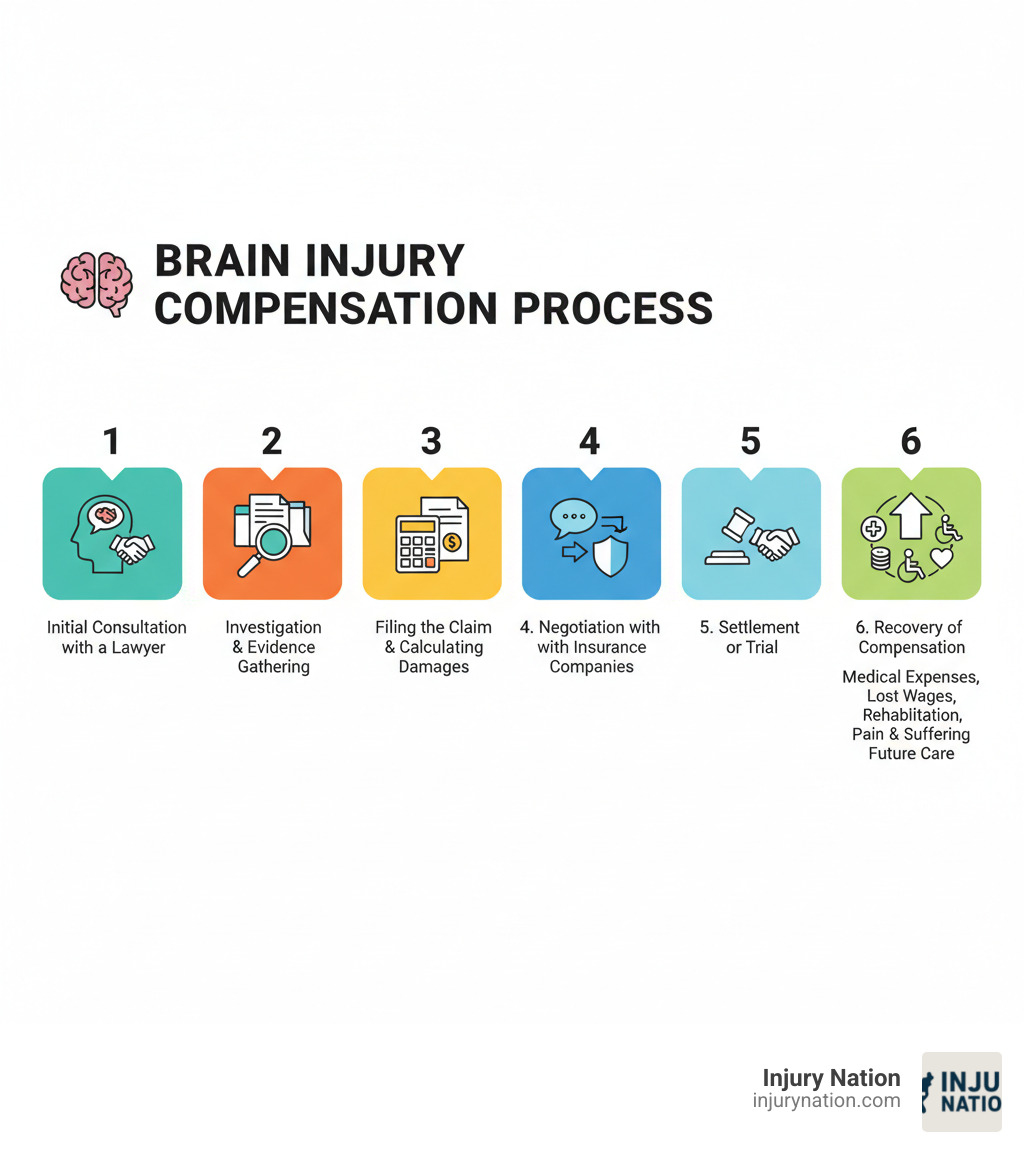
The Legal Steps for Filing a TBI Claim
The path to compensation generally follows these steps:
- Initial Consultation: A free meeting with a brain injury compensation lawyer to discuss your case and legal options.
- Investigation: Your lawyer gathers evidence, including accident reports, witness statements, and medical records.
- Calculating Damages: All economic and non-economic losses are carefully documented and calculated, often with help from medical and financial experts.
- Filing the Claim: A formal claim is filed against the negligent party and their insurance company.
- Negotiation: Your lawyer negotiates with the insurer, countering lowball offers and fighting for a fair settlement.
- Litigation: If a fair settlement cannot be reached, your lawyer will file a lawsuit and prepare your case for trial. Most cases settle before reaching a courtroom.
Throughout this process, your lawyer manages the legal complexities, allowing you to concentrate on your recovery.
The Critical Role of a Brain Injury Compensation Lawyer

Recovering from a brain injury is a full-time job. A brain injury compensation lawyer acts as your advocate, handling the legal burdens so you can focus on getting better. They are essential for navigating a legal system that is overwhelming for someone dealing with cognitive challenges, fatigue, and memory issues.
What Does a Brain Injury Lawyer Do for You?
A specialized lawyer manages every aspect of your claim. They start by building a strong case, gathering all medical records, accident reports, and witness statements. Because brain injuries are often “invisible,” they work with expert witnesses like neurologists and neuropsychologists to provide objective medical evidence of your condition and its impact on your life.
Calculating total damages is another critical task. This goes beyond current bills to include future medical care, long-term rehabilitation, and lost earning capacity over your lifetime. They also quantify non-economic damages like pain and suffering.
Crucially, your lawyer handles all communication with insurance companies. Adjusters are trained to minimize payouts and may pressure you to settle for less than you deserve. Your lawyer knows their tactics and negotiates aggressively on your behalf. You can learn more about the process in our Personal Injury Lawyer guide.
How a Lawyer Helps Fund Rehabilitation and Ongoing Care
Many essential therapies—physical, occupational, and psychological—are not fully covered by health insurance. A lawyer ensures your settlement includes the full cost of these treatments, both now and in the future.
They also account for other long-term needs, securing funds for:
- Home modifications (ramps, grab bars)
- Assistive devices (wheelchairs, communication tools)
- Ongoing medication for chronic pain or seizures
- Long-term care in specialized facilities, if necessary
An experienced brain injury compensation lawyer works to secure a settlement that reflects the true, lifelong impact of your injury, providing the resources necessary for your recovery.
Navigating Legal Timelines and Specific Claim Types
Time is a critical factor in a brain injury case. Strict legal deadlines, known as statutes of limitations, can prevent you from recovering compensation if you wait too long to act. For more insights on various injury claims, you can explore our blog.
Deadlines for Filing a TBI Claim
Each state sets a statute of limitations for filing a personal injury lawsuit. For most TBI cases, this deadline is typically two years from the date of the accident. Some states allow more time, but it’s crucial not to assume.
Brain injury symptoms can be delayed, which can make it confusing to know when the clock starts. The “findy rule” in some states may start the clock when the injury is finded, but you should not rely on this without legal advice.
Different rules and deadlines apply in specific situations:
- Minors: The statute of limitations for a child’s injury often doesn’t begin until they turn 18.
- Government entities: If a government body is at fault (e.g., for an unsafe road), you may have as little as 10 days to file a formal notice of claim.
- Car accidents: Insurance policies have their own deadlines, such as 7 days to report the injury or 30 days to submit benefit applications.
Missing any of these deadlines can jeopardize your entire claim. Immediate legal consultation is essential.
Workplace Brain Injuries: Workers’ Comp and Third-Party Claims
If your brain injury occurred at work, your case involves additional layers of complexity.
Workers’ compensation is a no-fault system that provides benefits to injured employees, covering medical bills and a portion of lost wages. In exchange for these benefits, you generally cannot sue your employer for other damages like pain and suffering. Our Workers Compensation Lawyer resources offer more detail.
However, workers’ comp may not be your only option. A third-party claim may be possible if someone other than your employer or a co-worker was responsible for your injury. Examples include:
- Suing a negligent driver who hit you while you were working.
- Filing a product liability claim against the manufacturer of faulty equipment that caused your injury.
Third-party claims allow you to seek full compensation, including pain and suffering, which workers’ comp does not cover. A brain injury compensation lawyer can determine if you have grounds for both a workers’ comp claim and a third-party lawsuit, maximizing your potential recovery. Additionally, laws like the Americans with Disabilities Act (ADA) protect you from discrimination and require employers to provide reasonable accommodations.
Finding the Right Legal Advocate for Your TBI Case

Choosing the right brain injury compensation lawyer is a critical decision that can significantly impact your settlement and your future. You need an advocate who understands the unique challenges of TBI cases and can carry the legal burden while you focus on healing. While organizations like the Brain Injury Association offer valuable support, a specialized attorney is necessary to pursue compensation.
How to Choose the Right Brain Injury Compensation Lawyer
Not all personal injury lawyers are equipped to handle complex TBI claims. Look for an attorney with specific expertise. Here’s what to consider:
- Firm Specialization: Does the lawyer or firm have a proven track record with brain injury cases?
- Case History: Review their past results. Have they successfully handled cases similar to yours?
- Client Testimonials: What do former clients say about their experience? Look for comments on communication, support, and results.
- Contingency Fee Basis: Reputable lawyers work on a “no win, no fee” basis. You should not pay any upfront costs. Their fee is a percentage of the compensation they recover for you.
- Free Consultations: Take advantage of free consultations to meet with several lawyers and find one you trust.
Be wary of online ads and rankings, as they don’t always reflect a lawyer’s true experience or client satisfaction. Do your own research and trust your instincts.
Key Questions to Ask a Brain Injury Compensation Lawyer
Use your free consultation to gather important information. A good lawyer will welcome your questions. Here are some to ask:
- Have you represented clients with brain injuries similar to mine? What were the outcomes?
- How much of your practice is dedicated to brain injury cases?
- Who will be my primary point of contact at your firm?
- What are the steps in the legal process for my case, and what is a realistic timeline?
- What is your fee structure, and what percentage do you take?
- What will you need from me during this process?
- Based on similar cases, what is a potential range of compensation I might expect?
Asking these questions will help you build a strong partnership with an attorney who will treat your case with the seriousness it deserves.
Frequently Asked Questions about Brain Injury Claims
Navigating the legal process after a brain injury can be confusing. Here are clear, concise answers to some of the most common questions.
How much does it cost to hire a brain injury lawyer?
Hiring a brain injury compensation lawyer costs you nothing out of pocket. Nearly all personal injury attorneys work on a contingency fee basis. This means:
- You pay no upfront fees.
- The lawyer covers all costs of building your case.
- The lawyer’s fee is a pre-agreed percentage taken only from the settlement or award they win for you.
- If you don’t win, you owe nothing.
Most lawyers also offer a free initial consultation to discuss your case without any financial commitment.
How long will my TBI case take to resolve?
There is no set timeline for a TBI case. The duration depends on several factors:
- Severity of the Injury: Mild injuries may resolve faster, while severe TBIs with long-term prognoses take longer to evaluate fully.
- Case Complexity: Disputes over fault or the involvement of multiple parties can extend the timeline.
- Negotiation vs. Trial: A case that settles through negotiation is much quicker than one that goes to trial, which can take years.
While waiting is frustrating, rushing to settle before understanding the full extent of your future needs can be a costly mistake. An experienced lawyer will advise on the right time to resolve your claim.
Can I still get compensation if I was partially at fault?
Yes, in most states you can. The legal doctrine of comparative negligence allows you to recover damages even if you were partially to blame for the accident. However, your total compensation will be reduced by your percentage of fault.
For example, if your case is valued at $1 million and you are found to be 20% at fault, you would receive $800,000.
Some states have a “modified” rule where you cannot recover anything if your fault is 50% or more. Insurance companies often try to exploit this by shifting blame onto the victim. A skilled brain injury compensation lawyer will fight these tactics and work to protect your right to compensation.
Conclusion: Taking the First Step Towards Justice and Recovery
When a brain injury turns your world upside down, the path forward can seem uncertain and overwhelming. The physical, cognitive, and financial burdens are immense, and you are not alone in this struggle. Each year, millions of Americans face the devastating consequences of TBIs.
As this guide has shown, you have legal rights if your injury was caused by someone else’s negligence. Compensation can cover everything from medical bills and lost income to the lifelong care many survivors need. However, time is critical. Strict legal deadlines, some as short as 10 days, can bar you from ever filing a claim if you wait too long.
Don’t face this fight alone. A brain injury compensation lawyer is your essential advocate, equipped to handle the complex legal battle against insurance companies while you focus on healing. They work on a contingency basis, so there is no financial risk to you.
If you or a loved one has suffered a brain injury, take the first step today. The Injury Nation directory connects you with top-rated, specialized attorneys across the country who know how to win these complex cases.
Your future financial security depends on the action you take now. Find a catastrophic injury attorney to handle your case and schedule a free consultation. Let an expert fight for the justice and recovery you deserve.