

When Minutes Matter: Understanding Your Rights After ER Negligence
Emergency room attorney — if you’re searching for one, you likely suffered harm when you needed urgent medical care most. An emergency room attorney handles medical malpractice cases from negligent care in ERs, helping victims get compensation for preventable injuries.
Quick Answer: When You Need an Emergency Room Attorney
- You were misdiagnosed or diagnosis was delayed (heart attack mistaken for heartburn, stroke symptoms ignored)
- You received wrong medication or wrong dosage causing additional harm
- You were discharged prematurely before your condition stabilized
- Critical tests weren’t ordered (CT scan, MRI, bloodwork) leading to worsening injury
- Surgical errors occurred in emergency treatment
- Your condition deteriorated due to inadequate monitoring or follow-up
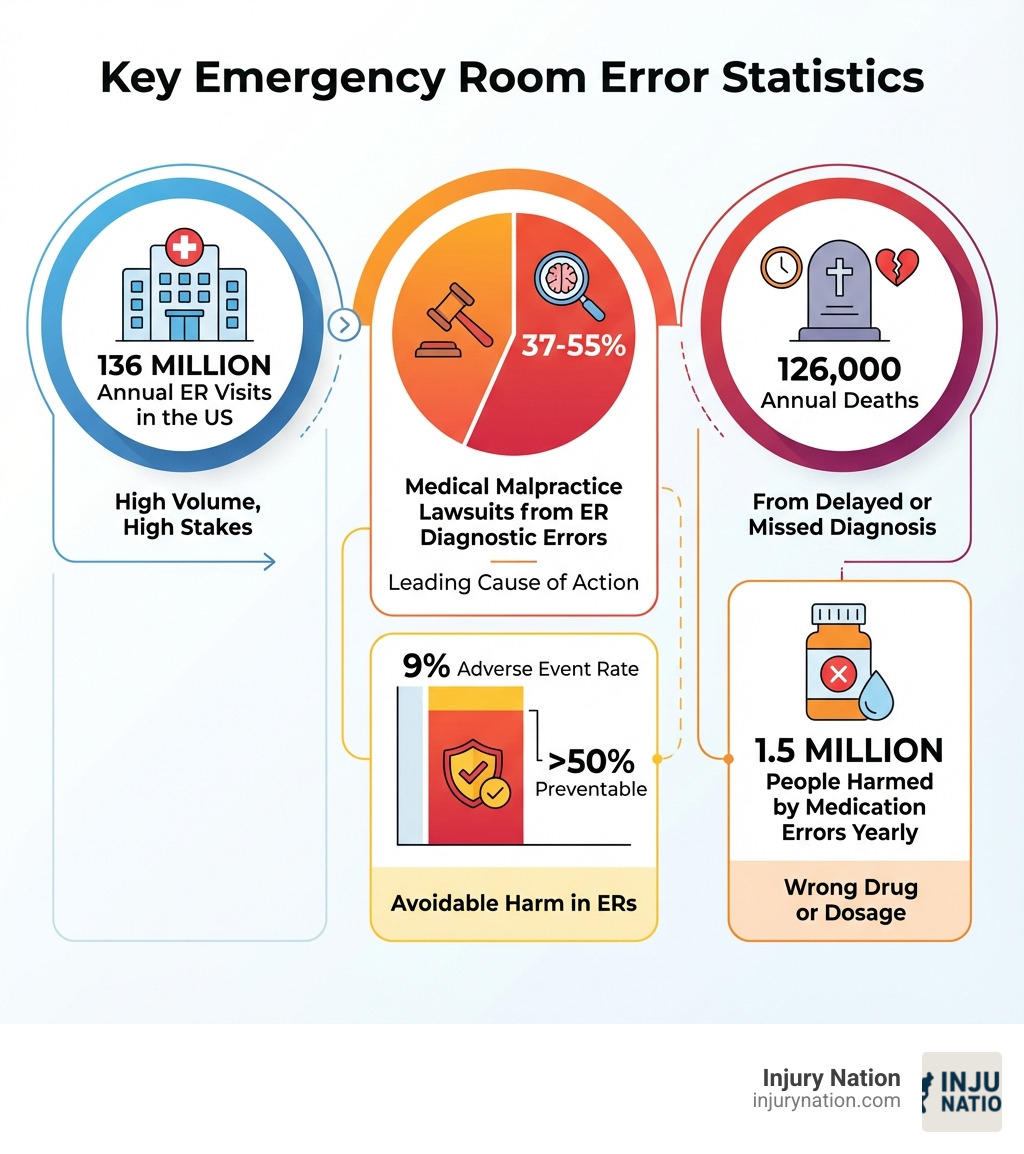
Over 136 million Americans visit ERs annually. In these high-pressure settings, split-second decisions are critical, but the chaos doesn’t excuse negligence.
The statistics are sobering. Emergency room diagnostic errors account for 37 to 55 percent of medical malpractice lawsuits. Nearly half of the 100,000+ annual deaths from medical malpractice stem from emergency room errors. Studies show that adverse events related to ER care occur in 9% of cases — and more than half are preventable.
When you enter an ER, you trust medical professionals at a vulnerable time. If substandard care violates that trust, you have legal rights.
An ER attorney investigates the incident, consults medical experts, steers complex laws, and fights for compensation covering medical bills, lost wages, and pain and suffering.
The legal landscape for ER malpractice is challenging. State time limits vary, medical standards are unique to the ER environment, and federal laws like EMTALA protect your rights. A successful case requires both medical and legal expertise.
This guide explains what constitutes ER negligence, your legal rights, the steps to take after suspected malpractice, and how to find the right attorney to represent your claim.
What Constitutes Medical Negligence in the Emergency Room?
Medical malpractice occurs when a healthcare provider’s failure to meet the accepted standard of care causes preventable harm. In a chaotic ER, defining negligence can be complex.
To win a malpractice claim in Las Vegas, Nevada, or elsewhere, four elements must be proven:
- Duty of Care: A doctor-patient relationship existed, meaning the medical professional had a responsibility to provide care. This is usually clear in an ER once you are triaged or seen.
- Breach of Duty (Negligence): The provider’s actions fell below the accepted medical standard of care, meaning they failed to act as a reasonably competent ER professional would under similar circumstances.
- Causation: The provider’s negligence must be directly linked to your injury. The error must have caused the harm.
- Damages: You suffered actual harm or losses, such as medical bills, lost income, or pain and suffering.
As the Clinical Orthopaedics and related Research notes, understanding these elements is crucial for any medical malpractice claim. An Introduction to Medical Malpractice in the United States

The Critical Difference: Medical Error vs. Medical Malpractice
Not every negative outcome or medical error in the ER is malpractice. A mistake or undesirable result isn’t automatically malpractice.
The difference is negligence. An error becomes malpractice when it was preventable, breached the standard of care, and directly caused harm. For example, a false cancer diagnosis might cause emotional distress, but if it doesn’t lead to physical harm or unnecessary treatment, it might not meet the legal threshold for malpractice. Conversely, operating on the wrong kidney is a clear breach of the standard of care that would almost certainly constitute malpractice.
Common Types of Preventable ER Errors
The high-pressure ER environment doesn’t excuse serious, harmful medical errors. Common errors leading to negligence claims include:
- Misdiagnosis or Delayed Diagnosis: This frequent, dangerous error involves misdiagnosing serious conditions like heart attacks or strokes as minor ailments. Delayed diagnosis can prevent crucial early treatment, leading to devastating outcomes. These errors cause 126,000 deaths in the U.S. annually.
- Medication Errors: These include wrong medication or dosage, failure to check for interactions or allergies, or improper administration. An estimated 1.5 million people are harmed by medication errors each year.
- Failure to Order Appropriate Tests or Misinterpretation of Results: ER staff may fail to order necessary tests (X-rays, CT scans) or misinterpret results, leading to an incorrect diagnosis and treatment plan.
- Improper Triage: Improperly prioritizing patients based on condition severity (triage) can force those with life-threatening issues to wait, leading to deterioration or death.
- Inadequate Monitoring: Lack of proper monitoring for admitted or held patients can allow a worsening condition to go unnoticed, causing further harm.
- Premature Discharge or Failure to Follow Up: Discharging an unstable patient or failing to provide clear follow-up instructions can lead to readmission or declining health.
- Surgical Mistakes or Procedural Errors: Minor emergency procedures can involve surgical mistakes, intubation errors, or improper use of life-saving equipment.
- Miscommunication: Poor communication among ER staff or failure to get a complete patient history can lead to a cascade of errors.
- Unsanitary Conditions: Less commonly, unsanitary ER conditions can cause deadly infections.
Even defective medical devices can contribute to ER errors if they malfunction or are improperly used. You can learn more about such cases in our guide to Defective Medical Devices.
The Unique Legal Landscape of an ER Malpractice Claim
The ER’s chaotic, high-pressure environment, where doctors make life-saving decisions in minutes, makes malpractice claims originating there uniquely complex and challenging to win.
Statistics show the challenge: only about 25% of ER malpractice claims result in payment. Nearly 75% of claimants receive nothing. This highlights why an experienced emergency room attorney is crucial.
Legal standards for ER malpractice account for this unique environment. While providers are accountable, special rules and legal protections may apply. For instance, some state laws protect emergency personnel from liability under certain circumstances, often called “Good Samaritan laws,” though these typically don’t apply in cases of gross negligence.
Despite the challenges, adverse events related to Emergency Department care occurred in 9% of cases, and more than half of them were deemed preventable. This means that while ERs are tough environments, negligence still happens and often has devastating consequences, including preventable deaths, as highlighted by the Emergency Medicine Journal in “Preventable deaths in patients admitted from emergency department” Preventable deaths in patients admitted from emergency department.
The “Standard of Care” in a Chaotic Setting
The “standard of care” is the level of skill a reasonably competent medical professional with similar training would provide under similar circumstances. In the ER, the “similar circumstances” clause is crucial.
ER personnel have a different standard of care than other physicians. The law recognizes the frantic pace, limited patient history, and need for immediate decisions, giving ER doctors slightly more leeway than physicians in controlled settings.
However, this doesn’t mean anything goes. The standard still requires ER doctors to conduct appropriate medical screening exams, order necessary tests, and provide stabilizing treatment. Proving a breach requires expert testimony from an emergency medicine specialist who can explain what a prudent ER doctor would have done. For example, if a patient presents with classic heart attack symptoms, an ER doctor’s failure to perform an EKG would likely be considered a breach, regardless of how busy the ER was.
Your Rights Under Federal Law: What is EMTALA?
Beyond the standard of care, patients have significant protections under a federal law known as the Emergency Medical Treatment and Labor Act, or EMTALA. This law was enacted to prevent “patient dumping,” where hospitals would turn away uninsured or underinsured patients.
EMTALA gives you specific rights when you visit a hospital emergency department:
- Appropriate Medical Screening Exam: The hospital must provide a medical screening exam to determine if you have an emergency medical condition, regardless of your ability to pay.
- Stabilizing Treatment: If an emergency medical condition is found, the hospital must provide treatment to stabilize your condition, meaning it is unlikely to get materially worse.
- Appropriate Transfer: If the hospital cannot stabilize you, they must arrange a safe and appropriate transfer to another facility that can, with the receiving hospital’s consent.
EMTALA applies to all individuals in the U.S., regardless of citizenship or insurance status. If you believe your EMTALA rights were violated, you can file a complaint with the Department of Health and Human Services. Understanding these protections is vital. You can learn more about your rights on the CMS website: You have rights in an emergency room under EMTALA.
Steps to Take if You Suspect Emergency Room Negligence
Finding you or a loved one was harmed by ER negligence is distressing. If you suspect malpractice, taking immediate, deliberate steps can protect your rights and strengthen a potential legal claim.

Preserving Your Claim: Immediate Actions
The moments after suspected negligence are crucial for preserving evidence. We recommend these steps:
- Seek Immediate Follow-Up Medical Care: Your health is the priority. If your condition worsened after an ER visit, see another doctor or go to another hospital. This addresses your health needs and creates new medical records documenting your condition.
- Request All Medical Records: Obtain copies of all records from the ER visit, including intake forms, triage notes, doctor’s orders, test results, medication logs, and discharge instructions.
- Document Everything: Keep a detailed journal. Note your symptoms, how they evolved, medical visits, expenses, and communications with medical staff.
- Identify Potential Witnesses: If anyone was with you at the ER, their observations could be valuable. Get their contact information.
- Contact an Experienced Emergency Room Attorney: This is a critical step. An emergency room attorney can guide you, help gather evidence, and ensure you meet legal deadlines. For more information, see our guide on Accident Victim Legal Help.
The Clock is Ticking: Understanding Statutes of Limitations
The “statute of limitations” is a strict legal deadline for filing a lawsuit after an injury. If you miss it, you may lose your right to seek compensation, regardless of your case’s merits.
Statutes of limitations vary significantly by state. In many states, the time limit for filing a medical malpractice lawsuit can be as short as one or two years.
In Las Vegas, Nevada, the statute of limitations for medical malpractice is generally three years after the date of injury or one year after the injury was finded, whichever occurs first. For wrongful death claims from medical malpractice, the statute is typically two years from the victim’s date of death. State law might pause this countdown under specific circumstances, such as if the patient was a minor.
Because these deadlines are strict and nuanced, consult an experienced emergency room attorney immediately. They can determine the precise deadline for your Nevada case and ensure timely legal action. Don’t let time run out on your right to justice. For more insights into medical malpractice laws in our area, check out our page on Medical Malpractice in Las Vegas.
The Role of an Emergency Room Attorney
After ER negligence, the legal system can be overwhelming. An emergency room attorney acts as your dedicated advocate, guiding you from investigation to securing compensation. We fight for accountability and justice for you.
How an Emergency Room Attorney Builds Your Case
Building a strong ER negligence case is a meticulous process requiring legal and medical expertise. Here’s our typical approach:
- Thorough Investigation and Evidence Gathering: We collect all relevant documents, including complete medical records from the ER and subsequent treatments. We also interview witnesses.
- Medical Record Analysis: Our team, often with medical consultants, reviews your records to identify deviations from the standard of care by analyzing notes, charts, and lab results.
- Expert Witness Consultation: We retain qualified medical experts, like ER physicians, to review your case. They determine if the standard of care was breached and if that breach caused your injury. Their testimony is essential to prove negligence.
- Establishing Negligence and Proving Causation: Using evidence and expert opinions, we establish how the ER staff was negligent and how that negligence caused your injuries.
- Calculating Damages: We work with experts to assess your full current and future damages, including medical costs, lost income, and pain and suffering.
- Negotiation and Litigation: We negotiate with the defendants’ insurance companies. While many cases settle, we are prepared to litigate aggressively in court if a fair offer isn’t made.
Our goal is to maximize your compensation and hold the culpable parties accountable. For a deeper dive into how personal injury attorneys approach complex cases, refer to our comprehensive Personal Injury Attorney Guide 2025.
What Damages Can Be Recovered in an ER Negligence Lawsuit?
If your emergency room attorney proves negligence caused your harm, you may recover damages to compensate for your losses, which fall into two main categories:
- Economic Damages: These are quantifiable financial losses from the negligence. They include:
- Medical Expenses: Past and future costs for corrective treatment, hospitalization, medications, and rehabilitation.
- Lost Income: Wages you lost because your injuries prevented you from working.
- Loss of Earning Capacity: Compensation for a diminished ability to earn money in the future due to permanent injuries.
- Non-Economic Damages: These are subjective losses that compensate for the injury’s impact on your quality of life. They include:
- Pain and Suffering: Physical pain and emotional distress caused by the injury.
- Emotional Distress: Psychological trauma, anxiety, or depression.
- Loss of Enjoyment of Life: Compensation for your inability to participate in activities you once enjoyed.
- Loss of Consortium: Compensates a spouse for the loss of companionship and support.
In rare cases of egregious conduct, punitive damages may be awarded to punish the wrongdoer and deter similar behavior.
Nevada caps non-economic and punitive damages in medical malpractice cases. An experienced emergency room attorney can explain how these limits might apply to your case. For more information about various types of injury claims, including those involving long-term suffering, consider our guide on Chronic Pain Claim.
Frequently Asked Questions about ER Malpractice Claims
We understand you have many questions when facing potential ER negligence. Here are some of the most common ones we encounter:
Can I sue the hospital for an ER doctor’s mistake?
Yes, you can often sue the hospital for an ER doctor’s or other staff’s negligence. The hospital can be liable under several doctrines:
- Respondeat Superior: This principle holds employers responsible for the negligent acts of their employees.
- Negligent Hiring or Supervision: The hospital might be liable if they negligently hired an incompetent physician or failed to supervise staff, even independent contractors.
- Systemic Failures: Hospitals can be responsible for issues like understaffing, poor training, or inadequate safety protocols that contribute to errors.
- Third-Party Contractors: If the ER is staffed by a third-party medical group, both the individual professional and the group might be liable.
An emergency room attorney can help you identify all potentially liable parties.
How much does it cost to hire an emergency room attorney?
Access to justice shouldn’t be limited by your finances. Most emergency room attorneys, including those in our network, work on a contingency fee basis.
This means:
- Free Case Evaluation: We offer a free, no-obligation consultation to discuss your case.
- No Upfront Costs: We cover all costs of investigating and litigating your case.
- Payment Only Upon Success: We only get paid if we win your case, taking a pre-agreed percentage of the compensation.
- No Fee if We Don’t Win: If we don’t secure compensation for you, you owe us nothing in attorney fees.
This arrangement allows victims to pursue justice without financial risk.
What if my injury was a misdiagnosed heart attack or stroke?
Misdiagnosed heart attacks and strokes are common and can lead to catastrophic results like brain damage or death. These are among the most serious ER negligence cases.
Symptoms of a heart attack or stroke can be atypical, mimicking lesser conditions. An ER doctor’s failure to recognize these signs, order proper tests (EKG, CT scan), or interpret results correctly can delay diagnosis. This delay can mean the difference between recovery and permanent disability or death.
If you were harmed by a misdiagnosed heart attack or stroke, you may have a strong malpractice case. We would investigate if the ER staff followed the standard of care and if their negligence worsened your condition. For information related to such severe injuries, please see our guide on Brain Injury Compensation Lawyer.
Find the Right Legal Help for Your Hospital Injury Claim
ER negligence is a devastating, life-altering event. You deserved competent care, not further harm. The legal journey to hold negligent parties accountable is complex, but you don’t have to face it alone.
Your patient rights are paramount. Federal laws like EMTALA ensure you receive emergency care. When these rights are violated and the standard of care is not met, it’s time to act.
Alarming ER error statistics highlight the need for legal recourse. Preventable mistakes like misdiagnosis or medication errors can have profound, lasting impacts on your life.
Acting quickly is essential due to strict statutes of limitations. The sooner you consult an experienced emergency room attorney, the better your chances of preserving evidence and building a strong case.
Injury Nation helps hospital injury victims find experienced legal representation. Our directory connects you with top-rated personal injury lawyers who specialize in these cases. They are ready to investigate, consult experts, and fight for the compensation you deserve.
Don’t let negligence go unanswered. Take the next step towards justice and accountability.