When Hospital Care Goes Wrong: Your Rights and Options
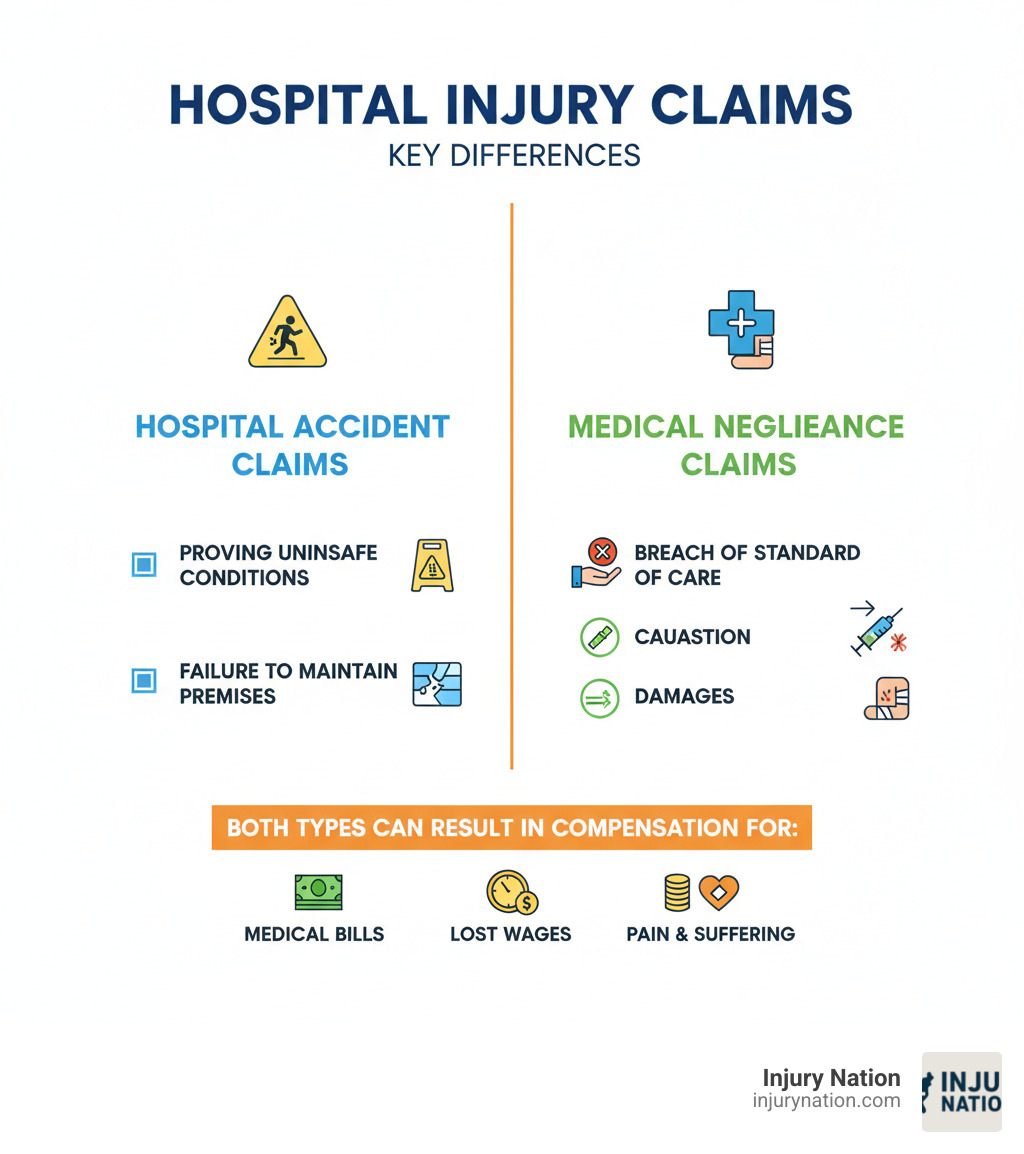
Hospital injury claims arise when a patient is harmed by substandard medical care or unsafe conditions in a hospital. If this has happened to you, you may be entitled to compensation for your medical expenses, lost wages, pain and suffering, and other damages.
Quick Overview: What You Need to Know About Hospital Injury Claims
- Two Main Types: Accidental injuries (slips, falls, equipment failure) and medical negligence (surgical errors, misdiagnosis, medication mistakes)
- Who Can Be Held Liable: The hospital itself, individual doctors, nurses, or other medical staff
- Time Limits Apply: Most states require you to file within 2-3 years of finding the injury
- No Upfront Costs: Most lawyers handle these cases on a contingency fee basis—you only pay if you win
- Compensation Available: Medical bills, lost income, future care costs, and pain and suffering
Patients admitted for routine procedures can sometimes end up in worse condition due to medical mistakes like misdiagnosis, surgical errors, or unnecessary procedures.
When you seek medical care, you trust professionals to provide safe treatment. If that trust is broken by a preventable error, you have legal rights. Hospital injury claims hold facilities accountable and help you recover the compensation you need to heal.
However, not every bad outcome is negligence. To have a valid claim, you must prove that the care you received fell below accepted medical standards and directly caused your injury. This guide explains what qualifies as negligence, how to build a case, the compensation available, and why an experienced attorney is crucial.
Hospital injury claims vocab to learn:
Understanding the Legal Basis for Hospital Negligence
Hospital injury claims typically involve medical negligence, also known as medical malpractice. It’s important to know that not every bad outcome qualifies as negligence. Medicine is complex, and even good care can have unexpected results.
Negligence occurs when a healthcare provider fails to meet the accepted standard of care, and that failure directly causes you harm. To prove medical negligence, four elements are required:
- Duty of Care: The hospital and its staff owed you competent treatment.
- Breach of Duty: They failed to meet that professional standard.
- Causation: Their failure directly caused your injury.
- Damages: You suffered measurable harm as a result.
For example, a surgeon operating on the wrong leg is a clear breach of duty that causes harm.
A key legal principle is vicarious liability, which can hold a hospital responsible for the negligence of its employees (like nurses, technicians, or staff doctors). However, many doctors are independent contractors, not hospital employees. In those cases, holding the hospital liable is more complex and depends on factors other than the doctor’s specific error. Understanding the difference between hospital responsibility and individual doctor liability is critical.

If you’re dealing with a hospital injury in Las Vegas, you can learn more about your specific legal options on our Medical Malpractice Las Vegas page.
What Constitutes a Breach in the Standard of Care?
A breach in the standard of care occurs when a healthcare professional’s actions—or inaction—fall below what a reasonably competent professional would do in a similar situation. Doctors are not expected to be perfect, but they must meet a baseline level of competence.
This is often evaluated using the Bolam test principle, which asks what a responsible body of medical professionals would have done. If their actions were significantly different from what happened to you, a breach may have occurred. For example, a doctor dismissing stroke symptoms as Bell’s palsy or a radiologist misreading a serious fracture as a sprain could be considered breaches.
Proving the breach almost always requires expert medical opinions. You need qualified healthcare professionals to testify about the standard of care, how the defendant failed to meet it, and how that failure caused your injury. Both incorrect actions (like cutting the wrong blood vessel) and inaction (like ignoring abnormal test results) can constitute negligence and form the basis of a hospital injury claim.
How Vicarious Liability Applies to Hospitals
Vicarious liability is a legal concept where an employer is held responsible for the negligent acts of an employee. In a hospital setting, this means the facility can be sued when nurses and staff make mistakes within the scope of their employment.
However, many doctors are independent contractor doctors, not hospital employees. When an independent contractor is negligent, the hospital may not be vicariously liable for that specific error.
Even so, a hospital can still be held liable for its direct negligence. This includes:
- Negligent hiring: Employing staff without checking their credentials or history.
- Inadequate training: Failing to ensure staff can use equipment or follow procedures correctly.
- Systemic failures: Allowing problems like understaffing, broken equipment, or a lack of supervision to contribute to a patient’s injury.
Even if the doctor who harmed you was an independent contractor, the hospital might still be responsible if its own policies or failures contributed to your injury. An experienced attorney can help determine who is liable under these complex laws.
Common Types of Hospital Errors Leading to Claims
Hospitals are complex environments where mistakes can happen, sometimes with devastating consequences for patients. Understanding common errors can help you recognize when you might have grounds for a hospital injury claim.

-
Surgical errors are among the most serious mistakes. These “never events” include operating on the wrong body part, leaving instruments inside a patient, or damaging nearby organs. Undiagnosed post-surgical bleeding can also be catastrophic.
-
Anesthesia errors carry high stakes. Too much anesthesia can cause brain damage or death, while too little can lead to a patient waking up during surgery. Failure to monitor vital signs or review a patient’s medical history can lead to disaster.
-
Misdiagnosis or delayed diagnosis prevents patients from getting timely treatment. When a doctor dismisses stroke symptoms or a radiologist misreads a fracture, the delay can cause permanent harm.
-
Medication errors can occur when a doctor prescribes the wrong drug, a pharmacy dispenses the wrong one, or a nurse administers it incorrectly. These mistakes can worsen a patient’s condition or even be fatal.
-
Birth injuries are a heartbreaking form of negligence. Mistakes during labor and delivery, such as excessive force or failure to respond to fetal distress, can cause lifelong disabilities like cerebral palsy.
-
Hospital-acquired infections can result from poor hygiene or contaminated equipment. When a hospital fails to maintain a safe, clean environment, patients can develop serious infections that complicate their recovery.
-
Patient falls can cause severe injuries, especially for elderly or weakened patients. Hospitals are negligent when they fail to use proper precautions like bed rails, adequate supervision, and assistance with movement.
-
Failure to treat or monitor a patient’s condition can turn a manageable issue into an emergency. If staff don’t check vital signs or fail to alert a doctor to concerning changes, the patient’s health can rapidly decline.
-
A defective medical device can also cause injury. If a hospital used equipment it knew was faulty or failed to maintain it properly, it can be held responsible for the resulting harm.
These errors cause physical, emotional, and financial burdens. If a hospital error led to the death of a loved one, our Wrongful Death Law Firm page can help you understand your options for seeking justice.
Navigating the Process of Hospital Injury Claims
Being harmed in a hospital can be overwhelming. Pursuing a hospital injury claim may seem daunting, but understanding the process can help you feel more in control. The steps you take immediately after an injury are critical to protecting your rights.

Key Steps to Take Immediately After a Hospital Injury
If you suspect hospital negligence caused you harm, taking immediate action can strengthen your hospital injury claim.
- Get Medical Help: Your health is the priority. Seeking treatment for the new injury or complication also creates a medical record of the harm.
- Document Everything: Keep a detailed journal of your symptoms, pain levels, and how the injury impacts your daily life. Record all conversations with hospital staff, including dates and what was said.
- Request Your Medical Records: You have a legal right to your complete medical file. Obtain copies of all charts, notes, test results, and billing statements.
- File an Incident Report: If possible, file an official report with the hospital to create a formal record of the event.
- Don’t Sign or Give Statements: Hospital administrators or insurers may ask you to sign documents or give a recorded statement. Politely decline until you have spoken with an attorney, as anything you say can be used against you.
Building Your Case for a hospital injury claim
Building your hospital injury claim is a complex process best handled by an experienced attorney. Your lawyer will begin with evidence collection, gathering your medical records, hospital policies, staff training logs, and any incident reports.
A critical step is having independent medical experts review your records. These experts determine if the hospital or its staff deviated from the standard of care and if that deviation caused your injury. Their professional opinions are often the deciding factor in a case.
Witness statements from family members or even other healthcare workers can help paint a complete picture of what went wrong. Photographs of your injuries also serve as powerful evidence of what you have endured.
In Nevada, expert witnesses are essential. Medical malpractice cases require testimony from qualified professionals to explain the standard of care, how it was breached, and how that failure caused your injuries. Without this testimony, it is nearly impossible to prove a hospital injury claim. Your attorney must clearly demonstrate both causation (the link between the negligence and your injury) and damages (all the harm you’ve suffered).
Understanding Statutes of Limitations for hospital injury claims
You have a limited time to file a hospital injury claim due to a legal deadline called the “statute of limitations.” If you miss this deadline, you lose your right to seek compensation.
In Nevada, the rules are strict. According to the Medical malpractice information from the State Bar of Nevada, you must generally file a lawsuit within three years of the date of injury, or one year after you finded (or should have finded) the injury—whichever comes first.
This “findy rule” provides some flexibility if the harm wasn’t immediately apparent, but the clock is always ticking. There are some exceptions for minors, where the deadline may be paused until the child turns 18, or for individuals who are mentally incapacitated.
Because these time limits are complex and unforgiving, it is crucial to speak with a personal injury lawyer as soon as you suspect something is wrong. Waiting too long can mean losing your chance to get the compensation you deserve.
Compensation and Damages in a Hospital Lawsuit
When you’ve been harmed by hospital negligence, the legal system allows you to seek financial recovery through “damages.” These are intended to compensate you for your losses and suffering. Damages fall into two main categories: economic and non-economic.

Types of Damages You Can Claim
Damages are categorized as economic (special) and non-economic (general).
-
Special Damages (Economic): These are your measurable financial losses. They include all medical bills (past and future), rehabilitation costs, lost wages, and compensation for a reduced ability to earn in the future (loss of earning capacity). Costs for necessary home modifications are also included.
-
General Damages (Non-Economic): These compensate for the human cost of your injury. This includes pain and suffering, emotional trauma (like anxiety or PTSD), disfigurement or scarring, and loss of enjoyment of life if you can no longer pursue hobbies or daily activities as before.
-
Punitive Damages: These are rare and awarded only in cases of extreme misconduct, such as malice or fraud. Their purpose is to punish the wrongdoer, not just compensate the victim.
Are There Caps on Damages in the U.S.?
Many states have placed legal limits, or “caps,” on the amount of damages you can recover in medical malpractice cases. These caps vary significantly by state.
In Nevada, the law imposes a $350,000 cap on non-economic damages in medical malpractice cases, as confirmed by the Medical malpractice information from the State Bar of Nevada. This means your compensation for pain, suffering, and loss of life’s enjoyment cannot exceed this amount.
Importantly, this cap does not apply to economic damages. There is no limit on what you can recover for actual financial losses like medical expenses, lost income, or the cost of future care. For victims facing a lifetime of medical needs or who can no longer work, these economic damages can be substantial.
For those with catastrophic injuries, understanding the full scope of compensation is critical. Our Burn Injury Lawsuit Ultimate Guide explores how damage claims work in these devastating cases.
Frequently Asked Questions about Hospital Injury Claims
Facing a hospital injury claim can be overwhelming. Here are answers to some of the most common questions we hear.
Can I sue a hospital for a doctor’s mistake?
Often, yes, but it depends. Under the principle of vicarious liability, a hospital is responsible for the negligence of its employees, including staff doctors and nurses. If a doctor employed by the hospital harms you, the hospital typically shares responsibility.
The situation is more complex if the doctor is an independent contractor. In that case, the hospital may not be liable for the doctor’s individual mistake. However, the hospital could still be held directly liable for its own negligence, such as negligent hiring, inadequate staffing, or failing to maintain a safe environment. A thorough investigation is needed for every hospital injury claim.
How much does it cost to hire a lawyer for a hospital negligence case?
Most hospital injury claims are handled on a contingency fee basis. This means you pay no upfront fees to get started. Your lawyer’s fee is a percentage of your final settlement or court award. If you don’t win your case, you don’t owe a legal fee.
This arrangement allows everyone, regardless of their financial situation, to access quality legal representation. Case costs, such as hiring expert witnesses, are typically advanced by the law firm and reimbursed from the final award.
How long will my hospital negligence lawsuit take?
There is no simple answer, as hospital injury claims are complex. Most lawsuits take several years to resolve, typically from two to five years.
The timeline depends on several factors:
- Injury Severity: More serious injuries often mean higher stakes and longer negotiations.
- Evidence Clarity: Cases with clear proof of negligence may resolve faster.
- Expert Testimony: Coordinating with medical experts to review records and testify takes time.
- Settlement vs. Trial: Most cases settle, but going to trial adds significant time to the process.
While we work efficiently, our priority is securing the maximum compensation you deserve, not rushing to a quick settlement. We will keep you informed at every stage.
Why You Need an Experienced Lawyer for Your Claim
When facing a hospital injury claim, you are up against powerful hospital systems and insurance companies whose goal is to pay as little as possible. You should not face this fight alone.
Hospital injury claims are among the most challenging personal injury cases due to their medical complexity and demanding legal standards. An experienced attorney can be the difference between fair compensation and walking away with nothing.
Here’s why you need an expert lawyer:
- Navigating Complexity: An attorney understands both medicine and law, which is essential for interpreting records, proving negligence, and navigating Nevada’s specific malpractice laws, including damage caps and statutes of limitations.
- Access to Medical Experts: Proving your case requires testimony from qualified medical professionals. Top lawyers have networks of respected experts ready to review your case and testify on your behalf.
- Expert Negotiation: Insurance adjusters use tactics to minimize payouts. A skilled attorney knows how to counter these tactics and negotiate effectively, often securing settlements far greater than initial offers.
- Maximizing Compensation: A lawyer ensures all damages are calculated, including future medical care, lost earning capacity, and pain and suffering—categories you might otherwise overlook.
Most lawyers work on contingency fee agreements, meaning you pay nothing upfront and they only get paid if you win. This levels the playing field, giving you access to top-tier legal help.
At Injury Nation, our directory helps you find experienced attorneys who successfully handle hospital injury claims. We make it easy to Compare Personal Injury Lawyers with proven track records in medical malpractice.
You’ve suffered enough. Don’t try to steer this complex legal battle alone. Find a qualified lawyer on Injury Nation to help with your claim today. The right attorney will handle the legal complexities so you can focus on your recovery.