

When a Simple Walk Becomes a Legal Battle
A sidewalk falls injuries lawyer can guide you through the legal process after an injury from a defective sidewalk. You may need a lawyer if you have:
- Severe injuries with extensive medical needs
- A fall on a government-owned sidewalk (which have strict 6-month claim deadlines)
- Received a lowball settlement offer from an insurance company
- Unclear liability between property owners and the city
- A need for help with evidence preservation and proving negligence
Sidewalk falls are surprisingly common. In Los Angeles, over 4,600 of its 10,000 miles of sidewalk need repair. Tree roots, responsible for over 50% of sidewalk damage, create dangerous uneven surfaces.
The consequences can be severe, ranging from broken bones to traumatic brain injuries. Each year, over 300,000 people are hospitalized for hip fractures, most resulting from falls.
What many victims don’t realize is that another party may be legally responsible for their injuries and medical bills. The challenge lies in identifying who is at fault and proving it.
This guide explains everything from liability to finding the right lawyer, helping you steer premises liability law and government claims so you can focus on recovery.
Basic sidewalk falls injuries lawyer glossary:
Understanding Sidewalk Falls: Common Causes and Injuries
Sidewalk falls are more than just minor stumbles; they can cause serious injuries. With aging infrastructure, many sidewalks hide potential hazards. In Los Angeles, for example, over 4,600 of its 10,000 miles of sidewalk are in disrepair.
Common causes of sidewalk falls injuries include:
- Tree roots, which cause over 50% of sidewalk damage by pushing up concrete.
- Cracked pavement and uneven slabs.
- Poor lighting that conceals defects.
- Weather conditions like ice, snow, or wet leaves.
- Debris or unmarked construction hazards.
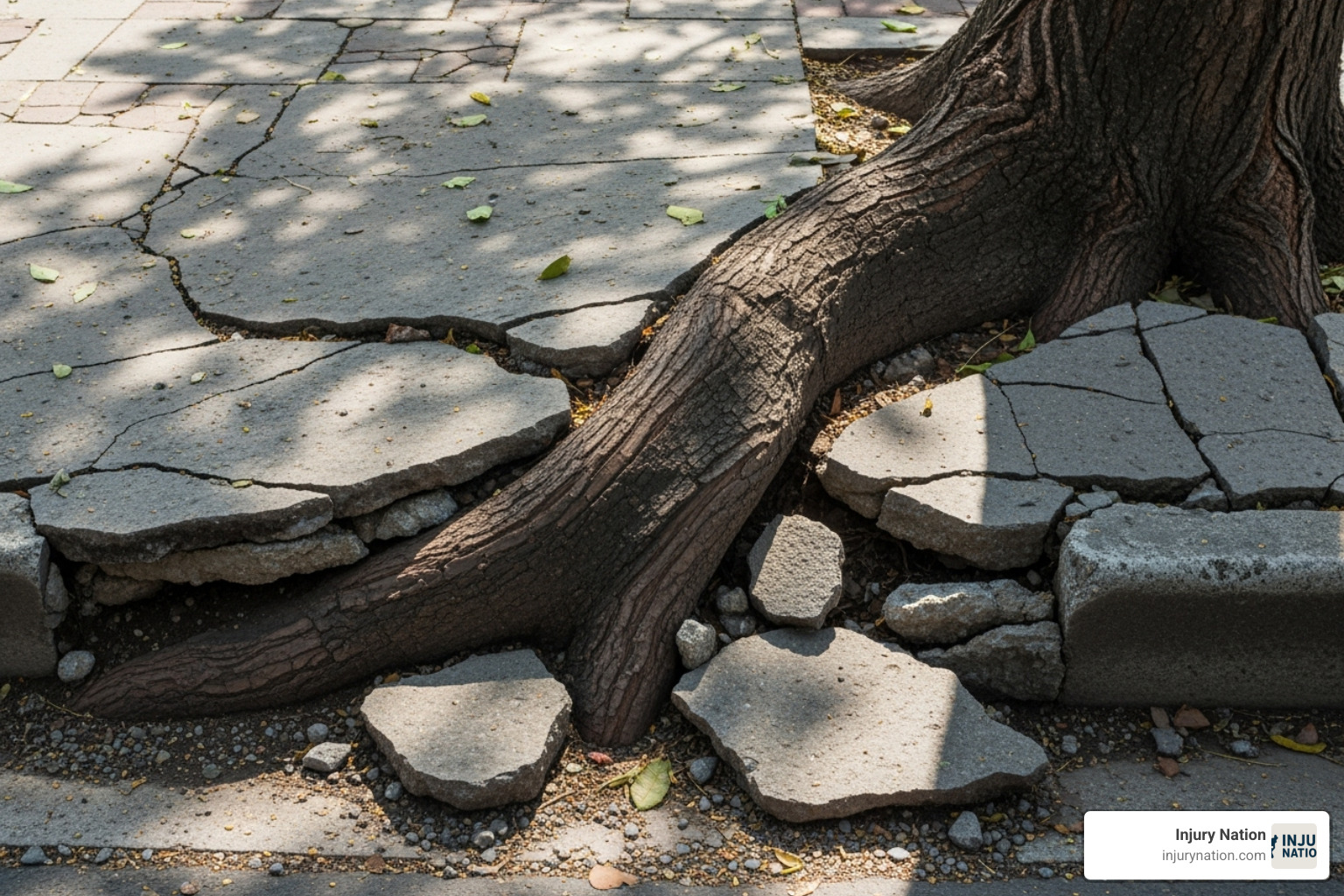
Common Causes of Sidewalk Defects
The most common defects include:
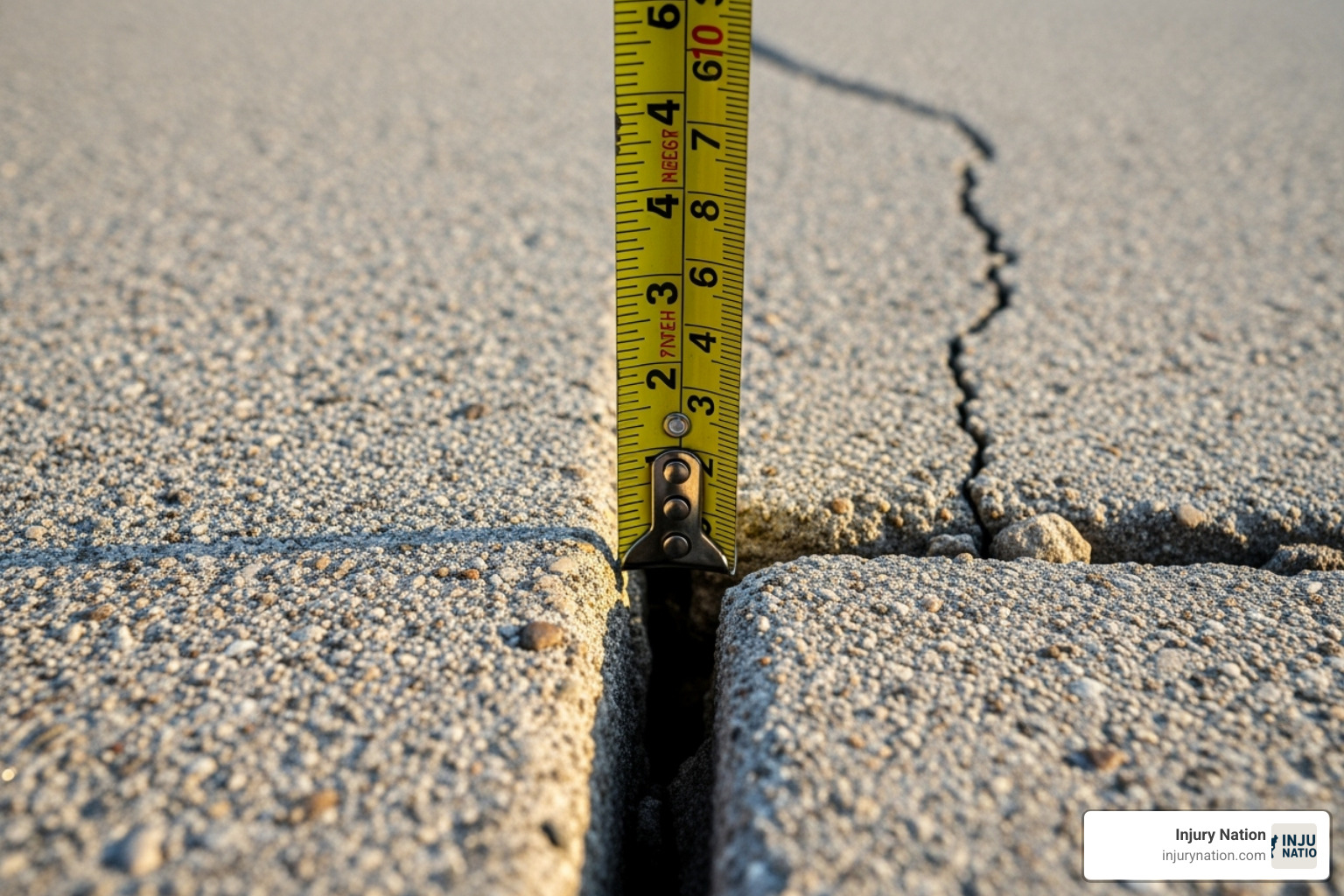
- Vertical displacement: One sidewalk slab is higher than the next. In California, a height difference of just 1/2 inch is legally considered a tripping hazard.
- Surface deterioration: Concrete crumbles over time, creating an unstable walking surface.
- Soil compaction issues: The ground beneath settles, causing the sidewalk to become uneven.
- Protruding objects: Utility covers, metal edges, or rebar can stick out and create a hazard.
- Shoddy construction: Poor initial work or repairs can lead to long-term dangers.
Even small defects can cause serious injuries, which is why rules like California’s 1/2 inch hazard rule exist. For more on staying safe, the NHTSA offers helpful pedestrian safety tips.
Types of Injuries from Sidewalk Falls
A fall on concrete can cause severe, life-changing injuries. Common injuries include:
- Broken bones: Wrists, ankles, hips, and arms are frequently fractured. Hip fractures are especially dangerous for older adults, leading to over 300,000 hospitalizations annually.
- Head injuries: Falls are a leading cause of traumatic brain injuries (TBI), accounting for nearly 50% of TBI-related hospital visits.
- Spinal cord injuries: These can range from herniated discs to paralysis and account for 32% of all spinal cord injuries in the U.S.
- Sprains and strains: Torn ligaments and muscles can cause long-term pain and mobility issues.
- Cuts and lacerations: Rough pavement can cause deep cuts that require stitches and may leave scars.
- Back and neck injuries: The impact can lead to chronic pain or whiplash.
These injuries often result in significant medical bills, lost wages, and a diminished quality of life. A sidewalk falls injuries lawyer can help hold the responsible party accountable. For more details, check out our comprehensive guide on Types of Sidewalk Fall Injuries.
Who’s at Fault? Navigating Liability in Sidewalk Fall Cases
Figuring out who is at fault for your sidewalk fall is a complex but crucial step toward compensation. It’s not enough to simply fall; a sidewalk falls injuries lawyer must prove liability.
This requires establishing four elements:
- A party had a duty of care to keep the sidewalk safe.
- They breached that duty.
- The breach caused your injury.
- You suffered real damages.
A key part of proving a breach is demonstrating “notice.” This means showing the responsible party either had actual notice (they were told about the hazard) or constructive notice (the hazard existed long enough that they should have known about it).
Public vs. Private Sidewalk Liability
The first question is: who owns the sidewalk? The answer dictates the legal strategy.
- Public Sidewalks: Owned by government entities (cities, counties). Suing the government is complicated by special protections like sovereign immunity and short deadlines.
- Private Sidewalks: Found on commercial or residential properties. The property owner (business, landlord, homeowner) is typically responsible.
Responsibility can also be shared. In California, for instance, while cities own most sidewalks, the adjacent property owner is often responsible for maintenance and repairs under California Streets & Highway Code 5610. This means a homeowner could be liable for a fall on a city-owned sidewalk.
The Role of the City and Government Entities
Suing a city or government entity involves unique challenges. While they have a duty to maintain safe sidewalks, they are protected by sovereign immunity, which limits when and how they can be sued. In California, the Tort Claims Act specifies these rules.
The most critical factor is the deadline. You have only six months from the accident date to file a claim against a government entity in California. This is much shorter than the two-year statute of limitations for private parties. If your claim is denied, you then have six months to file a lawsuit.
Proving government negligence requires investigating maintenance records, inspection schedules, and prior complaints to establish they had notice of the hazard.
Can a Property Owner Be Held Liable?
Yes, and it’s often easier to prove than government liability. A private property owner can be liable in several situations:
- Adjacent Property Rule: In states like California, owners are legally required to maintain the sidewalk next to their property.
- Creating the Hazard: If the owner’s actions caused the danger (e.g., sprinkler runoff creating ice, tree roots buckling the pavement), they are liable.
- Failure to Repair: Owners can be held responsible for not fixing a known or obvious hazard.
- Foreseeable Distraction: A business may be liable if they create a distracting environment that causes a patron to miss an otherwise obvious hazard.
Potential Defenses in a Sidewalk Fall Lawsuit
Defendants will use several strategies to avoid liability. Being prepared for these defenses is key.
- Trivial Defect Rule: The defense may argue the defect was too small to be dangerous. However, in California, a defect of half an inch or more is considered a hazard.
- Open and Obvious Danger: They might claim the hazard was so obvious you should have avoided it. A lawyer can counter this by proving you were distracted or the hazard was concealed.
- Comparative Negligence: This is the most common defense. They will argue you were partially at fault (e.g., looking at your phone). In California, this reduces your compensation by your percentage of fault.
- Pre-existing Injuries: Defendants may claim your injuries existed before the fall. Thorough medical records are the best defense against this.
- Lack of Notice: They will often claim they didn’t know about the hazard. A detailed investigation by a sidewalk falls injuries lawyer can uncover evidence to prove they did.
Your Legal Journey: Steps to Take After a Sidewalk Fall
The moments after a sidewalk fall are overwhelming, but the steps you take are critical for any future legal claim. Each action helps build a stronger case and prevents insurance companies from exploiting weaknesses. You don’t need to be a legal expert, but you do need to know what to do to protect your rights.
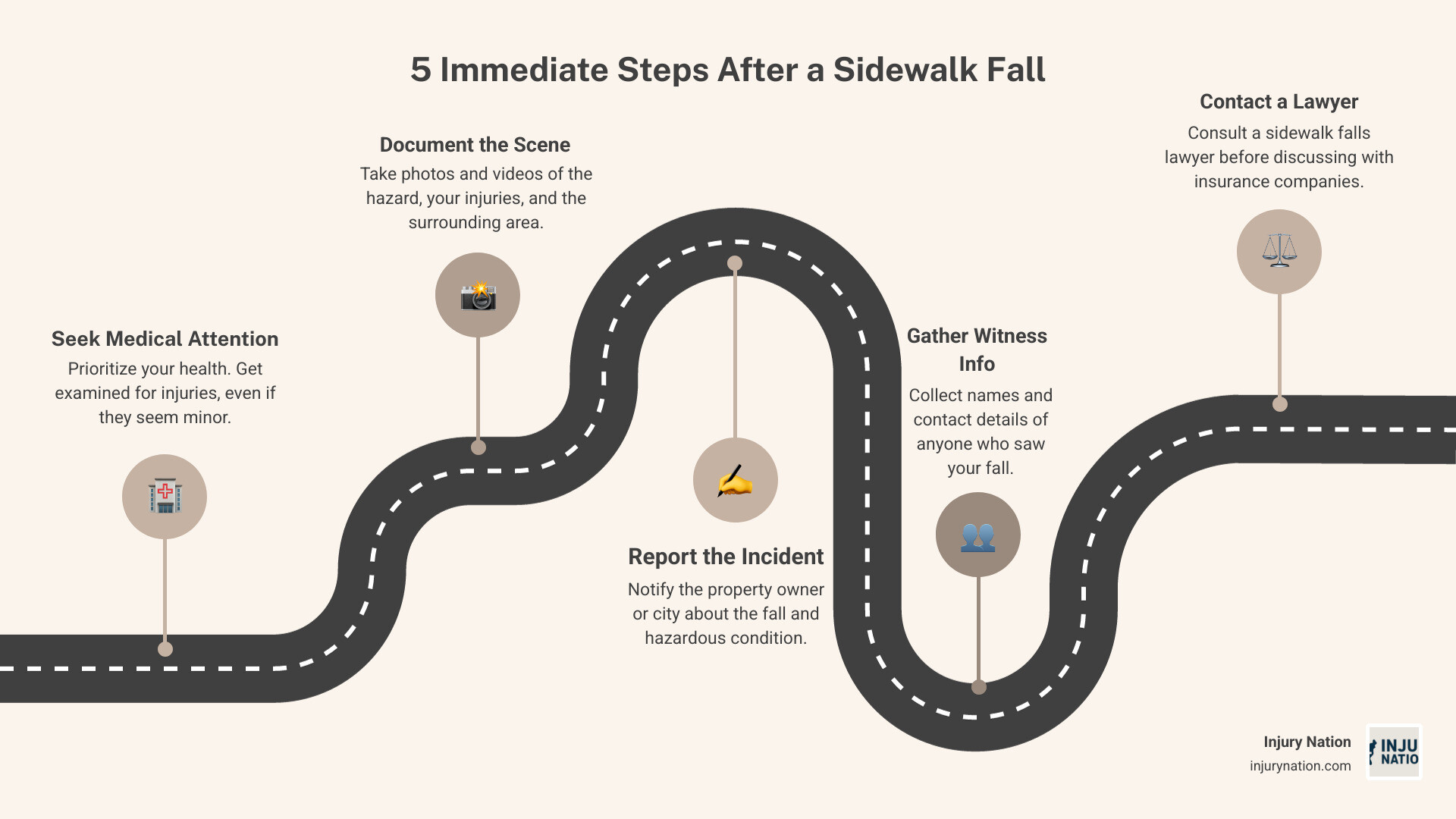
What to Do Immediately After a Fall
While your health is the top priority, these immediate steps can protect your legal rights:
- Seek medical attention immediately: Adrenaline can mask injuries. A medical visit creates an official record linking your injuries to the fall, which is crucial for countering insurance company arguments.
- Report the incident: Inform the property owner, manager, or the city’s public works department. Request a copy of the incident report to create a paper trail.
- Document the scene: Use your phone to take photos and videos of the exact spot where you fell. Capture close-ups of the defect with an object for scale (like a coin) and wider shots of the surrounding area and lighting conditions.
- Get witness information: If anyone saw the fall, politely ask for their contact information. Their testimony can be invaluable.
- Preserve your footwear: Keep the shoes you were wearing in the same condition as they were during the fall. They are a piece of evidence.

Gathering Crucial Evidence
A strong case is built on solid evidence. Collect the following:
- Medical Records and Bills: Keep all documents related to your diagnosis, treatment, and costs.
- Photos and Videos: These are powerful evidence. Document the hazard immediately and consider returning at different times of day to capture various lighting conditions.
- Witness Statements: Written or recorded accounts add credibility.
- Maintenance Logs and Previous Complaints: This evidence can prove the property owner had notice of the hazard.
- Police or Incident Reports: Official reports provide crucial documentation.
- Proof of Lost Wages: Use records from your employer to show financial losses.
- Personal Journal: Document your pain levels, daily struggles, and the emotional impact of the injury. This helps prove pain and suffering.
Understanding Compensation and Statutes of Limitation
Understanding what compensation you can receive and the deadlines for filing is critical.
Types of Compensation:
- Economic Damages: These cover tangible financial losses like medical bills, lost wages, and loss of future earning capacity.
- Non-Economic Damages: These compensate for non-financial impacts, such as pain and suffering and loss of enjoyment of life.
For more details, see our guide on Compensation for Sidewalk Fall Injuries.
Statutes of Limitation (Deadlines):
These deadlines are strict and can end your case if missed.
- Private Property: In California, you generally have two years from the accident date to file a lawsuit.
- Government Property: The deadline is much shorter. For claims against a government entity in California, you have only six months to file an initial claim.
Missing the six-month government deadline will likely bar you from ever recovering compensation. This is why contacting a sidewalk falls injuries lawyer immediately is so important. For more general information, see our page on the Statute of Limitations for Sidewalk Fall Claims, but always seek personalized legal advice.
Why You Need an Experienced Sidewalk Falls Injuries Lawyer
While you’re trying to heal and deal with medical bills, insurance adjusters are often trying to settle your claim for as little as possible. This is when you need an experienced advocate.
Sidewalk fall cases are deceptively complex, involving difficult questions of ownership, liability, and notice that you shouldn’t have to steer alone. Insurance companies will offer quick, lowball settlements, betting you don’t know the true value of your claim, including future medical costs and lost earning capacity.
Claims against the government are even more challenging, with strict six-month deadlines and special legal protections that can end your case before it begins.
A sidewalk falls injuries lawyer levels the playing field. They know how to value your case, negotiate with insurance companies, and steer complex government claims. Most work on a contingency fee basis, meaning you pay nothing unless they win your case.

How a Sidewalk Falls Injuries Lawyer Proves Your Case
A lawyer builds a winning case through a strategic process:
- Immediate Investigation: While you recover, your lawyer investigates the scene, measures the defect, checks weather records, and looks for surveillance footage.
- Identifying Liable Parties: They determine who is responsible, which could be the city, an adjacent property owner, or both. A sidewalk falls injuries lawyer understands local laws, like California Streets & Highway Code 5610, to pinpoint liability.
- Proving Negligence: Your attorney gathers evidence (medical records, maintenance logs, witness statements) to prove the responsible party had a duty of care and breached it, causing your injuries. This may involve hiring expert witnesses. Learn more about How to Prove Negligence in a Sidewalk Fall Case and proving negligence in California.
- Calculating Full Damages: They work with medical and economic experts to calculate the full value of your claim, including current and future medical bills, lost earning capacity, and pain and suffering.
What to Look for in a Sidewalk Falls Injuries Lawyer
Choosing the right attorney is crucial. Look for these qualities:
- Experience with Premises Liability: Your lawyer should specialize in sidewalk fall cases, not just general personal injury.
- Proven Track Record: Ask about their history of successful settlements and verdicts in similar cases.
- Trial Experience: Insurance companies offer better settlements to lawyers who aren’t afraid to go to court.
- Positive Client Testimonials: Reviews can reveal an attorney’s communication style and dedication.
- Clear Communication: Your lawyer should explain things clearly and keep you informed.
- No-Win, No-Fee Structure: Ensure they work on a contingency fee basis, so you only pay if you win.
The right sidewalk falls injuries lawyer is your advocate, guiding you through the legal system so you can focus on recovery.
Frequently Asked Questions about Sidewalk Fall Claims
After a sidewalk fall, you’re probably dealing with pain, medical appointments, and a flood of questions about what happens next. We get it—this is uncharted territory for most people. Let’s address the questions we hear most often from folks in your situation.
How does comparative negligence affect my sidewalk fall claim?
Even if you were partially at fault for your fall, you can still recover compensation under a rule called comparative negligence.
California uses a “pure comparative negligence” system. This means your total compensation is reduced by your percentage of fault. For example, if your damages are $100,000 and you are found to be 20% at fault (perhaps for being distracted), your award would be reduced by $20,000, leaving you with $80,000.
A skilled sidewalk falls injuries lawyer will work to minimize any fault assigned to you by proving the dangerous condition was the primary cause of your fall, maximizing your compensation.
How much is a typical sidewalk fall case worth?
There is no “typical” payout for a sidewalk fall case, as the value depends on several unique factors:
- Severity of Injuries: A traumatic brain injury will be valued much higher than a simple sprain.
- Total Medical Costs: This includes all past, present, and future medical expenses related to the fall.
- Lost Income and Earning Potential: Compensation covers time missed from work and any long-term impact on your ability to earn a living.
- Strength of Evidence: Clear proof of negligence and well-documented injuries increase a case’s value.
- Insurance Policy Limits: The amount of the at-fault party’s insurance coverage can cap the potential recovery.
An attorney can evaluate these factors to determine what your specific case may be worth.
How long do I have to file a claim for a sidewalk fall?
Missing the filing deadline, or statute of limitations, can permanently bar you from recovering compensation. These deadlines vary based on who is at fault.
- Claims Against Private Parties: In California, you generally have two years from the date of the accident to file a lawsuit against a private property owner.
- Claims Against Government Entities: The deadline is much shorter. In California, you have only six months from the accident date to file a formal claim with the responsible government agency. If that claim is denied, you then have another six months to file a lawsuit.
Because these deadlines are so strict and it can be difficult to determine who owns the sidewalk, it is critical to contact a sidewalk falls injuries lawyer as soon as possible to protect your rights.
Conclusion
A simple walk shouldn’t end in a legal battle, but a fall on a defective sidewalk can leave you with serious injuries, medical bills, and complex legal questions.
As we’ve covered, sidewalk fall cases are challenging. They involve identifying the responsible party (city or private owner), navigating strict deadlines like the strict six-month deadline for government claims, and fighting back against insurance companies that want to minimize your settlement.
Attempting to handle this alone while you’re recovering is a daunting task. A skilled sidewalk falls injuries lawyer is your greatest asset. They level the playing field by investigating your case, proving liability, and negotiating for the full compensation you deserve. Because they work on contingency, meaning you don’t pay unless you win, you can seek justice without financial risk.
Your focus should be on healing. Let an experienced attorney handle the legal complexities.
If you’ve been injured in a sidewalk fall, don’t wait. The sooner you act, the stronger your case will be. Injury Nation connects victims with top-rated attorneys who have a proven track record in sidewalk fall cases. Your journey to justice starts with getting the right help.